If a city doubles in size, it does not simply double its output. It produces more than double. That is the startling picture in Bettencourt, Lobo, Helbing, and West’s 2007 paper on growth, innovation, scaling, and the pace of life in cities. Biology gets more efficient as it gets bigger. Cities do the opposite. They compound. This week’s research debate (469R) on What is The Future for Cities? podcast treated that compounding as both a gift and a trap. Thursday’s conversation (470I) with Geoffrey West, theoretical physicist and distinguished professor at the Santa Fe Institute, then asked what the same maths means when some cities still cannot build enough houses, and others are already shrinking.
Five lessons sit between those two episodes.
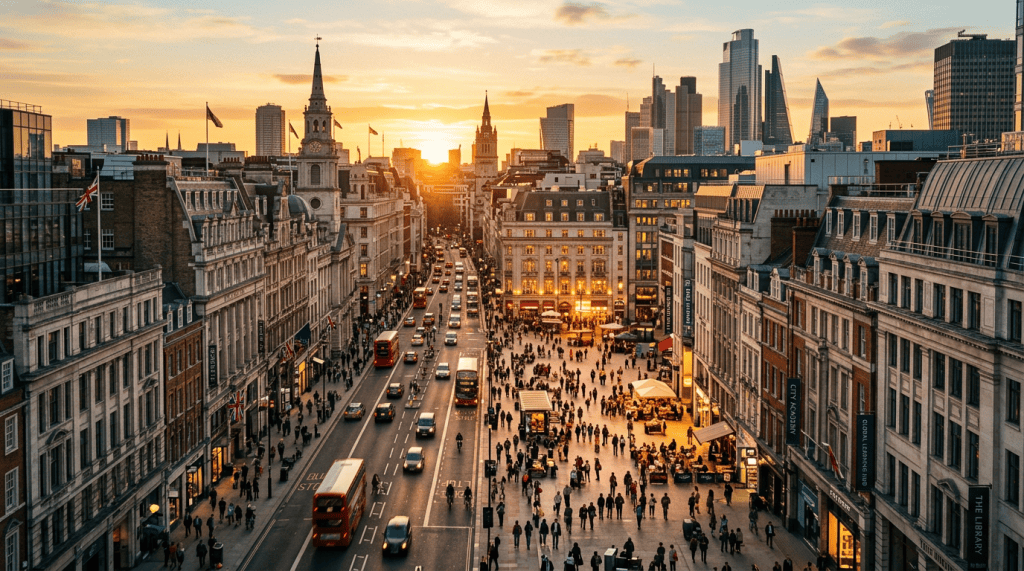
Superlinear scaling is the urban engine
The 2007 study found that quantities reflecting wealth and innovation scale with an exponent of about 1.1 to 1.3. New patents sit around 1.27. Inventors around 1.25. Wages around 1.12. Super-creative employment around 1.15. Private R&D employment around 1.34. Double the population and you get more than double the ideas, wages, and research jobs.
That is why cities feel like engines. It is also why they feel as if they are speeding up. Pedestrian walking speed scales with city size at about 0.09. Move from a small town to New York or London and the pavement itself seems to hurry you. The pace of life is not a metaphor. It is a measured exponent.
The treadmill speeds up
Superlinear growth, followed far enough, is not a gentle S-curve. The maths describes a finite-time singularity: the line curves toward infinity in a finite number of years unless a paradigm-shifting innovation resets the clock. Coal to electricity. The internet. A city of a million people, in this framing, may have only a couple of decades between major resets, and that interval shrinks as the city grows.
The dark side scales too: AIDS cases around 1.23, serious crime around 1.16, electrical consumption around 1.07. The optimistic reading is that wealth and patents still sit a little above the damage. The pessimistic reading is that the margin is thin, and that humans still take about twenty years to reach productive maturity. If the required innovation cycle falls below that constant, a new generation cannot grow up fast enough to invent the next reset.
You do not have to pick a winner in the debate to take the practical point: a city that only plans for more of the same is planning as if the treadmill never changes speed.
Growth and contraction can share the same decade
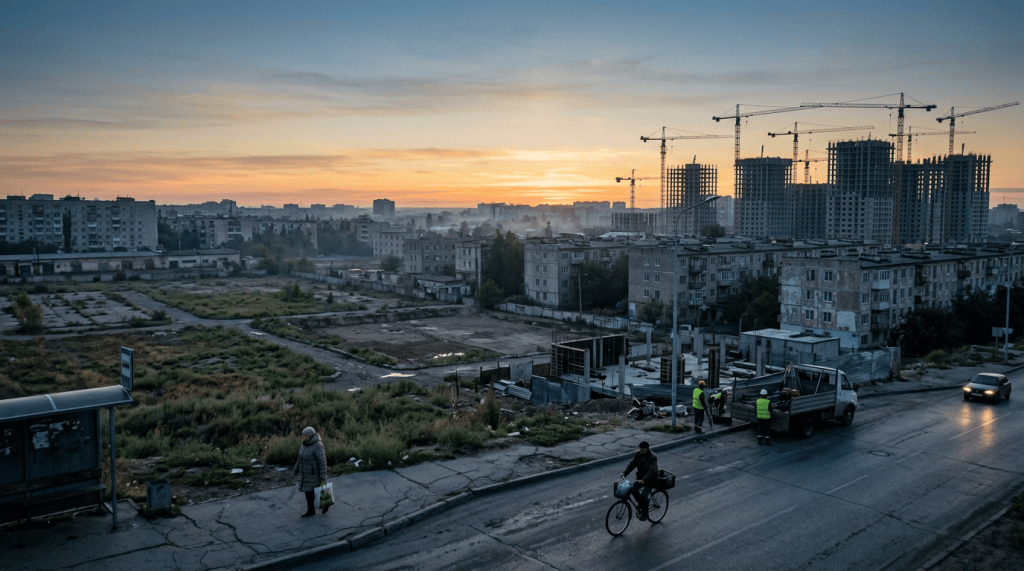
West used to worry most about urban population growing faster than exponential. He still does. He now spends as much time on the other side of that singularity. In some parts of the world, city populations are already decreasing. In others, including the place he lives, the complaint is still that we are not building enough houses or infrastructure.
Without immigration, he argues, much of Europe and possibly the United States would already be depopulating. Immigration is therefore both a demographic save and a political flashpoint. That is a short-to-medium future, perhaps twenty years, not a distant science-fiction collapse.
Cities and economies, in his telling, have only thrived because they keep growing, at least exponentially. We do not have a well-tested model for a city that has to reverse after faster-than-exponential growth. Planning only for shortage, or only for shrinkage, misses the weird tension he names: both can be true at once, on different parts of the map.
Cities are machines for mixing people
Ask West what a city is, and he does not start with buildings. “I do see the city as this extraordinary machine for facilitating social interaction.” Theatres, parks, offices, universities, coffee houses. Formal institutions and informal gathering. “The reason that we have cities is because A talks to B talks to C talks back to A, and we build on each other.” Most of the ideas are rubbish. The same dynamic, he says, also leads to relativity, quantum mechanics, Amazon, and Toyota.
That is why he is uneasy about wealth stratification: gated communities, private airports, doormen as default. The genius of a city is bringing people together and mixing them up. Fragment that mix too rigidly and you lose the buzz, the mobility, and the accidental collisions.
He wants lumpiness, not a homogenous cake. Diversity of thought and background is part of what makes the machine creative. Global connection is already making the planet feel like one large city of social interaction. The risk is that everyone ends up knowing the same things and thinking the same thoughts. Keep the mix.
Treat cities as science, not only as design
West came to cities from biology. Scaling laws there are so regular they span the biosphere. Thinking in networks made growth and even evolutionary trends predictable. Social organisations are also networks. When he and colleagues looked at cities, the surprise was not that scaling existed. It was that the same exponents showed up from the United States to Chile, China, and Sweden, across metrics from electricity to patents to AIDS cases.
Give him the size of a city inside an urban system, he says, and he can tell you within about 10 to 20 percent how many police it should have, how much crime, how many patents. That baseline is a way to see over- and under-performance. It is also a warning to anyone drawing a city from scratch. Washington, Brasilia, Canberra, Islamabad: designed on a clean sheet, then often experienced as boring and soulless, because the organic, network-based dynamics were treated as optional.
Companies, by contrast, are top-down. The half-life of a firm already listed on the New York Stock Exchange is about ten years. Cities, on a human timescale, keep going. They tolerate extremes. You cannot have the good of that machine, West says, without some version of the traffic jam. The job is to minimise the ugly, not to pretend you can design it away.
The two episodes (469R and 470I) do not ask you to celebrate growth or to romanticise decline. They ask whether you know the exponents your city is already obeying, whether you have a plan for both shortage and shrinkage, and whether the next design still makes it easy for A to talk to B to talk to C.
Next week we are investigating urban heat with V. Kelly Turner!
Share your thoughts – I’m at wtf4cities@gmail.com or @WTF4Cities on Twitter/X. Subscribe to the What is The Future for Cities? podcast for more insights, and let’s keep exploring what’s next for our cities.
If you would like to support the podcast, check out the Building Better Cities book or our Patreon!


Leave a comment