
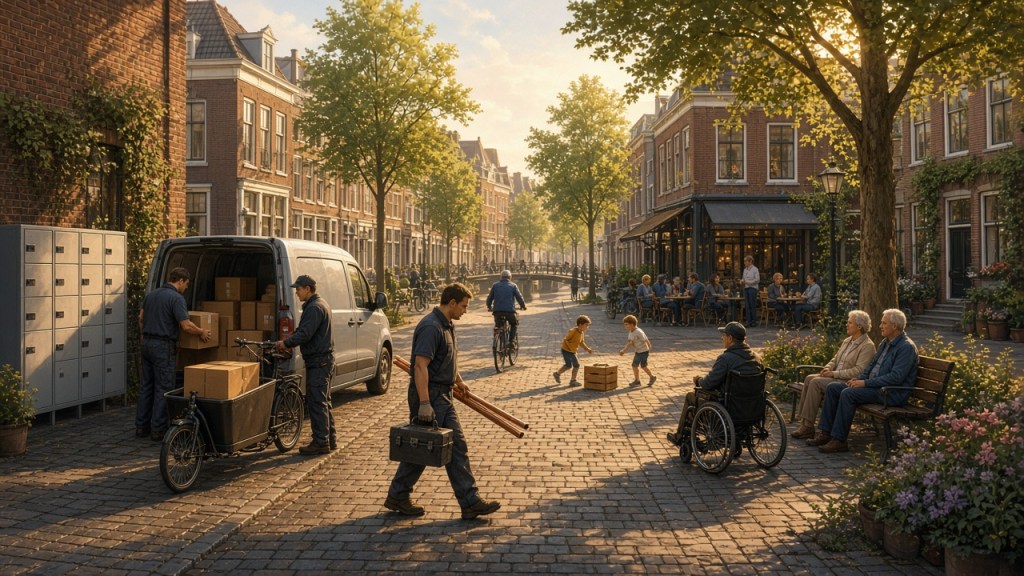
How does the cafe on the corner get its coffee beans when the street in front of it is car-free? This week’s research debate in episode 481 on the What is The Future for Cities? podcast worked through the 2023 paper Integrating city logistics in spatial planning – Creating the conditions for decarbonization and hubs by Bram Kin and Hans Quak, and asked whether long-term spatial plans can make room for city logistics, or whether a fast-changing market will always outrun the concrete. Thursday’s conversation in episode 482 with Bram Kin, professor of applied sciences in transition processes in urban and rural areas at Van Hall Larenstein University of Applied Sciences, came from the author’s side of the same paper. The debate asks where the vans should go. Bram asks why we keep planning as if they were not there.
Five lessons sit between those two episodes.
Someone still has to park the truck
The debate starts with a paradox. As cities pour concrete over old car lanes to build plazas, bike paths and climate-proof streets, they erase the space that delivery and service vehicles need to keep those streets alive. Most councils still treat city logistics as a traffic issue, managed with time windows and low emission zones, but a zero emission van still takes up space when it stops to unload. The paper’s Dutch cases show how much space that is. For the Spoorzone in Zwolle, a new and largely car-free district, the model expects 118 to 150 heavy trucks a day and 466 to 1,229 light vans, many of them plumbers, electricians and construction workers rather than parcel couriers. “Service logistics is the blind spot of the 15-minute city.”
The other host pushes back on concrete. Spatial plans last fifty to a hundred years, while the logistics market changes in months, so a permanent micro hub built for ten-minute grocery deliveries risks becoming a house built around a landline telephone. Edge loading zones with a booking system for drivers, as in a new Utrecht district, keep the centre calm but concentrate the traffic on the people who live at the edge. Paris’s location perimeters, which oblige developers to build logistics space on their own land, only work if someone enforces them, and an unenforced loading bay quickly becomes general parking. The reply is that the window is now: Rotterdam alone plans fifty thousand new homes in the coming decade, and “once a plaza is pedestrianized, you can’t go back and retroactively insert a loading dock.” Both hosts end in the same place. Logistics has been siloed from urban design, and a logistics expert needs to sit at the table with the architect from day one, because “someone still has to figure out where to park the truck carrying the paint.”
What we design today will last fifty years
Bram Kin starts from what urban logistics actually is. People tend to think of parcels, but in some Dutch cities 50 to 70% of vans are service related, and only five to six percent deliver parcels. The rest collect waste, keep public space clean, build and renovate homes, and repair what breaks. Society needs these movements, he says, but would rather not look at them: “They need it, but they don’t want to see it.” New developments come with parking norms for cars, yet there are hardly any norms for logistics vehicles, and many plans for car-free neighbourhoods leave no place for the deliveries, window cleaners and kitchen fitters who will certainly come.
That is also why he sees this moment as an opening. Cities are being redesigned for heat waves, heavy rain and people rather than cars, and where logistics is part of the design from the start, the solutions can be simple: a supermarket supplied from a loading dock on the outside of a car-free neighbourhood in Utrecht, parcel lockers required in apartment buildings, logistics hotels in Paris that mix logistics with offices. He does not want to push out every car, only to give inclusivity, livability and people more weight. “What you design today will have an effect in the next 30, 40, 50 years, that’s a huge opportunity.”
The same curb can do two jobs
The debate argued about whether fixed loading bays are too rigid for a market that changes every few years. Bram’s answer is to make the space itself flexible. He calls the smart use of data a risky opportunity: done badly, it leads to Black Mirror and 1984, with everyone tracked everywhere. Done right, with companies and governments together, it can improve safety and reduce nuisance. A theatre is used for two hours a day, and the same logic can apply to the street. “In the morning it’s in a loading zone, and in the afternoon it’s a terrace or a bike parking.”
To make that work, the curb has to be reserved, monitored and enforced, the same gap the debate found in Paris and Utrecht, and that needs data shared between the people who deliver, the people who live there and the city. Bram adds that this kind of alignment is easier at city level than nationally. Deciding whether to swap three parking spots for more trees and one unloading zone is a conversation a street can have with its own city hall, not with The Hague or Canberra.
There is no silver bullet
Hubs come up in both episodes. The debate’s sceptic wants white label consolidation centres outside the city instead of more local infrastructure. Bram has studied urban consolidation centres for years and counts more than two thousand scientific articles on the concept, but he does not see them as the solution. Carriers have little reason to stop at a hub and pay extra for it until access to the city becomes much harder. Meanwhile, the sector is already optimising: distribution centres work as hubs, transport companies collaborate, and parcel lockers let one van drop twenty, thirty or forty parcels at one point. Cargo bikes and light electric freight vehicles work in restricted areas, but remain a niche.
“There’s not a silver bullet.” What works is a mix: innovation by companies, alignment between municipalities and companies, nudging customers to accept bundled deliveries, and the right vehicle for each area. He adds one lever that cities often forget, procurement. Universities, offices and municipalities buy printing paper, catering, sand, bricks and sewage pipes, and they can set how those goods arrive. In the Netherlands, businesses each contract their own waste collector, so one street can see several waste trucks, and organising collection per area is close to low-hanging fruit. Anne Goodchild looked at the wider urban freight system in episode 466.
Our own orders create the traffic
Bram’s first fear is unjust cities. The effects of logistics are not shared equally: distribution centres and heavy traffic tend to sit close to poorer neighbourhoods, so the orders placed in richer districts are felt somewhere else. Next-day delivery has pulled warehouses back towards the cities they serve, and in some Dutch cities children living along ring roads cannot learn to cycle because the traffic is too dangerous. Another fear runs the other way. In Amsterdam, some service companies no longer want to come into the city at all, because parking is expensive, the rules are strict and they have enough customers outside it.
He also widens justice to the people who keep the city running. Logistics is something “we don’t really want to pay for”: a study he mentions put the cost of delivering and returning a fashion parcel at around 12.50 euro, while the customer pays nothing, so the cost lands on drivers, construction workers and others with low pay and harsh working conditions. His closing request is about awareness. “We are the people generating those movements because of our demand.”
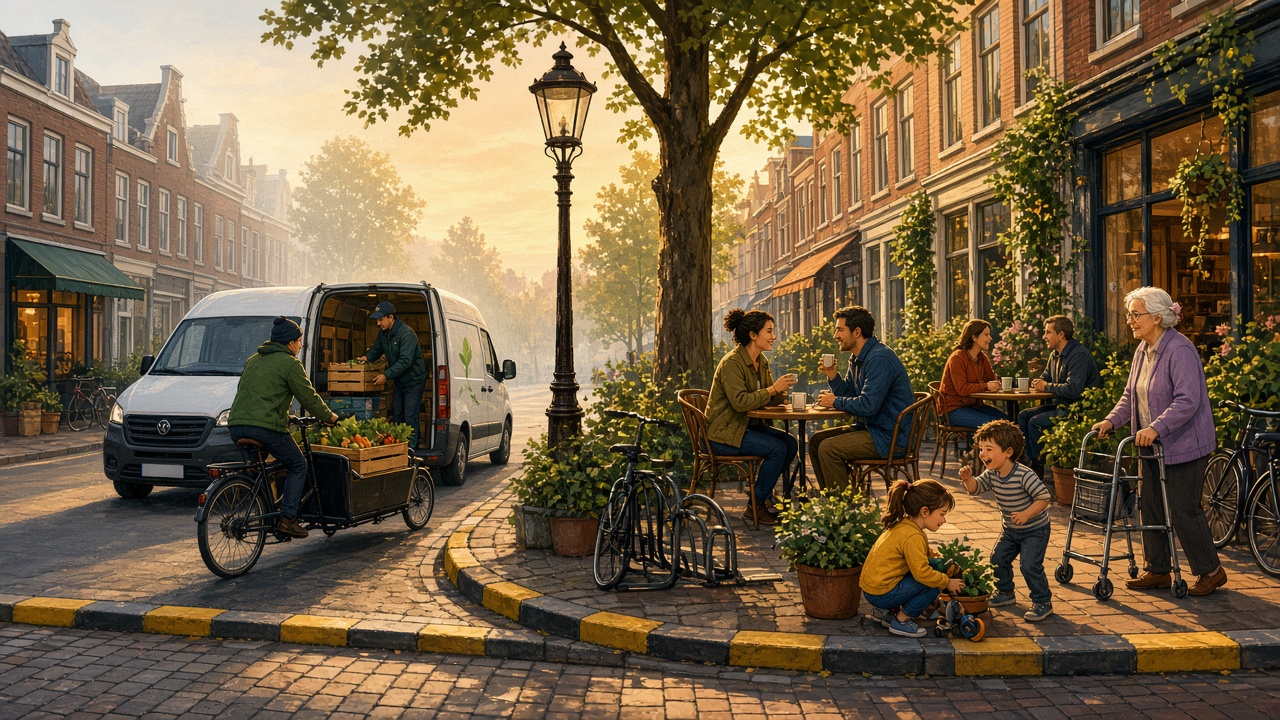
The two episodes (481R and 482I) do not ask whether livable cities need logistics. They ask whether we plan for it or pretend it away. The debate is right that a fixed loading dock can become a monument to today’s supply chain, and that an unenforced bay is just another parking spot. Bram is right that the vans, plumbers and waste trucks will come anyway, and that a car-free district without a place for them simply moves the problem onto the pavement. A city that designs logistics in from day one can keep its plazas calm. A city that forgets it will find the delivery van in the bike lane.
Look at the street outside your home or office.
Who delivers, repairs or collects there every day, and where do they stop?
Could the same piece of curb be a loading zone in the morning and a terrace in the afternoon?
And how many of the vans in your street are there because of your own orders?
Next week we are investigating how built environments shape physical activity and health, ahead of a conversation with Graham Alabaster!
Share your thoughts – I’m at wtf4cities@gmail.com or @WTF4Cities on Twitter/X. Subscribe to the What is The Future for Cities? podcast for more insights, and let’s keep exploring what’s next for our cities.
If you would like to support the podcast, check out the Building Better Cities book or our Patreon!


Leave a Reply