
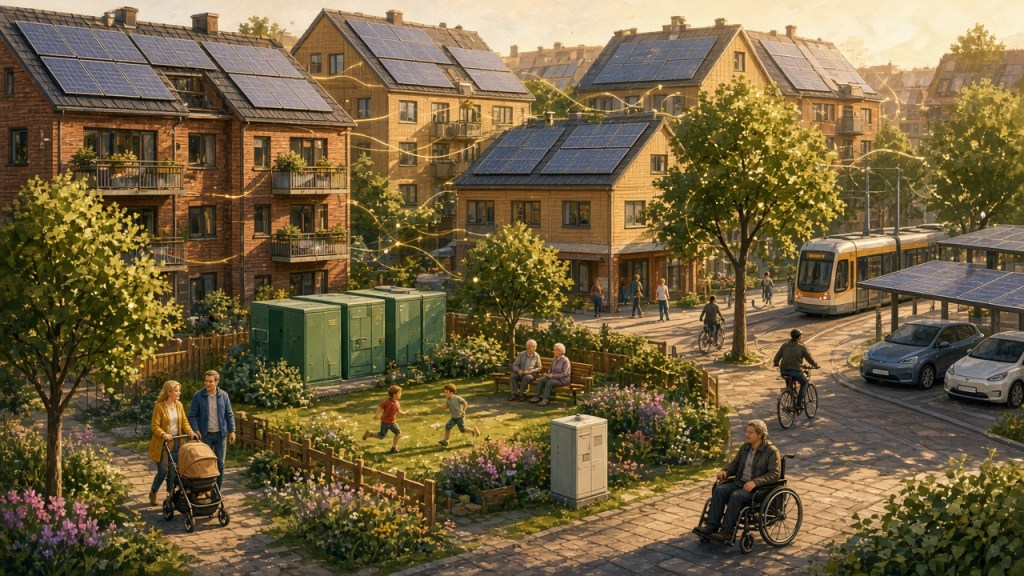
Most of us never think about the grid until the lights go out. This week’s research debate in episode 479 on the What is The Future for Cities? podcast worked through the 2025 paper EnergyNet explained: Internetification of energy distribution by Jonas Birgersson, Marc A. Weiss, Jimmy Chen, Daniel Kammen, Tomas Kåberger, Franklin Carrero-Martínez, Joakim Wernberg, Michael Menser and Newsha K. Ajami, and asked whether electricity can be routed the way the internet routes data. Thursday’s conversation in episode 480 with Jonas Birgersson, founder and vice chairman of the board of ViaEuropa and one of the people who brought broadband to Swedish homes, came from the other side of the same paper: he is its lead author, and he is already building it. The debate asks what happens when physics meets software. Jonas asks why cities are still waiting.
Five lessons sit between those two episodes.
Physics does not wait for a reboot
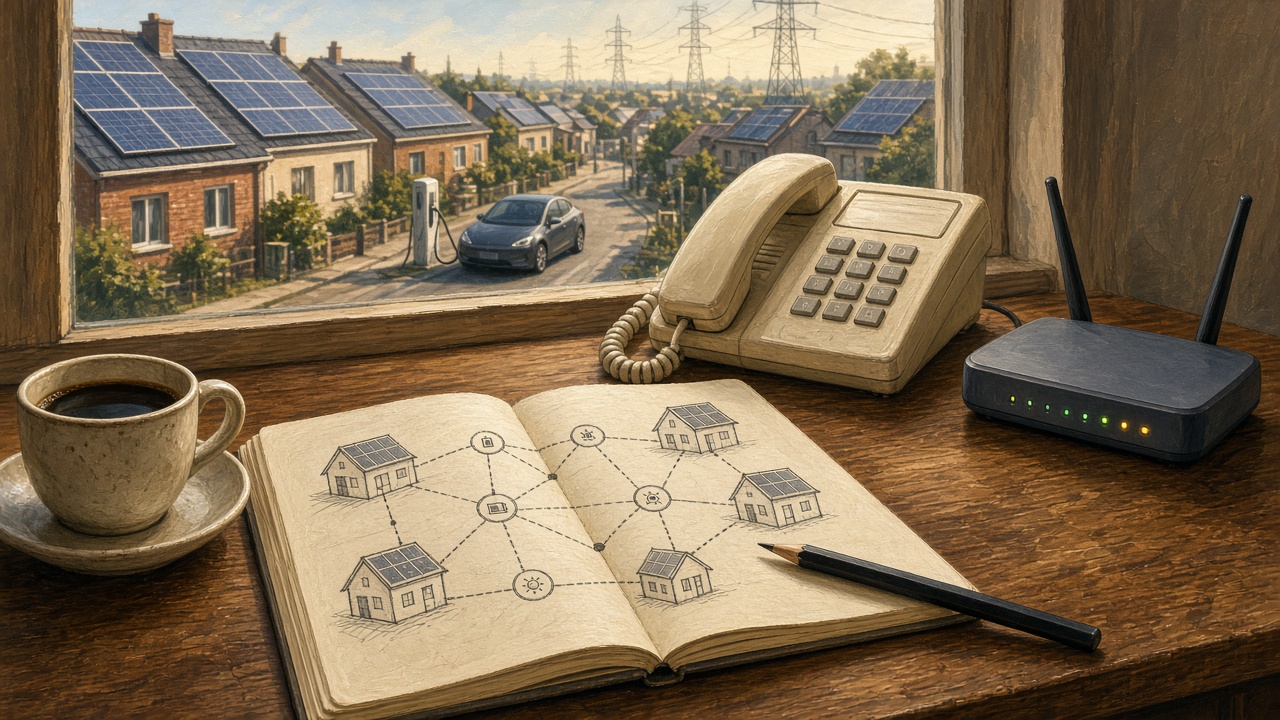
The debate starts with what EnergyNet wants to replace: POGS, the plain old grid system, built as a one-way street from big power plants to passive consumers. Rooftop solar, electric cars and home batteries now push power backwards into a grid that was never designed for it. The paper’s answer borrows from the internet. Neighbourhoods become ELANs, energy local area networks, that buffer imbalances in local storage the way a router holds data. Galvanic separation keeps them physically apart from the wider grid, like two pools joined by a water wheel instead of a pipe, so a surge on one side cannot cross to the other, and power only crosses when the energy protocol negotiates it.
The other host keeps pulling the metaphor back to the ground. “Physics doesn’t wait for a reboot.” A dropped data packet disappears; a dropped packet of electricity becomes heat, tripped breakers or a blackout. When the Baltic Sea cables were cut in 2024, data routed around the damage because data is massless. “You cannot software update your way out of a melting wire.” The answer comes back through the cold snap: under the old grid, one failing substation can take down a whole city, while in an EnergyNet a neighbourhood sheds its EV chargers, keeps the heat on and survives the night. A brittle system that fails all at once is traded for one that degrades gracefully. Both hosts end in the same place: the one-way grid has reached its limit, and the question is how carefully the new one is built.
The hard science is done, now we need to organise
Jonas Birgersson starts from a very different worry: not that the technology is risky, but that we keep waiting for it. For him, the focus is an abundance of energy without harming nature, and that “went from a really difficult problem to today being something that is more about organization, policy, open standards, and a new system architecture.” All the hard science is done, he says, and the Nobel Prizes for it have already been won.
“Now we need to organize.” That has been hard at national and international level over the last decade, so he looks to people coming together “in enough scale, but not too large”, which is where he sees “the cities taking this incredible role as catalysts.” In his words, they are “on the cusp of becoming the catalyst for a new and incredible, much better green future”.
Every roof without solar is a human mistake
He has nothing against nuclear power, and fusion would be fantastic if it comes along, but we do not need to wait for either. He compares nuclear plants to the mainframe computers of the past: “The solar panel is the equivalent of the home PC.” It is cheap because it goes to volume, and with wind, solar, hydro, storage and new distribution systems, we have everything we need.
So the debate over which source is right should not stop anyone from starting. “We have everything today. It’s cheap. It’s available, and every roof that doesn’t have solar in one form or another is just a human mistake.”
Take back control by putting society’s needs first
Jonas thinks the old grid is “heading into a dead end”, the way the fixed phone network once did. In Amsterdam, a city where everyone was aligned on clean mobility, the plans for electric vehicles hit a hard limit because the grid could not deliver enough capacity to charge them. His answer is the paradigm he has seen work in radio, mobile phones and broadband: move from few, large and expensive to many, small and cheap, orchestrated digitally. In geopolitics, he adds, cities are the many small, and instead of cheap they can be quick.
His tool for it is the freedom cable. After Russia’s war on Ukraine, the European Union allowed people in a city or a neighbourhood to build parallel electrical grids. They can share the cost of a cable between buildings, trade surplus in a local market, and use power electronics that arrive within hours, where a new transformer can take three and a half years. The neighbourhood stays connected to the traditional grid, with a firewall in between, and it all speaks one open language, the energy protocol, which his team made zero licence and gave away to the world.
He borrows a slogan to say it. “With this open standard, with many small cheap, you can take back control of your energy destination, so you can make your own destiny.” A city does not have to wait for the grid. “You should set society’s needs first, and the technology, including the grid, will have to adapt to the human needs, not the other way around.”
Every parking space can be part of the grid
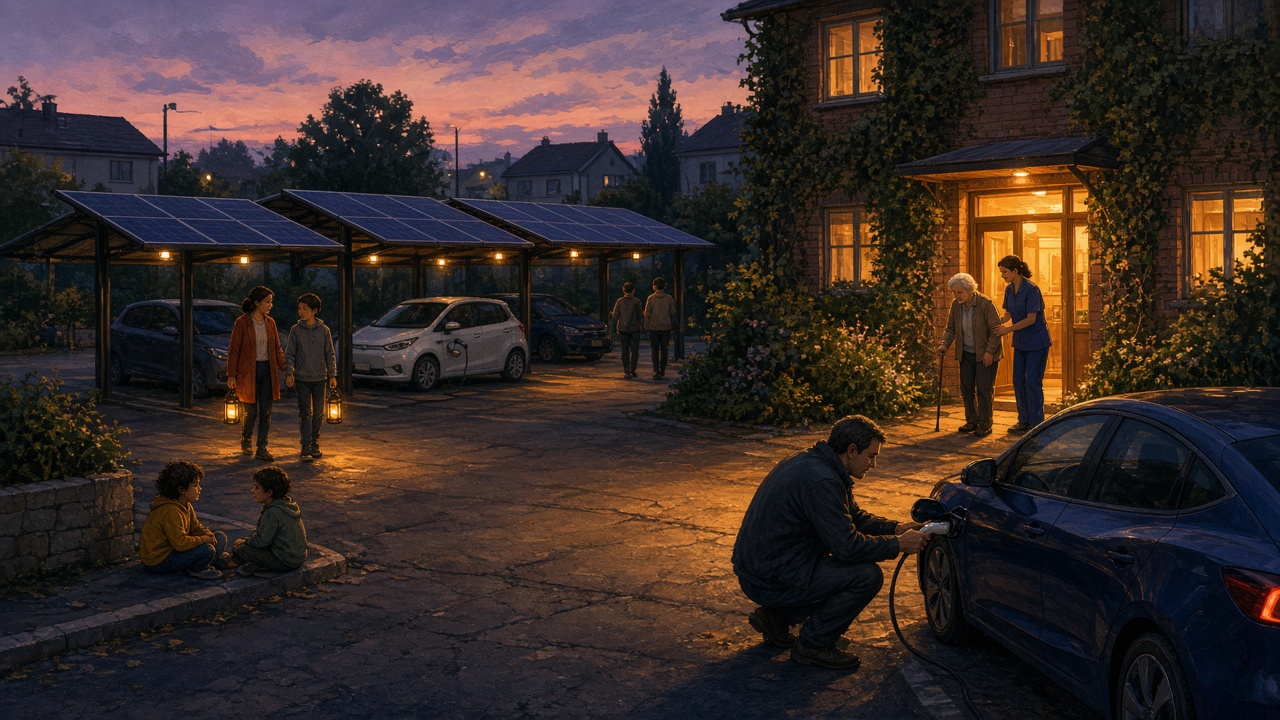
The debate’s hardest case was a cold night with empty batteries. Jonas points to the batteries already parked around us. Every parking space can become a flexible resource, a place with power and connection. Car batteries that were once thought to last five thousand cycles are now rated for many times more. If all of Sweden’s five million cars were electric and connected to two-way grids, he says, their batteries could run the whole country, industry included, for twelve hours in winter and twenty-four in summer. With a solar shade roof over each parking space and a local grid, a software signal could send a car with a charged battery to an elderly home during a power cut.
He also says it pays. The transition he describes has “zero green premium”: it is profitable for real estate companies to invest in the cables, energy routers, storage, solar and chargers. Sveriges Allmännytta, the association of Sweden’s municipally owned housing companies, signed up for its members’ million homes and six hundred and fifty thousand parking spaces. Karl R. Rabago made a similar case for distributed energy in episode 460.
The two episodes (479R and 480I) do not ask whether the grid should change. They ask who changes it, and how fast. The debate is right that electricity is not data, and that a melting wire does not care about good software. Jonas is right that waiting for a perfect centralised upgrade means waiting years for a transformer while the parts for a local network arrive in hours. A city that leaves the grid to someone else will keep the grid it has. A city that builds its own without respecting the physics will learn the hard way.
Look at the roofs, courtyards and parking spaces in your neighbourhood.
Which of them could produce, store or share power today?
Who would you need to sit with, your neighbours, your housing company, your city, to build the first cable?
And what should your neighbourhood keep running when the rest of the grid goes dark?
Next week we are investigating how city logistics can be integrated into spatial planning, ahead of a conversation with Bram Kin!
Share your thoughts – I’m at wtf4cities@gmail.com or @WTF4Cities on Twitter/X. Subscribe to the What is The Future for Cities? podcast for more insights, and let’s keep exploring what’s next for our cities.
If you would like to support the podcast, check out the Building Better Cities book or our Patreon!


Leave a Reply