
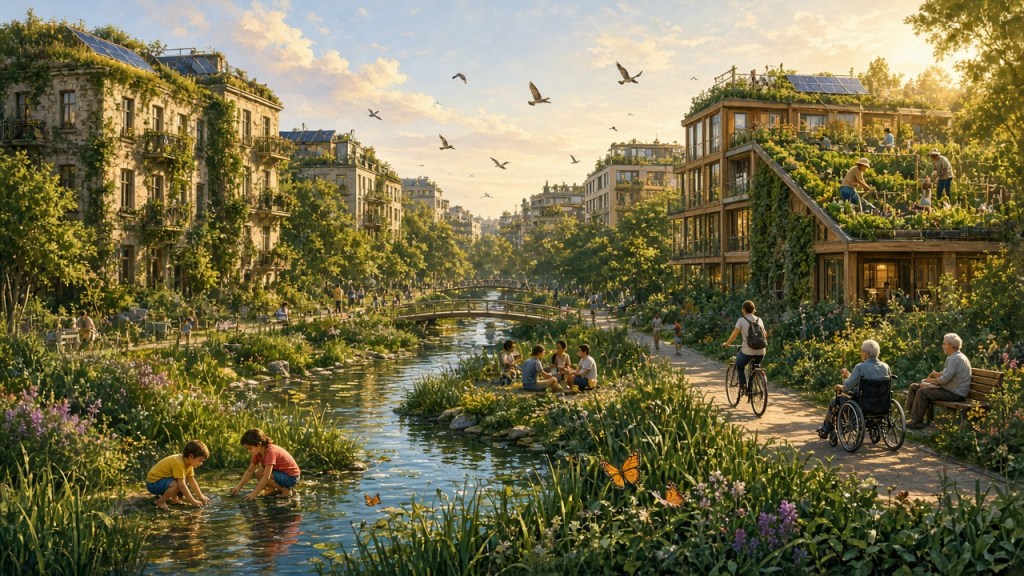
A city can look green and still be breaking its own water cycle. This week’s research debate in episode 477 on the What is The Future for Cities? podcast worked through the 2022 review Nature-based solutions addressing the water-energy-food nexus: Review of theoretical concepts and urban case studies by Pedro N. Carvalho, David Christian Finger, Fabio Masi, Giulia Cipolletta, Hasan Volkan Oral, Attila Tóth, Martin Regelsberger and Alfonso Expósito, and asked whether green roofs, wetlands and urban farms can carry water, energy and food together. Thursday’s conversation in episode 478 with Moein Nodehi, founder and CEO of Biotonomy, came from the building site: what happens when one building treats its own water, grows food and cools itself. The review asks for proof at the scale of a city. Moein asks people to start with the next project.
Five lessons sit between those two episodes.

Three resources need one measurement
The debate starts from how cities are usually built: a pipe for water, a wire for power, and a highway to truck in food. The water-energy-food nexus says these cannot be kept apart. Energy needs water, water needs energy to be pumped and treated, and food needs both. One host goes through the case studies the review collects. In the debate, Brooklyn Grange’s rooftop farm in New York holds more than 662 cubic metres of rain per rainfall event while producing 13.4 tonnes of food a year. Constructed wetlands clean wastewater, grow biomass that can become biogas, and recover nitrogen and phosphorus. The restored Cheonggyecheon River in Seoul, where an elevated highway used to be, cools the blocks around it and brought wildlife back to the city centre.
The other host answers with the gap the authors name themselves. At the scale of the Gorla Maggiore water park in northern Italy or Oslo’s Fornebu stormwater system, the evidence is about water: lower flood peaks and fewer nutrients downstream, while food and energy stay unquantified. Studies rarely measure the three resources together, and the indicators are mostly single-purpose. Both hosts end up asking for the same thing: standardised, multipurpose indicators that count water, energy and food at once. Without them, a planner cannot zone a district around a roof mosaic, however good one roof looks.
Do the project, and the policy can follow
Moein Nodehi starts with decisions that last. A building can stand for a hundred years, so a careless choice stays in the city for a century. Cities expand, he says, by about the size of Paris every day, and most of those decisions still cap the ground, so rain runs off to the sea instead of soaking in. “We’ve learned how to take water from under the ground, but we never learned how to put it back.”
So whose job is it to fix? His first answer is that governments should set the standards, the way parents set the basic rules. His reality answer is that every developer, architect and home builder has to educate themselves and do the right thing, because waiting for policy can take decades. His team fought for a licence to reuse a building’s wastewater on its green walls and roofs, at a time when there were no standards for it. “We did it, and when we did it, then the city came to us and said, ‘Hey, this works.’” He wants more real-world projects, with the reports coming out of them, rather than one more 200-page report knocking on the city’s door.
One greenhouse can hold the whole nexus
The review asks for multipurpose design. Moein describes what that looks like inside one building. At school he learned water, heating, cooling and sewage as separate systems, and on site they are built by separate teams. “Imagine if your body was built like that.” Every project of his now starts from the whole. “So the shower water goes to greenhouses, where you also have food production.” The plants treat the water, the greenhouse grows food, and because it is attached to the building it works as a buffer that cuts heat loss. Water recycling, food and the heating and cooling are designed as one system, and he says he will never go back to the old way.
It is Tuesday’s constructed wetland at the scale of a home. What makes it work, in his telling, is that one team designs and engineers all of it, so the parts are made to fit together.
Do what is needed, not only what is romantic
His fears are concrete. Water comes first: cities sinking as the groundwater under them is emptied, drought rules that ban irrigating green areas, and decision-makers who do not understand how water works. Heat is second, made worse by the fix most people reach for. “Air conditioning doesn’t cool your space. It just moves the heat.” The more we cool our buildings, the more we heat the city. Third is human wellbeing, in cities built so that people have to leave them to recharge in nature.
His advice to anyone who wants to help is modest on purpose. “You’re not gonna be able to save the world, neither am I. But the contribution that we can do for going in that direction, that’s what matters.” There will be days when the pipe breaks, things smell, and everyone else is building the usual way. He asks people not to give up, to fail where others can learn from it, and to take on the unromantic parts too. “If you really wanna contribute, do what’s needed.”
The solutions are easier than the problem
The debate’s hardest barriers are economic. Retrofitting an existing building with dual pipelines to separate grey water from black water is expensive. Structural limits stop a heavy, wet green roof going on top of an old apartment block. And because water tariffs are kept low by politics, a building owner’s half-million-dollar recycling system looks bad on paper.
Moein does not wave that away, but he starts at a different size. “Good news is that the solutions are way easier than the problem.” Reusing water just to flush the toilet can cut a household’s water use by about thirty percent, and it saves money. Plants already treat the wastewater of whole cities in projects that exist. The opportunity is to learn it and repeat it: two square metres first, then four, then twenty, then a hundred. “Be doers. The opportunity is to do something.”

The two episodes (477R and 478I) do not ask you to choose between a pilot and a system. They ask how a pilot becomes a system. The review needs numbers that count water, energy and food together before a city can plan around them. Moein needs projects on the ground before those numbers can exist. A city that waits for the perfect indicator never builds the roof. A city that builds roofs and never measures them never learns what they are worth.
Look at the next street, roof or courtyard in your city that is about to be paved, retrofitted, or left as it is.
Where could the rain go back into the ground instead of into the drain?
Which two square metres could show your neighbours that it works?
And who will measure what it does for water, energy and food together?
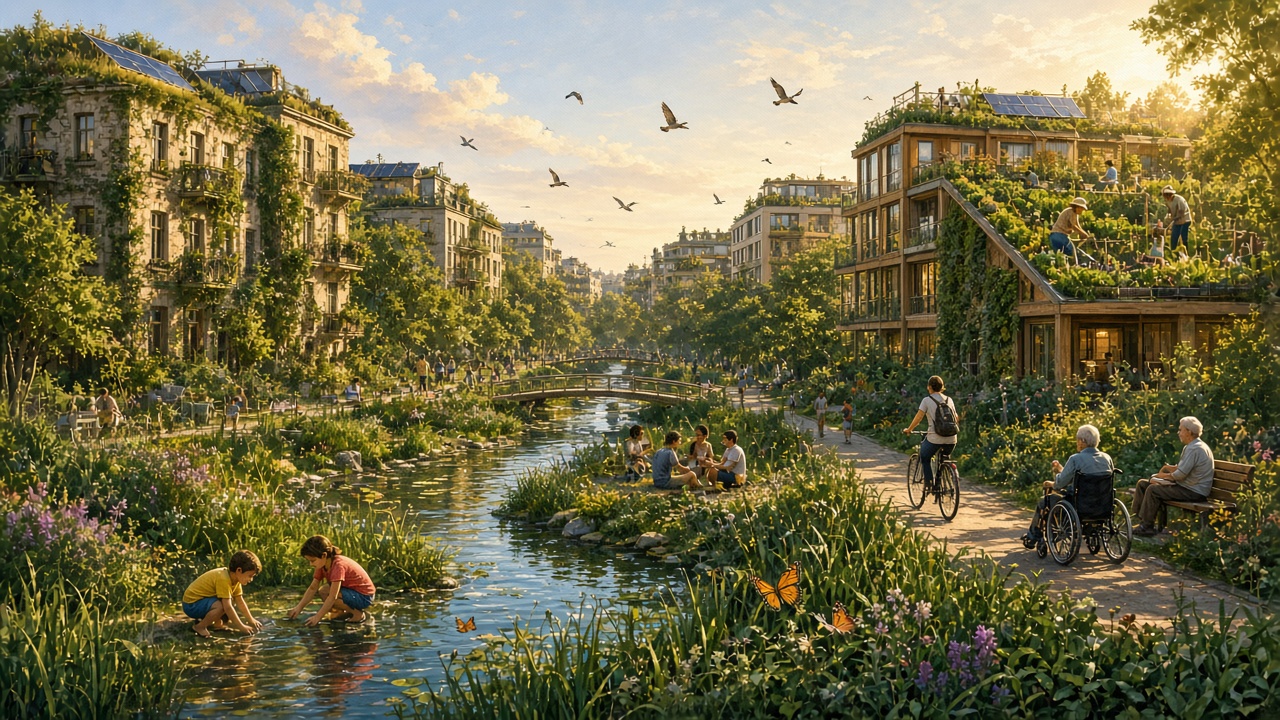
Next week we are investigating EnergyNet and the internetification of energy distribution, ahead of a conversation with Jonas Birgersson!
Share your thoughts – I’m at wtf4cities@gmail.com or @WTF4Cities on Twitter/X. Subscribe to the What is The Future for Cities? podcast for more insights, and let’s keep exploring what’s next for our cities.
If you would like to support the podcast, check out the Building Better Cities book or our Patreon!


Leave a Reply