A city square can feel priceless and still lose the argument the day a buyer arrives with a spreadsheet. This week’s research debate in episode 475 on the What is The Future for Cities? podcast worked through Jagoda Adamus‘s 2023 paper, How Much Are Public Spaces Worth? Non-market valuation methods in valuing public spaces, and asked whether economics can hold the worth of a plaza. Thursday’s conversation in episode 476 with Howard Kozloff, founder and principal of Agora Partners, started from the other desk: how that plaza gets financed, built, and kept open. He does not set the number and the welcome against each other. He treats them as two tests a project has to pass.
Five lessons sit between those two episodes.
The number is a defence, and a risk
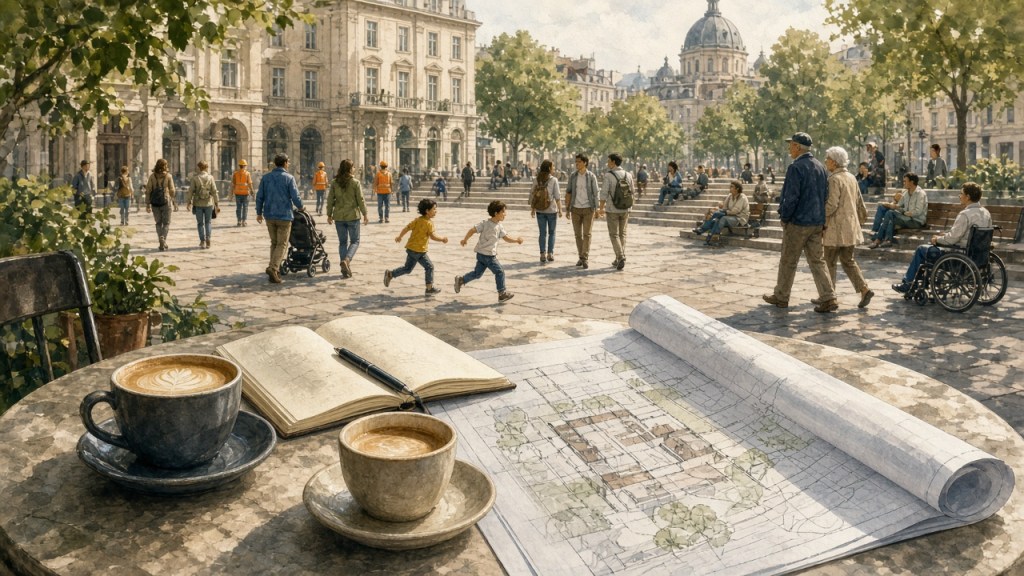
The debate opens on a sixteenth-century plaza, then on a developer who wants the land. One host says total economic value already holds culture, because a human need is an economic value. Bequest value is what someone will pay so a grandchild still has a plaza. Hedonic pricing finds that plaza in the gap between two identical houses. Contingent valuation has put a figure on damage as large as the Exxon Valdez spill, so a square, on this view, is within reach of a survey.
The other host answers with David Throsby’s cultural capital. Aesthetic, spiritual, and historical worth can move a price and still are not that price. A mall can copy the benches and the shelter. It cannot carry the genius loci of one square, and a value borrowed from another site fails for the same reason. Both sides agree that floor area misses what public space does for wellbeing and for a city’s ability to compete. Without a number, a planner walks into the negotiation empty-handed. With only a number, a specific place starts to look replaceable.
Planning that shapes is planning that can be paid for
Howard Kozloff does not start from a picture of the city in thirty years. He starts from thousands of decisions about design and capital that nobody can see all at once. Entrepreneurial planning, in his words, is “applying developer discipline and risk tolerance to problems that we usually leave to planning and policy.” The result he wants is planning that shapes, rather than planning that sits on a shelf.
Where that discipline lands, for him, is the public space itself. A park, a plaza, a sidewalk, a courtyard, or a lobby can be the actual product. The buildings are the walls around it. Who holds the title matters less than whether people are welcome and whether they show up. If they show up, the rents across the way go up, and the planning value is the same fact without a dollar sign: people want to be there. At Agora Partners he works where capital, design, and policy meet, and he describes the job as translating among those three languages. A project can be paid with tax dollars or philanthropy and still has to be financially viable. Advocacy that cannot read a pro forma, he says, is not useful to anyone.
The rule you publish becomes the land price
He learned as a student that land markets are efficient. Propose a zoning code and, once it is approved, the price of land can move overnight. “If the city proposes a new zoning code, that will be priced into the land. When that gets approved, literally overnight, the land markets respond.” He offers made-up figures to show the mechanism. A buyer underwrites 100,000 square feet. Mid-approval the city asks for half the site as a park, and only 50,000 square feet can be built. The deal that worked on paper may no longer work, and the lot can sit behind a chain-link fence for years. If the park share is known on the day of purchase, it is in the price, and the buyer either starts or walks away before the fence goes up.
So government’s useful role, for him, is a rule people can see, not a surprise about whether approval takes one year or five. He calls affordability a structural failure for the same reason: building what cities need has been made too slow and too expensive, and public space is what gets cut. Capital chasing the same product turns the street into a line item.
Someone has to own the running costs
Density, for Kozloff, is still the most efficient engine for innovation, opportunity, and sustainability. Public space is what makes that density livable rather than merely tolerable. Cubicles and high-rises pack people in. They do not give people a shared feeling for the place. Activation, programming, and stewardship belong in the business model, not in a list of amenities, because “someone has to own the operating costs of public spaces.” He is plain that this is “a design and financing question, not a civic one.”
Two failures end in the same empty square. Privately owned public space becomes defensive, over-programmed and hostile. Public parks are short of money, people, and time, not of intent. His opportunity is a capital structure in which public and private partners build and look after the space together, with rules known early enough that building does not stall. A privately financed life science lab he co-founded in Los Angeles, approved by right inside rules that already existed, was his proof that the city can help without rewriting the code mid-deal.
An empty street is not a reason to give up on the city
“By their very nature, cities are resilient and adaptive, and they have absorbed every shock we’ve thrown at them over thousands of years.” He rejects the claim that cities are finished. After 11 September 2001 in New York, people said nobody would live in a tower, and the city built bigger and denser. After COVID, downtown Los Angeles, where he lives, is still hurting, and he does not take that as a reason to leave. “I think that the predictions of the demise of the city are greatly overstated.” Cities get sick, he says, and you do not give up on a person who is sick. World Cup crowds are his rough reminder that people still gather.
His role is places where people can feel a connection, and places around them to live, work, and play. An empty park, an empty plaza, an empty sidewalk does not help build the future of cities. An empty street where the only people out need help is, first, a street missing everyone else. Shops and time spent in the space, Jane Jacobs’s eyes on the street, change what help is possible. Every project, even in your own neighbourhood, is an incursion. A site plan that stops at the property line is his red flag.
The two episodes (475R and 476I) do not ask you to choose a spreadsheet or a feeling. They ask whether your city can speak both languages at once. Adamus’s readers need a way to say what a square is worth when the market will not name a price. Kozloff needs a way to get that square built, maintained, and used. A number without a welcome becomes a commodity. A welcome without a number becomes a speech that does not survive the underwriting.
Look at the next plaza your city is about to sell, mandate, or leave half-finished.
Is there a number that can walk into the negotiation without pretending the place is interchangeable?
Is the public-space rule public before anyone buys the land?
And who is still paying for the welcome ten years after the ribbon is cut?
Next week we are investigating nature-based solutions at the water-energy-food nexus, ahead of a conversation with Moein Nodehi!
Share your thoughts – I’m at wtf4cities@gmail.com or @WTF4Cities on Twitter/X. Subscribe to the What is The Future for Cities? podcast for more insights, and let’s keep exploring what’s next for our cities.


Leave a Reply