
This week’s episodes of What is The Future for Cities? podcast ran through a double habit. Tuesday’s research debate (467R) worked through a 2026 systematic review by Shiva Manshour and Steffen Lehmann of 30 studies on passive cooling in hot, arid cities. Thursday’s conversation (468I) with Shawn Meyers, Middle East Masterplanning Director at DLR Group, added the planning version of the same problem. We already know how to cool without treating buildings as patients on the grid. We already know mixed-use, walkable places outperform gated sprawl. We still keep plugging glass boxes into mechanical life support, and we still keep ordering the safest item on the development menu. Five lessons follow from putting the two episodes next to each other.
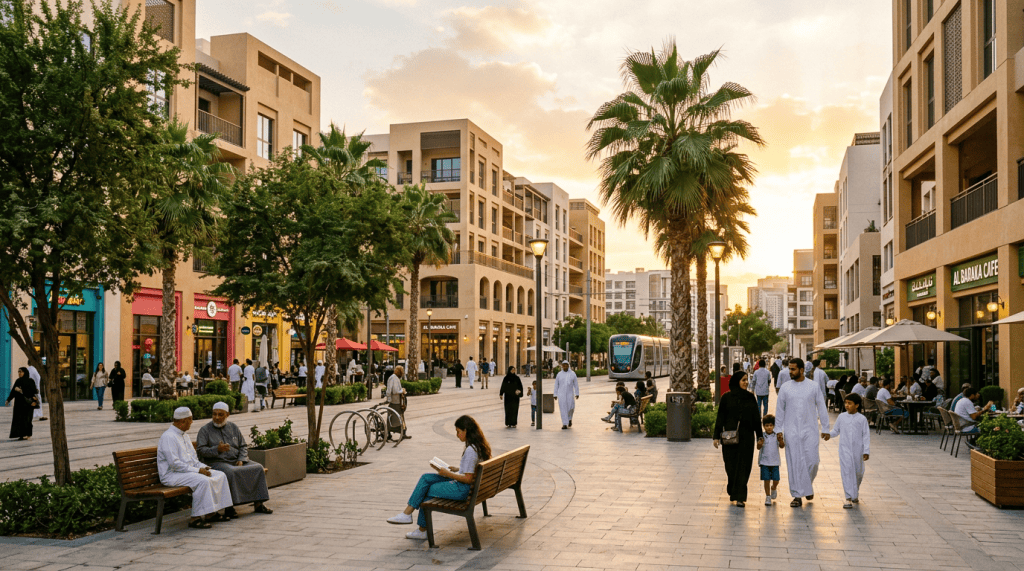
Cooling starts with the skeleton, not the machine
The research episode opens on a picture that is hard to unsee. Modern buildings in hot climates are treated like patients on permanent life support: sealed glass, mechanically chilled air, and a quiet prayer that the machines never fail. One side of the debate argues that traditional geometry already did the heavy lifting. Wind catchers can drop indoor temperatures by four to six degrees Celsius with no electricity. Thick adobe or stone walls, 40 to 60 centimetres, can damp indoor swings by five to eight degrees. Compact, self-shading streets block the daytime sun and then radiate heat to the night sky.
The other side does not deny the physics. It denies the photocopy. You cannot drop a mud-brick courtyard into a twenty-first-century downtown and cool 10,000 office workers. Floor-area ratios will not pay for two-foot walls. Ground-floor families will not sleep with the windows open for a night flush in a noisy, insecure street. The argument is not that vernacular was wrong. It is that the city we actually live in will not rebuild itself as a medina overnight.
Scale the physics, do not scale the postcard
A contemporary mosque in the review copied traditional courtyard proportions and blew them up. When the courtyard got too wide, the walls could no longer shade the ground. The microclimate failed. It became a basin of solar heat.
That is the useful failure. The thermodynamics stay non-negotiable: solar control, thermal inertia, natural ventilation. How you deliver them can change. Phase-change materials mimic the storage of masonry in slim modern walls and can cut cooling energy by 15 to 30 percent. In Algeria, computational design, asymmetrical shading, and high-albedo surfaces cut felt heat on wide boulevards by 3.1 degrees Celsius of physiological equivalent temperature. Dubai’s Al Sa’fat and Abu Dhabi’s Estidama frameworks, the hosts note, are starting to demand that performance rather than a style.
Hybrid is the practical landing. Traditional methods as the ecological baseline. Modern tools where density, privacy, and security make the old behavioural routines impossible. Ignoring the skeleton is still a design failure. Pretending the skeleton can be copied at any size is a different one.
We keep ordering what is already on the menu
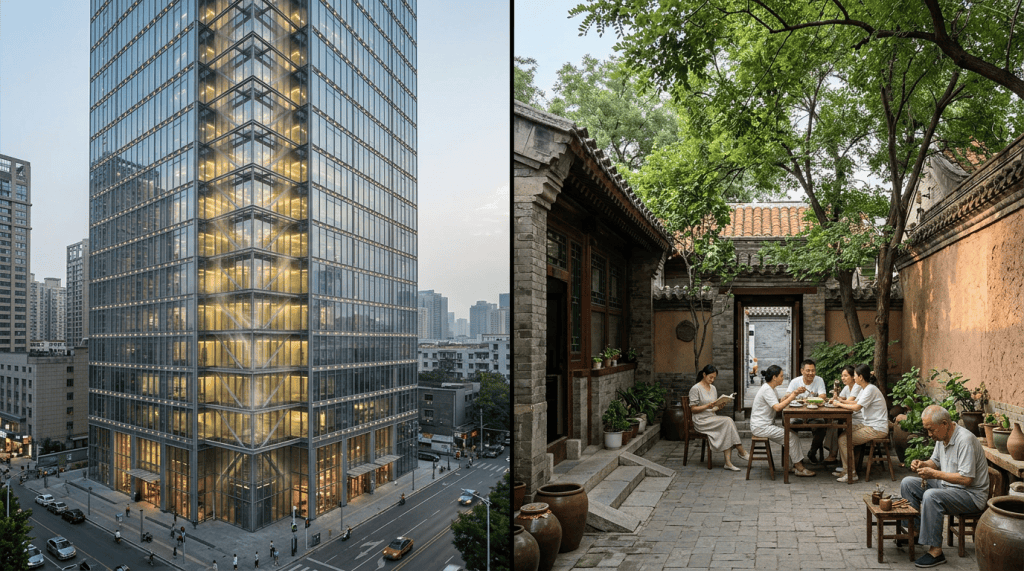
Shawn Meyers’s first fear is not heat. It is habit. We know mixed-use neighbourhoods outperform single-use districts. We know walkability improves health. We know a good public realm creates economic value and a sense of belonging. Developers, financiers, and governments still choose the thing that has been delivered a hundred times before, because it is the lowest risk.
The world, he says, is not simply urbanising. It is rapidly suburbanising. The gated community is the most popular housing type being built globally. Small mixed-use examples exist and they are loved. They are not yet competing, at scale, with the space and perceived safety of suburbia. So we keep ordering what is on the menu. We optimise what is familiar rather than asking what is possible.
Japan’s metro authorities own the land around stations and build schools, shops, clinics, and housing as one dense, convenient place. Singapore’s public housing is of higher quality than its private housing. Barcelona mandates storefronts per linear metre of street. Copenhagen measures social connection, children’s independence, walking, and mental wellbeing, then builds for those values. The knowledge is not missing. The product on the menu is.
Progress is implementation, not another diagram
Meyers’s second fear is that we will mistake innovation for progress: AI, autonomous vehicles, and sensors added to a fundamentally flawed urban model, like renovating a house without questioning the floor plan. He has already seen first- and last-mile robots in Chinese streets that are simply more traffic.
True progress, in his studio’s work, is seeing the thing built in line with the original vision. Knowledge Economic City in Medina had been through multiple talented teams over decades. The gap was not ambition. The region is long on ambition and short on implementation. The WAFX Award-winning approach was to treat master planning as a development strategy that aligns competing stakeholders, with more overlap between pre-design and post-design, so the first phase – more than 670 hectares – is actually being built.
On an Abu Dhabi industrial regeneration scheme, MESA, the team did not redraw the whole approved arts-district master plan. They looked for the minimum intervention with the maximum impact, designed alongside economics and cost teams, and built a roadmap the client could fund. Design talk is cheap. Implementation of the things that should be implemented is the test.
Younger generations will not order the old menu
Cities still magnetise talent. People still choose density, culture, and social life. In the Middle East that pressure is demographic. Around 60 percent of the population is under 40. In Saudi Arabia, around 60 percent is under 36. They are not satisfied with giant villas, isolated sprawl, and a public life that happens mainly at the mall or the mosque. They want a new menu.
That is the hopeful version of a harder fear: that we lose what makes a city, which is strangers cooperating. When people retreat into gated communities, private cars, private schools, and screens, the city stops being a shared civic experience. Jane Jacobs’s line still sits underneath the work: people must take a modicum of responsibility for each other even if they have no ties. Jan Gehl’s line sits next to it for the desert: cultures and climates differ, but people will gather in public if you give them a good place to do it. It is not too hot. It is not a good enough place yet.
The two episodes (467R and 468I) do not ask you to choose mud brick over glass, or heritage over sensors. They ask whether your city’s cooling and your city’s housing are still the safest items on an old menu. Look at the next tower, the next gated community, the next climate code.
Does the building still need life support because the geometry was never asked to work?
Is mixed-use still a pilot while suburbia remains the default product?
And if younger people already expect better than their parents, who is allowed to take the familiar dish off the menu?
Next week we are investigating the laws of scaling in cities with Geoffrey West!
Share your thoughts – I’m at wtf4cities@gmail.com or @WTF4Cities on Twitter/X. Subscribe to the What is The Future for Cities? podcast for more insights, and let’s keep exploring what’s next for our cities.
If you would like to support the podcast, check out the Building Better Cities book or our Patreon!


Leave a Reply