
This week’s episodes of What is The Future for Cities? podcast ran through a simple mismatch. Passenger travel in many US cities is getting cleaner. Freight is not. Tuesday’s research debate (465R) worked through a 2024 paper by Thomas Maxner, Giacomo Dalla Chiara, and Anne Goodchild: a content analysis of municipal plans in 58 major US cities. Thursday’s conversation (466I) with Anne Goodchild, professor of civil and environmental engineering at the University of Washington and founding director of the Urban Freight Lab, added the lived version of the same problem. Last-mile urban freight is how food, parcels, waste, and shop stock actually reach people. It is also how we keep streets liveable.
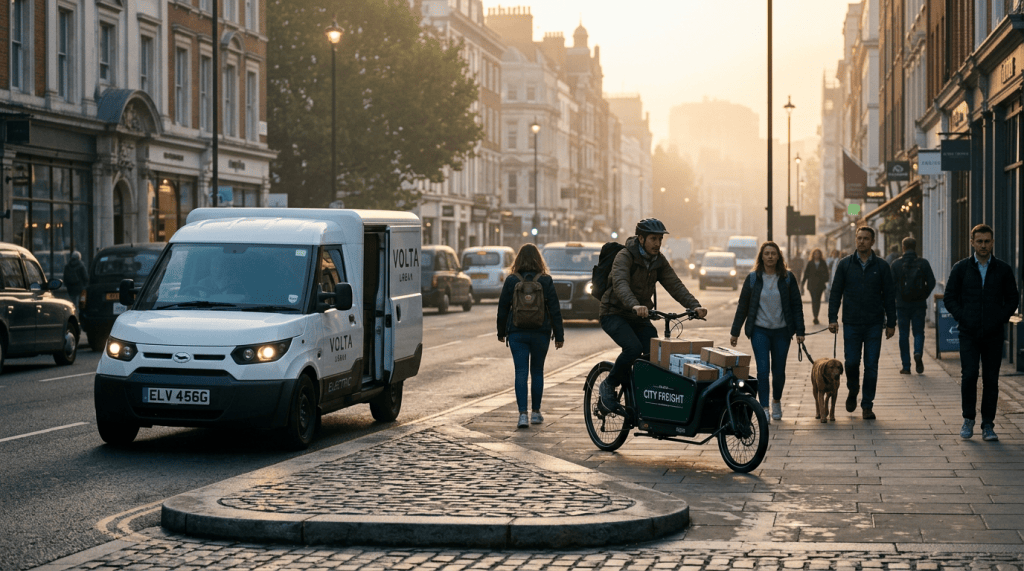
Name the last mile, then fund a real plan
If you only read climate plans, last-mile freight still looks optional. Of 58 major US cities, 45% had not even mentioned last-mile freight in their sustainability plans. Only 17 cities – 29% – had said they would dedicate resources to actionable freight planning. Sixty-nine percent of the strategies the authors found sat in the bottom two tiers: anecdotal mentions and vague guidelines.
That would be easier to live with if freight were a shrinking problem. It is not. In Oakland, Seattle, and New York, freight already accounts for about 10 to 12% of transport emissions. Passenger vehicle emissions are falling. Freight emissions are rising. Dense cities may see goods-related vehicle traffic grow by up to 30% this decade.
The debate in the research episode is not whether this matters. It is how fast cities should move. One host wants sticks: low-emission zones, tickets for idling, cargo-bike corrals that actually exist. The other wants data and carrots first, because only New York and Seattle had even estimated how many last-mile trucks they have. Both sides agree on the starting failure. You cannot manage what you have not named.
One word for freight hides three different cities
The same paper found that 34 of 58 cities still mix last-mile e-commerce with regional highway transport or port drayage. Anne Goodchild is blunt about why that matters. A mile-long train, a port crane, and a person carrying a drink into a body are all freight. They need different land use, different vehicles, different employees, and different policies.
She started in ports. For the last 10 to 15 years she has worked at neighbourhood scale, on the last mile that has to happen where people live, walk, and sleep. The test is not whether the truck can get through. It is whether the street is still liveable: not too noisy, not too smelly, still a place you would let a child walk.
If your freight chapter still reads like a port masterplan, it is not a last-mile plan.
Transport only leaps when it is one of a few priorities
Goodchild is an engineer, not a politician, and she does not pretend expertise makes you a visionary. What she has watched, though, is that big transport shifts need a leader who will spend years on one idea. Ken Livingstone put congestion charging near the front of his agenda in London. Pedestrianisation in New York needed transport-oriented people who would sacrifice other fights for a time.
She is not arguing that every mayor should be a freight person. Cities go through phases. Parks matter. Housing matters. A mix of leaders is healthy. But if transport is the twelfth item on a list of twelve, nothing expensive or slow will happen. Last-mile freight will stay in the vague-guideline drawer.
Density is how we house more people with less consumption
Asked for opportunities, Goodchild does not start with a gadget. She starts with proximity. Cities, she says, give us a much bigger chance to live in a sustainable way, because sharing infrastructure cuts individual energy use and lets us deliver people, goods, and services at much lower cost. If the task is to accommodate more people on the planet while consuming less, we have to do both. We can do that in cities. We cannot do it without the efficiencies of living that way.
That is a practical requirement, not a lifestyle slogan. It also explains why last-mile freight belongs in the climate conversation. Density only works if goods can arrive without turning the neighbourhood into a depot.
Treat last-mile delivery as a public good, and treat travel as a choice
The quiet claim in the interview is the one cities still resist. You can only exist in a city because this transport system brings you the food you need to eat. Goodchild has been trying to make the case that last-mile delivery is a public good the government should invest in, not a private inconvenience to be squeezed into leftover kerb space.
That sits next to a harder idea: all travel is a choice. Walking still costs food. A banana that did not grow nearby is a choice. So is sprawl, and so is a self-driving car sold as the fix for every transport problem. Goodchild’s first fear is that automation will divert attention from isolation, energy, and streets that kill people outside the vehicle. Warehouses and ports can be fenced and controlled. A public road is a shared common. That is the last place she would start.
The work, as she describes her own role, is still upstream of cargo-bike studies. It is getting officials to see that freight matters enough to spend money and political capital on it. Until that happens, we will keep arguing about which van is greener while the plan remains a wish.
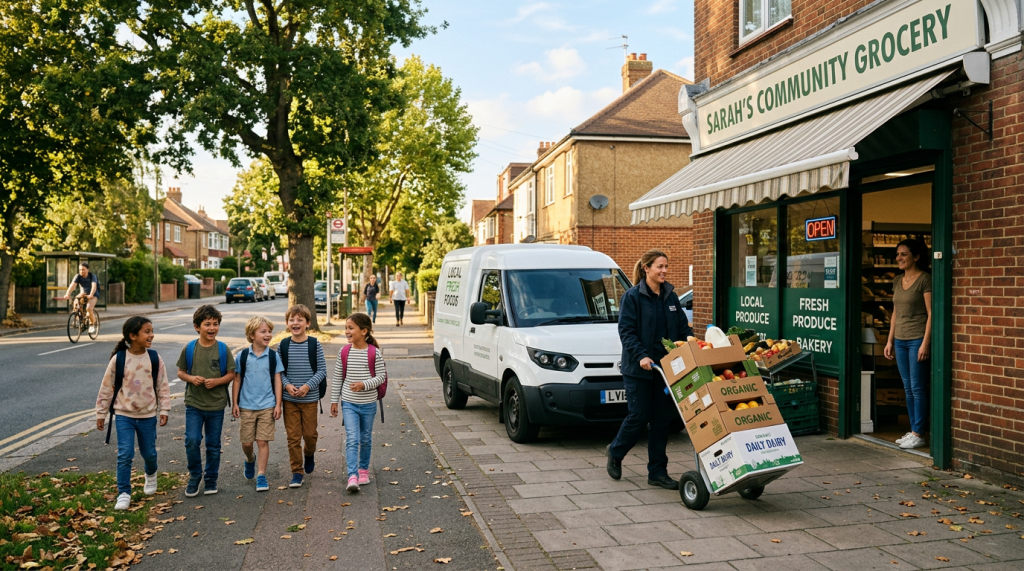
The two episodes (465R and 466I) do not tell you whether your city should start with a stick or a working group. They do tell you that last-mile freight is not a niche. It is how density stays humane. Look at your own long-range plan. Does it name last-mile freight? Does it count the trucks? Does it use one word for the port and the cargo bike? And if last-mile delivery is a public good, who in your city is allowed to treat it that way?
Next week we are investigating how the Middle East is a good testing ground for climate change solutions with Shawn Meyers!
Share your thoughts – I’m at wtf4cities@gmail.com or @WTF4Cities on Twitter/X. Subscribe to the What is The Future for Cities? podcast for more insights, and let’s keep exploring what’s next for our cities.
If you would like to support the podcast, check out the Building Better Cities book or our Patreon!


Leave a Reply