This week’s episodes of What is The Future for Cities? podcast examined two linked questions that sit at the heart of how cities will feed themselves in a changing climate. The research debate in episode 453R asked whether crop diversification reliably produces climate-related resilience for rural households, based on a 2022 research article by Ronnie Vernooy. The interview in episode 454I with Kamogelo Thumankwe, founder and CEO of Tsarona, explored the extended foodprint of cities and the practical work of bringing climate-adapted African crops into wider use. Together they offer clear, grounded lessons that move beyond simple prescriptions.
Diversification functions as ecological insurance
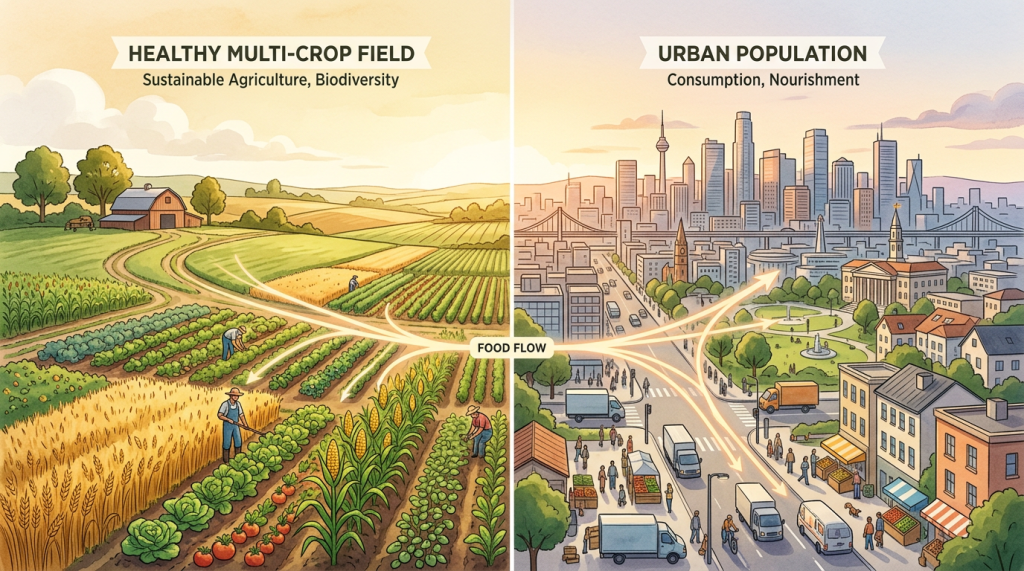
The research debate opened with a powerful analogy: crop diversification behaves like a natural index fund. Instead of concentrating risk in a single optimised crop, a diversified field spreads functions across multiple species. When one plant struggles under heat, drought or pests, others can continue to retain water, fix nitrogen or suppress weeds. Large meta-analyses covering thousands of field experiments show consistent gains in yields and environmental performance from practices such as intercropping and agroforestry. Long-term trials reinforce the point. A thirty-one-year study in Ontario found that a maize-soybean rotation combined with reduced tillage lifted yields by as much as 22 percent in hot, dry years compared with monocultures. In Malawi, “doubled-up” legume systems pairing grain legumes with deep-rooted pigeon peas improved soil fertility, reduced erosion and supplied food later in the hungry season. These results demonstrate that biological redundancy creates a tangible buffer against climate shocks. The principle itself is robust: when species outnumber the essential functions of the agroecosystem, the system is less likely to collapse under stress.
Field success does not automatically equal household resilience
Yet the same literature reveals a critical gap. Measuring improved plant height, nitrogen fixation or seasonal yield does not tell us whether a household can withstand successive years of difficulty. True resilience involves buffer capacity, the ability of communities to organise responses, and the capacity to adapt over longer time horizons. Several reviews found that many studies stop at biotic and abiotic variables and never examine economic or institutional outcomes. A temporary income lift or an extra bag of grain does not necessarily protect core assets or allow families to plan beyond the next season. Market dynamics can even reverse the gains. In the Bolivian highlands, farmers shifted toward commercial sweet potatoes and quinoa in response to rising demand, abandoning traditional bitter potatoes that stored well as freeze-dried chuño. When severe frost arrived, the commercial crops failed and the historic buffer had disappeared. Similar policy and market lock-ins appear in intensive corn-soy systems elsewhere. The lesson is precise: ecological performance is necessary, but it is not sufficient. Resilience assessments must track whether households actually retain options and capacity when shocks compound.

A city’s foodprint is larger than its map
Kamogelo Thumankwe’s central observation cuts through much of the conventional conversation about urban food systems. A city’s true footprint extends far beyond its municipal boundary. Most of the calories and protein consumed in European or Australian cities are grown on other continents. Look at any supermarket shelf and the origins stretch from Ecuador to Zimbabwe. This extended dependence creates hidden fragility. Cities often rest their staple supplies on a narrow set of crops grown in climate-vulnerable regions. Energy and water systems receive careful resilience planning; food is still treated as a given. Climate change will redraw the crop map. Regions that currently feed distant cities may no longer be able to do so in a decade. At the same time, the people who grow the food remain largely invisible in urban decision-making. When the supply base erodes because farmers lose the economic reason to continue, cities feel the consequences last and most severely. Recognising the scale of the foodprint is the first step toward treating food systems as critical urban infrastructure rather than an external afterthought.
Circularity starts with production residuals
Practical circularity does not require complex new technologies. It begins with refusing to treat residual streams as waste. In Tsarona’s work with Bambara groundnut and tigernut, the pulp left after milk extraction was initially discarded. Once the team recognised that the residual material retained its nutritional value and flavour, they began turning it into crackers and energy balls. The same logic appears across plant-based processing: spent grains and pulps can re-enter the food stream instead of leaving it. This approach keeps nutrients in use and reduces the volume of material that must be managed as waste. It is modest, production-side work rather than an attempt to recycle finished meals, yet it demonstrates how closing loops can be built into everyday operations. The principle scales: wherever processing creates a residual stream that still holds value, the opportunity exists to redesign the flow so that material returns to useful form.
Match crops to the climates where they already thrive
The final lesson concerns the geography of production. Vertical farms and other urban methods excel at delivering fresh greens and can strengthen local community connections. They are less suited to supplying staple calories or protein at city scale. Growing protein crops in climates that demand heavy inputs of water, energy or fertiliser can prove more extractive than producing climate-adapted crops where they already perform well and moving them efficiently. Bambara groundnut illustrates the alternative. It has been cultivated across parts of Africa for thousands of years. It requires no fertiliser, pesticides or irrigation, regenerates soil, and continues to yield under drought conditions that challenge other crops. Building transparent, high-quality supply pathways for such crops allows cities to diversify their protein sources while drawing on plants already proven in warming conditions. Transport emissions form only a small fraction of the overall climate impact of food; the larger shares come from how crops are grown and processed. The practical priority is therefore to expand the range of climate-adapted crops in use and to ensure the infrastructure exists to move them reliably.
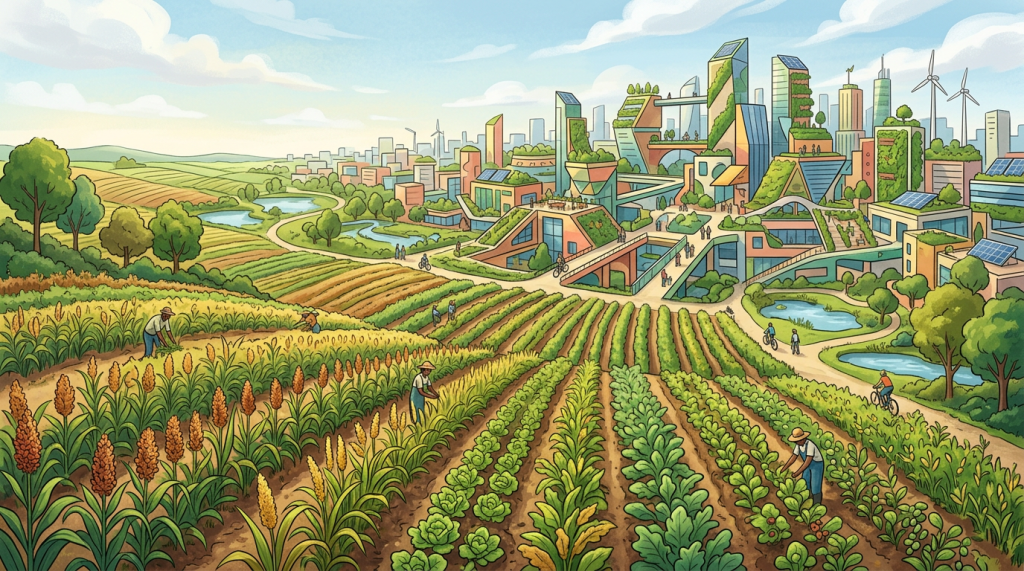
These five lessons form a coherent picture. Ecological redundancy in the field provides a foundational buffer. That buffer only becomes livelihood resilience when wider market and institutional conditions support it. Cities must recognise the true extent of their foodprint and the fragility that accompanies narrow crop dependence. Practical circularity can begin with the residuals already generated in processing. And the most efficient path to diversified urban supplies often lies in matching crops to the environments where they thrive rather than forcing production into unsuitable settings. Taken together, the research debate in episode 453R and the conversation with Kamogelo Thumankwe in episode 454I point toward layered, evidence-based approaches that treat both biology and the systems surrounding it as essential.
Next week we are investigating biodiversity-ecosystem services and healthy living with Caroline Howell!
Share your thoughts – I’m at wtf4cities@gmail.com or @WTF4Cities on Twitter/X. Subscribe to the What is The Future for Cities? podcast for more insights, and let’s keep exploring what’s next for our cities.


Leave a Reply