
This week on What is the Future for Cities? podcast we sat with a deceptively simple question: how do the systems that keep cities supplied actually shape the places we live in?
Episode 451R examined a 2026 systematic literature review by Jiayu Joslyn Sun, Lóránt Tavasszy and Ron van Duin. It mapped the interface between city logistics and urban design through Matthew Carmona’s six dimensions. Episode 452I then brought one of the authors, Ron van Duin, into conversation about freight, zero-emission zones, resilience and the everyday realities of moving goods through dense urban fabric.
Taken together, the two episodes offer more than academic insight. They reveal practical tensions that city-makers, logistics operators and residents are already living with.
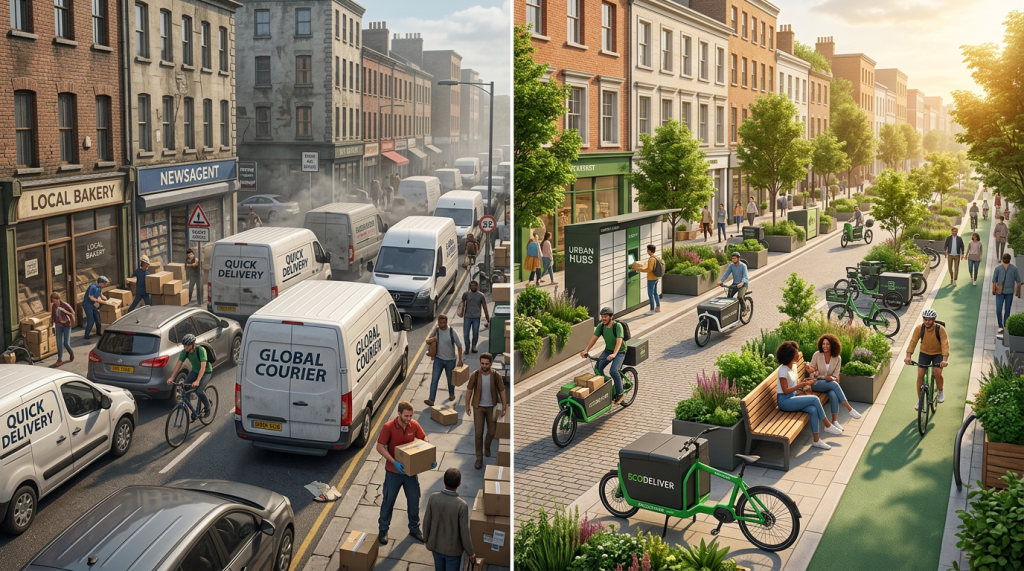
Lesson 1: Freight is the infrastructure of daily life, not just packages
Ron van Duin opened with a clarifying definition. Freight is the organisation of our daily needs. Construction and maintenance of housing alone account for roughly 35 per cent of urban transport movements. Food and supermarket supply, retail restocking, healthcare deliveries, parcels and the rising tide of meal and grocery fulfilment all add further layers.
Each stream has its own rhythm, vehicle type and spatial demand. Together they form the circulatory system that keeps a city functioning. Yet most public conversation still treats “logistics” as synonymous with the last-mile parcel van. That narrow view underestimates both the volume and the diversity of what actually moves through our streets every day.
Once we see freight this way, the design challenge becomes clearer. We are not simply managing inconvenience. We are deciding how the essential metabolism of the city occupies public space.
Lesson 2: We have studied the machinery more thoroughly than the human experience
The literature review at the centre of episode 451R is blunt on this point. Functional and morphological dimensions of the logistics–urban design interface are relatively well explored: street geometry, loading zones, network efficiency, the placement of micro-hubs and dark stores. Social, perceptual and visual dimensions remain significantly under-researched.
In the research debate that followed, one side argued that physical efficiency must come first — if the curb is broken and the network fails, nothing else works. The other insisted that efficiency-first thinking is precisely what produces streets that feel hostile, unpredictable and depleted of character. Delivery robots that mathematically fit on a footpath still alter how people walk. Blanked-out shopfronts of dark stores erase the visual cues that help a street feel like a place.
The review’s core finding is not that one set of dimensions is more important than another. It is that we have been designing with an incomplete set of tools. The historical separation between logistics professionals and urban designers is no longer tenable.
Lesson 3: Electrification solves air and noise, but not space
Fourteen Dutch cities have already introduced zero-emission zones. Ron van Duin expects major centres such as Rotterdam and Amsterdam to be fully zero-emission for freight in their inner areas by 2030. The air-quality and noise benefits are real.
Yet the same number of vehicles still compete for the same limited curb and road space. Switching from diesel to electric does not shrink the footprint of a delivery van. It does not prevent double-parking, contested loading zones or the cascade of delay that follows when one vehicle occupies space longer than planned.
The deeper requirement is fewer vehicles overall. That points toward collaboration — sharing loads, capacity and information across operators who are used to competing. Data spaces and federated platforms are emerging as more practical routes than earlier blockchain experiments. The goal is higher load factors and fewer half-empty vans circulating through constrained streets.
Lesson 4: Resilience is local, circular and behavioural as much as technological
Global supply chains remain vulnerable to geopolitics, climate disruption and capacity shocks. Ron pointed to opportunities that sit closer to the city itself: more deliberate local sourcing where it is feasible, and a stronger circular economy that recovers materials — especially in construction — rather than hauling everything from distant sources.
Behavioural change also matters. Not every order needs next-day delivery. When consumers accept slightly longer lead times for non-urgent goods, logistics operators gain the flexibility to consolidate loads more effectively. Small shifts in expectation can reduce vehicle kilometres without requiring new technology.
Drones, by contrast, remain limited in Ron’s assessment. Privacy, regulation, energy and the sheer impracticality of large-scale aerial delivery in dense cities constrain their role. Their clearest value appears in urgent medical or island supply cases rather than routine urban fulfilment. Autonomous vehicles and mobile parcel lockers show more promise for certain last-mile segments, but they still require careful allocation of street space.
Lesson 5: Progress requires facilitation across disciplines, not isolated optimisation
Both episodes converge on the same institutional lesson. Treating urban freight as a pure supply-chain problem produces solutions that the city cannot absorb. Treating urban design as a purely spatial or aesthetic exercise produces places that cannot be supplied.
Ron described the more productive pattern emerging in the Netherlands and elsewhere: long-term collaborative platforms that bring municipalities, companies, knowledge institutes and, increasingly, citizens into ongoing conversation. The government’s most useful role is often facilitation — setting clear direction (as with zero-emission timelines), providing shared infrastructure or data frameworks, and holding space for joint problem-solving — rather than pure market freedom or pure top-down control.
The research debate reached a parallel conclusion. The wall between logistics and urban planning is crumbling because it has to. Designing only for the package or only for the person both fail. The streets are contested, complex and alive. Solutions that last will be those that hold multiple dimensions — functional, morphological, social, perceptual, visual and temporal — in view at once.

The week’s two episodes (451R and 452I) leave a practical invitation rather than a single prescription. Delivery volumes are still rising. Street space is finite. Public expectations of both convenience and liveability continue to climb.
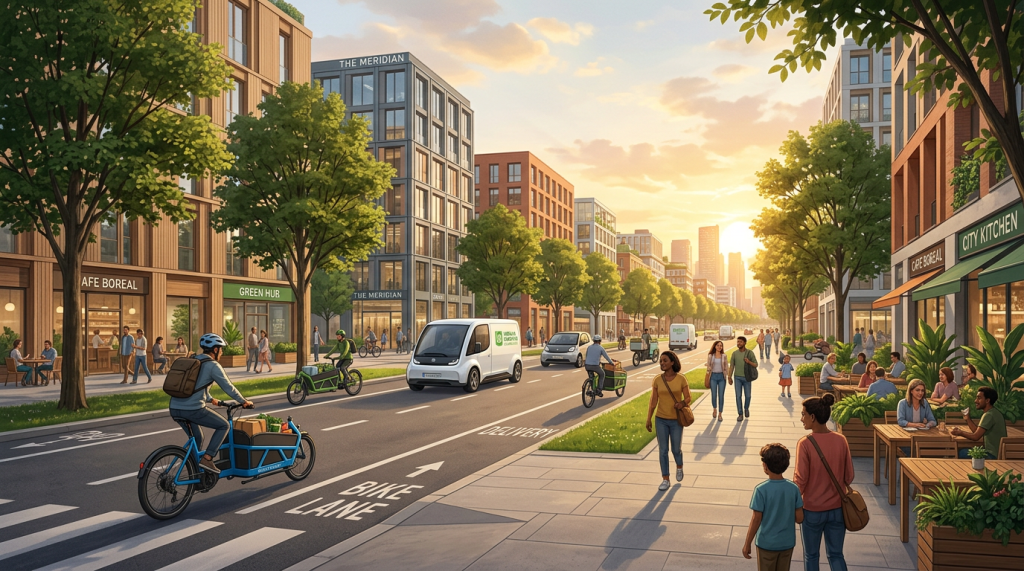
The most useful response is neither nostalgia for quieter streets nor uncritical acceptance of every new logistics technology. It is a more deliberate practice of integration: treating freight as essential urban infrastructure, measuring its human as well as operational impacts, and building the collaborative habits that allow cities to keep moving without sacrificing the quality of the places people actually inhabit.
That work is already under way in zero-emission zones, curb-management experiments, micro-hub pilots and multidisciplinary research. The remaining task is to scale the mindset as quickly as the technology.
Next week we are investigating food supply chains and crop diversity with Kamogelo Thumankwe!
Share your thoughts – I’m at wtf4cities@gmail.com or @WTF4Cities on Twitter/X. Subscribe to the What is The Future for Cities? podcast for more insights, and let’s keep exploring what’s next for our cities.


Leave a comment