
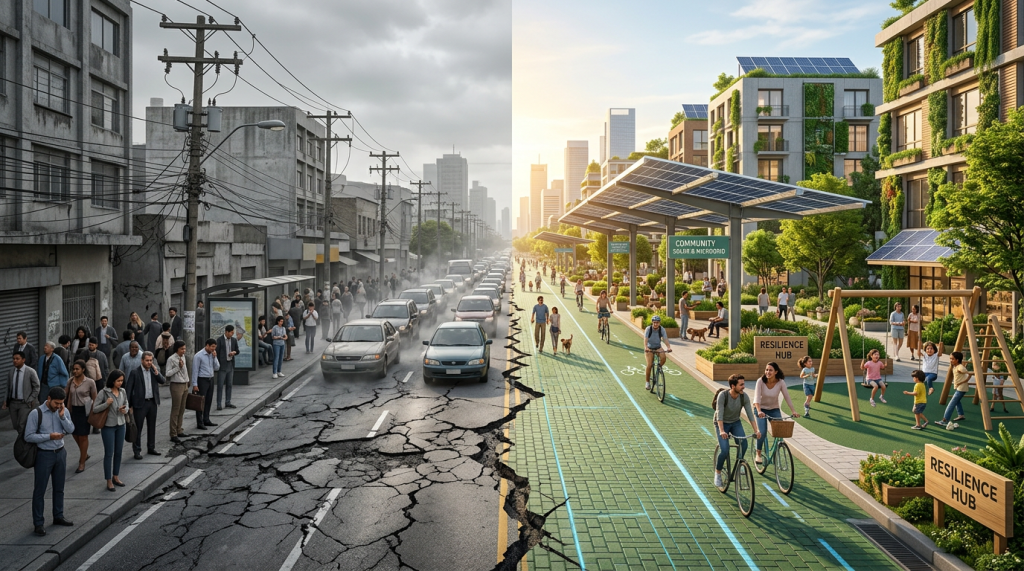
What if the real problem isn’t the leaking roof but the cracked foundation beneath it?
This week on What is The Future for Cities? podcast we explored exactly that question through two powerful episodes. Episode 425R brought a research debate summarising the upcoming book The Energy Foundation by AJ Perkins and Fanni Melles, while Episode 426I featured an inspiring conversation with AJ Perkins himself. Together they revealed why affordable, reliable energy is the bedrock of jobs, cost of living, housing stability and true community resilience. The discussions moved from diagnostic frameworks to practical decision tools and long-term stewardship.
Here are the five key lessons that stood out.
Energy is the true foundation beneath every urban challenge
The research debate opened with a striking metaphor. When families face rising rents, businesses close and people quietly leave town, we often treat the symptoms – rent relief, wage subsidies, food programs – like buckets catching leaks. But the real issue may be the foundation shifting. High utility costs act as a hidden compounding tax that inflates the price of everything else in the economy.
The book introduces the SOUND framework – Stability, Operating costs, Upstream risk, Normal life and Development – as a way to evaluate whether an energy system truly supports daily life. Without predictability and physical margin, businesses shorten planning horizons, hold back investment and turn their own workforce into a shock absorber for volatile power bills. The result is fragile economies where even well-intentioned surface-level fixes ultimately fail.
Hawaii serves as both warning and living laboratory
Islands like Hawaii function as a preview of challenges many cities will soon face: extreme energy costs, heavy import dependence and vulnerability to climate shocks. One delayed fuel shipment can cascade through water pumps, irrigation systems, food prices and daily routines. Fragile grids with zero margin turn ordinary storms into disasters, as tragically demonstrated in events like the Lahaina wildfires.
Yet AJ Perkins also framed Hawaii as a living laboratory. The microgrids, community solar-plus-storage projects and shared redundancy models being tested there are generating real lessons that can be exported. When energy systems have built-in margin they do not merely survive shocks – they absorb them internally and return stability to families and businesses.

Seven-generation thinking and the empty chair change how we decide
One of the most moving insights from the interview came when AJ described Hawaiian planning through seven generations. This is not abstract philosophy – it is about stewarding the land we inherited from ancestors and the land we will pass to those yet to come.
He introduced the “empty chair” practice: intentionally leaving a seat open in meetings to represent ancestors, future generations, plants, animals and the land itself – voices that cannot speak but must still be heard. This mindset shifts decisions away from short-term fixes toward genuine long-term resilience.
The clear framework turns endless discussion into defensible action
AJ shared a practical tool refined over years of stalled meetings: the CLEAR framework. It stands for Clarity (define the desired outcome), Limits (acknowledge real constraints), Evaluate (assess paths and eliminate unworkable ones), Assign (put names and accountability on responsibilities) and Run (execute, document and learn). Every step is recorded so decisions remain defensible even when leadership changes.
This directly tackles one of the biggest barriers to progress – fear of making the wrong choice. As AJ noted, indecision often costs far more than a thoughtful but imperfect decision. The framework gives communities, particularly lower-income and ALICE (asset-limited, income-constrained, employed) communities, a structured way to move from policy conversation to actual microgrids, nano-grids and resilient infrastructure.
Distributed energy is now investable and anti-fragile systems are within reach
Perhaps the most hopeful takeaway came when AJ declared that distributed energy has finally become investable. For years local resilience projects were treated like charity. Today microgrids and batteries can generate value every single day – charging when power is cheap and discharging during peaks – while protecting communities during outages.
This is anti-fragility in practice: systems that do not just bounce back but actually improve from volatility. Projects like Kauai’s community solar-plus-storage show how redundancy pays dividends in normal operations, not just emergencies. When energy has real margin, businesses can hire permanently, families invest in their neighbourhoods and cities stop passing shocks down to the most vulnerable.
These five lessons converge on one central truth: energy is the foundation. When we get it right – stable, affordable and built with margin – everything else becomes possible. Hawaii shows us both the cost of fragility and the promise of deliberate solutions. Seven-generation thinking and the empty chair remind us why long-term stewardship matters. The CLEAR framework gives us the practical tool to act, and the improving economics of distributed energy make shared resilience not only necessary but financially wise.
The conversation between the research debate and AJ Perkins’ interview delivered both urgency and genuine hope. We no longer have the luxury of treating energy as one more line item. It is the prerequisite that enables housing affordability, job quality, food security and thriving communities.
The big question for each of us is straightforward: what does the energy foundation look like in our own city? Are we still catching leaks or are we ready to strengthen the foundation? Whether you are a policymaker, business leader, researcher or resident, these ideas invite us to think longer term and act more deliberately.
Have you seen energy costs ripple through your own community? What is one step your city could take toward genuine anti-fragility?

Next week we are discussing amphibious architecture and construction with Elizabeth English!
Share your thoughts – I’m at wtf4cities@gmail.com or @WTF4Cities on Twitter/X. Subscribe to the What is The Future for Cities? podcast for more insights, and let’s keep exploring what’s next for our cities.


Leave a Reply