This week on the What is the Future for Cities? podcast we explored two complementary perspectives on urban transformation. In episode 445R, a research debate unpacked the 2024 paper by Yang Zhang, Chang Liu, and Caixia Hou on the driving mechanisms of green regeneration in old industrial areas, using evolutionary game theory focused on public satisfaction. In episode 446I, urban designer Andy Roberts, Director at Planit, shared his optimistic yet grounded vision for regenerative urbanism through ten interconnected principles.
Together, these episodes reveal a powerful through-line: transforming legacy industrial sites and designing future cities both require us to confront difficult economic realities while creating the conditions for positive emergence. Here are five key lessons that stood out.
1. Upfront ecological costs remain the central bottleneck in green regeneration
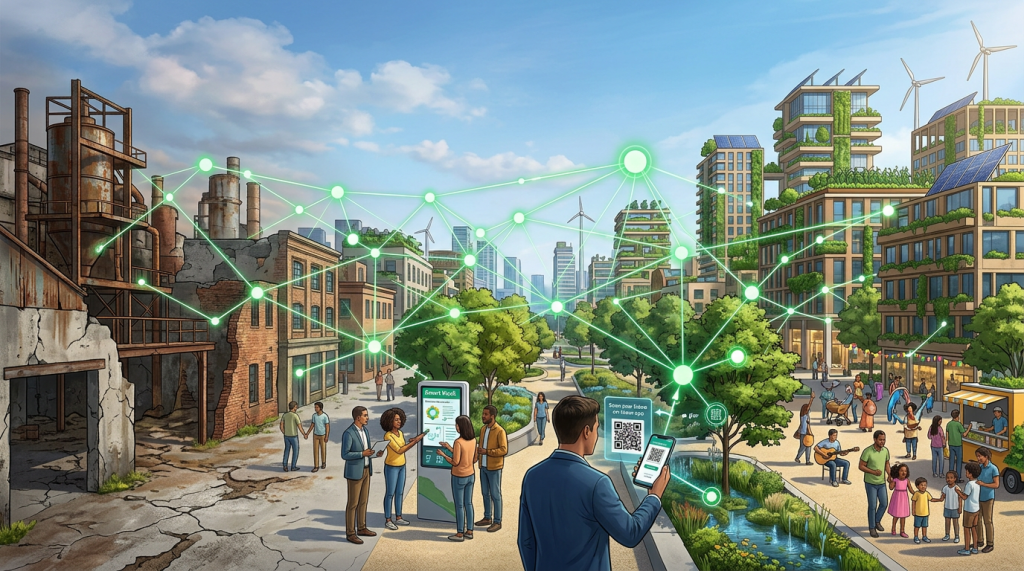
Old industrial sites (brownfields) often sit in prime urban locations, yet turning them into safe, thriving spaces is expensive. Deep soil decontamination, groundwater treatment, and green infrastructure carry massive upfront costs that traditional “static restoration plus functional replacement” approaches deliberately avoid. The research debate made clear that skipping these steps may look cheaper on a developer’s balance sheet today, but it externalises long-term environmental and public health risks onto the community and future generations.
Evolutionary game theory modelling in the paper shows why this happens: when incremental green costs exceed what governments are willing or able to subsidise, developers rationally choose the cheaper path. The result is either stalled projects or compromised outcomes that leave hazards buried beneath new development.
This lesson forces a hard question: are we willing to pay the true price of genuinely green regeneration, or will we keep deferring costs that will eventually come due?
2. Public supervision can act as a powerful, low-cost complement to regulation and subsidies
One of the most practical insights from the research episode is the role of public consciousness and supervision. When citizens actively report non-compliant behaviour – noticing illegal dumping, foul odours, or inadequate remediation – they effectively subsidise government enforcement. This crowdsourced accountability lowers the regulatory burden on local authorities and changes the payoff matrix for developers.
High punitive fines alone often backfire. They can trigger evasion, abandonment of sites, or unsustainable monitoring costs that eventually force regulators to retreat. Public pressure, however, raises the reputational and social cost of poor practice while supporting genuine green outcomes. The study emphasises that public satisfaction is not just a nice-to-have; it is a core variable in whether green regeneration becomes the stable equilibrium.
For practitioners and policymakers, this suggests investing in transparent processes, accessible reporting channels, and genuine community engagement is not just good ethics – it is smart economics.

3. Regenerative cities go beyond mitigating harm; they aim to give back more than they take
Moving from the research debate into Andy Roberts’ interview, a clear philosophical shift emerges. Sustainability often focuses on doing less damage. Regenerative urbanism asks a bolder question: what if every time we built something, the world actually got better?
Roberts describes regenerative cities as places that generate more clean energy and water than they consume, clear pollution, revitalise citizens, and have an ecological footprint that stays within the region’s biocapacity. This net-positive mindset moves beyond compliance or incremental improvement. It reframes development as an opportunity to restore and enhance social, environmental, and economic systems simultaneously.
This lesson challenges cities and developers alike to set higher ambitions. Net-positive outcomes are difficult in today’s systems, but they represent the direction of travel if we want cities that are not just less bad, but actively beneficial.
4. Design for evolution rather than trying to control every outcome
One of Roberts’ most compelling principles is “design for evolution.” You cannot design evolution itself; you can only create the conditions and capacity for positive change to emerge over time. This is perhaps the most selfless act a designer can make – deliberately building in redundancy and openness so that communities, ecosystems, and economies can adapt and improve beyond the original intervention.
The principle highlights nestedness (understanding how a project affects the neighbourhood, which affects the city, and vice versa) and emergence (where the whole becomes greater than the sum of parts through diverse interactions). Diversity – of uses, people, ideas, and ecological processes – creates exchange value that rigid master plans often stifle.
Real-world examples, such as community-led activation in Manchester’s emerging NOMA neighbourhood, show how participatory processes and small interventions can unlock larger, self-sustaining vitality.
This lesson has profound implications for urban planning practice. Instead of locking in fixed outcomes years in advance, we should design flexible frameworks that invite ongoing adaptation, learning, and contribution from many actors.
5. The most powerful visions emerge from the place itself
Finally, Roberts stresses that vision cannot be imposed from outside. It must arise from recognising the unique patterns, strengths, latent skills, and “DNA” already present in a location and its community. Imposed master plans frequently produce places that feel lifeless because they ignore local character and agency.
When vision is co-created with the people who live and work in a place, it gains legitimacy, relevance, and staying power. This principle aligns beautifully with the public supervision insight from the research episode: both remind us that successful urban transformation depends on distributed intelligence and ownership rather than top-down control.
This final lesson brings the week’s two episodes together. Whether we are remediating contaminated industrial land or shaping new regenerative neighbourhoods, the most durable solutions respect and amplify what is already there while creating space for what wants to emerge.
This week’s episodes (445R and 446I) illustrate that the future of cities will not be won by silver-bullet regulations, subsidies, or master plans alone. It requires a sophisticated blend: economic realism about upfront costs, creative use of public pressure as a low-cost enforcement mechanism, ambitious regenerative (rather than merely sustainable) targets, design approaches that enable evolution and emergence, and deep respect for the unique character and agency of each place.
The tension between strict ecological standards and pragmatic action to actually clean and reuse sites is real. So too is the tension between visionary ambition and the practical constraints of today’s development economics. Yet both the research modelling and Andy Roberts’ principles point toward the same hopeful direction: when public consciousness, place-based intelligence, and well-designed capacity for evolution are brought together, better outcomes become not just possible but more likely.
The work of building better cities continues – one thoughtful intervention, one engaged community, and one evolutionary step at a time.

Next week we are discussing urban forestry with Jasen Johns!
Share your thoughts – I’m at wtf4cities@gmail.com or @WTF4Cities on Twitter/X. Subscribe to the What is The Future for Cities? podcast for more insights, and let’s keep exploring what’s next for our cities.


Leave a comment