What makes a city truly resilient – beautiful, highly optimized designs, or robust, low-maintenance systems that actually work when maintenance is imperfect?
This week on What is the Future for Cities? podcast we explored exactly that tension. Tuesday’s Research episode (443R) debated a 2025 paper on enhancing resilient sustainable cities through public perspectives, using the Yongqing Fang revitalization in Guangzhou as a case study. Thursday brought a wide-ranging conversation in episode 444I with Markus Appenzeller (Founder & Director of MLA+), who shared his thoughts on finding real urban problems, robust systems, evolutionary urbanism, feedback loops, and rethinking post-industrial cities. Here are five key lessons that emerged.
Lesson 1: More resilience features do not automatically create more resilient places – balance is essential
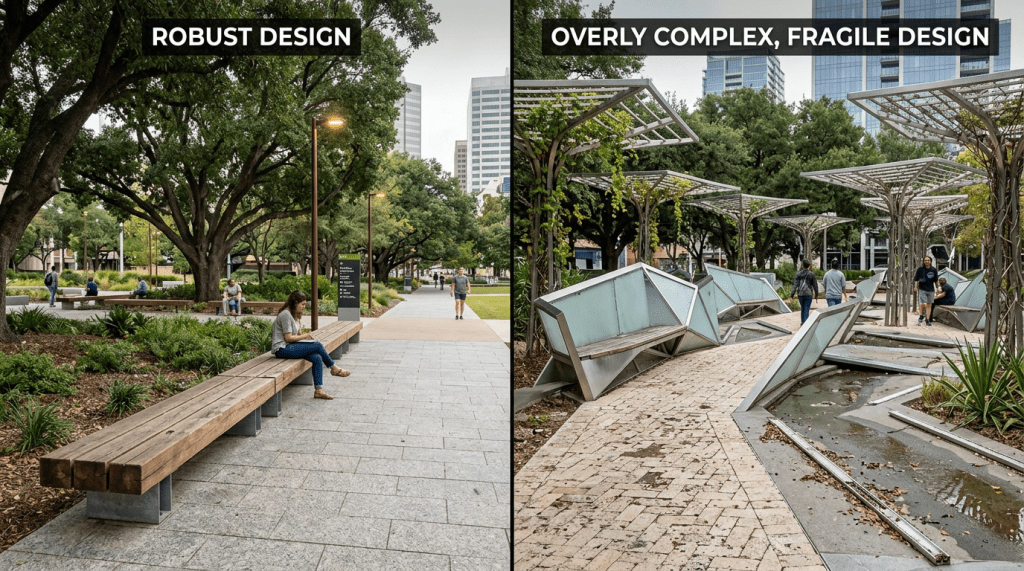
The research debate examined how planners in Guangzhou added aesthetic complexity, modern elements, redundant seating, water features, and visual freshness to a historic district. While the intention was to create vitality and attract people, many of these additions became liabilities when maintenance was imperfect. Stagnant water features, visual clutter, blocked accessibility, and generic commercialization led to public dissatisfaction rather than resilience.
The core insight: over-optimization and excessive redundancy can create fragility instead of strength. True resilience requires a careful balance between aesthetic appeal and basic functional reliability.
Lesson 2: Finding the real problem is often the hardest and most important step in urban planning
Markus Appenzeller emphasized that planners must resist jumping to solutions based on preconceptions. He outlined a clear sequence: gain broad experience across different contexts, talk directly to local residents (who are the real experts), dig deeper to understand how people actually experience the place, and only then propose solutions that fit the local context and capacity.
Many well-intentioned plans fail because they solve the wrong problem or apply generic global agendas without adapting to local realities.
Lesson 3: Robust systems are generally more valuable than hyper-optimized or antifragile ones in urban environments
Appanzeller prefers the term “robustness” over “antifragility.” While antifragile systems are meant to improve through shocks, robust systems are sturdy enough to absorb disturbances without breaking. In practice, many urban systems (especially landscapes and public spaces) become fragile when they are too complex or high-maintenance.
Overly ambitious designs often collapse when budgets, maintenance capacity, or political will fall short. Robustness offers a more realistic and sustainable baseline.

Lesson 4: Feedback loops in urban planning are dangerously slow, and we need to improve them
Appenzeller noted that by the time planners see the real results of their work, they are often retired or deceased. This long feedback loop makes learning and adaptation difficult. He suggested using better simulation tools, studying past projects to see what actually materialized, and building a stronger culture of city-making that encourages continuous improvement beyond minimum regulatory standards.
Lesson 5: We have a real opportunity to rethink post-industrial cities and develop new aesthetics and urban models
Appenzeller highlighted that we are still mentally and systemically stuck in the industrial city paradigm – obsessed with order, optimization, and control. He sees potential in embracing more evolutionary, context-specific approaches, particularly in rapidly urbanizing regions like sub-Saharan Africa or large city regions such as the Greater Bay Area.
He also suggested that we need to develop a new understanding of aesthetics – one that accepts a certain degree of “messiness” (as nature does) rather than enforcing perfect modernist order.
This week’s episodes (443R and 444I) highlighted a crucial tension in contemporary urbanism: the desire for beautiful, vibrant, and highly optimized spaces often conflicts with the need for robust, maintainable, and context-appropriate systems. Over-designing for every possible experience can create environments that look impressive on paper but fail in reality when maintenance, budgets, or local capacity fall short. At the same time, Markus Appenzeller reminded us that optimism, deep listening to local knowledge, and a focus on robust rather than perfect systems offer a more grounded path forward.
Cities are not static projects – they are evolving systems that require better feedback, stronger cultures of city-making, and the courage to adapt solutions to real contexts rather than global templates.
Have you seen examples in your city where beautiful designs became fragile due to maintenance issues, or where robust, simpler approaches worked better over time?
How can we improve feedback loops in urban planning so we learn faster from what we build?
Next week we are discussing regenerative principles with Andy Roberts!
Share your thoughts – I’m at wtf4cities@gmail.com or @WTF4Cities on Twitter/X. Subscribe to the What is The Future for Cities? podcast for more insights, and let’s keep exploring what’s next for our cities.


Leave a Reply