
This week on the What is The Future for Cities? podcast, we explored one of the most pressing and complex challenges facing cities today: the relationship between housing supply, regulation, and affordability. Through a research debate (episode 433R) on how land-use rules affect housing costs and a wide-ranging conversation (episode 434I) with Keith Cooke from Esri, we gained a clearer picture of why simply building more homes doesn’t automatically solve the affordability crisis – and what cities and planners are actually up against.

Lesson 1: Many cities are still planning with rules written for a different era
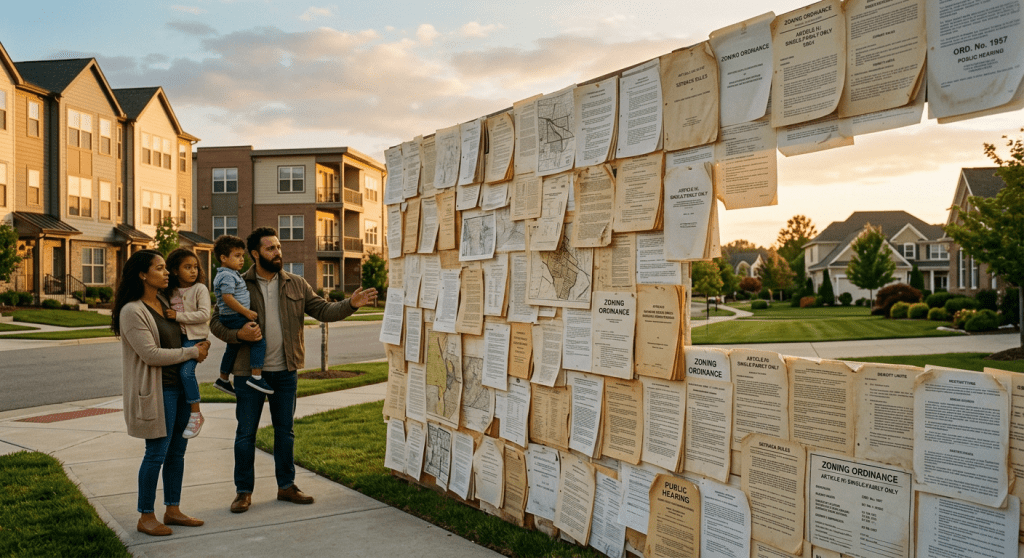
One of the strongest themes to emerge this week is that a large number of cities are operating with zoning and land-use frameworks created decades ago. These rules were often designed for different demographic realities, different household sizes, and different expectations about home ownership. As a result, many places now have zoning that makes it difficult or illegal to build the types of housing that younger generations and middle-income households actually need – such as townhomes, duplexes, or smaller-scale apartments.
Keith Cooke pointed out that comprehensive plans written even 10–15 years ago are increasingly out of step with current resident needs. This creates a structural problem: even when planners and city leaders want to respond to changing demand, their existing regulatory tools often don’t allow it. The research debate reinforced this by showing how restrictive land-use regulations have contributed to slower housing supply growth in many high-demand areas.
Lesson 2: Restricting housing supply raises prices – but the full picture is more complicated
The research debate on Raven Molloy’s 2020 paper made it clear that there is strong evidence linking restrictive land-use regulations to higher housing prices. When it becomes harder to build new homes (through density limits, large minimum lot sizes, lengthy permitting processes, or single-family zoning), supply is constrained and prices tend to rise. This is not seriously disputed in the economic literature.
However, the debate also highlighted important nuances. Households respond to high prices in different ways – by living in smaller homes, commuting longer distances, or moving to more affordable areas. In some highly regulated cities, traditional affordability measures (such as rent as a percentage of income) can look less severe than expected because lower-income households have already been priced out or have adapted by consuming less housing. This creates statistical effects that can mask the real human impact of restrictive rules.
Lesson 3: “Capacity” and “affordability” are connected but not the same thing
Keith Cooke made a useful distinction that came up several times during the interview. While affordability is often a politically charged term, most people can agree on the need for greater housing capacity – simply having enough homes to meet demand. He noted that many cities are significantly under-producing housing relative to job growth, and that this shortage creates real problems for economic development and quality of life.
At the same time, he acknowledged that increasing overall supply does not automatically deliver housing that is affordable to lower-income households. The type, location, and tenure of new housing all matter. This lesson sits in productive tension with Lesson 2: while supply restrictions clearly push prices up, simply removing restrictions does not guarantee that new housing will be affordable to everyone who needs it.
Lesson 4: Housing policy should be connected to economic mobility, not just unit counts
A valuable perspective Cooke brought was the idea of economic mobility as a broader goal. Rather than focusing only on the number of housing units, he argued that cities should think about whether residents – particularly lower- and middle-income households – have a realistic path to build wealth and access opportunity. This includes not just housing costs, but also access to jobs, education, healthcare, and daily services without needing a car.
This shifts the conversation from a narrow focus on “how many homes can we build?” to a wider question: “What kind of city are we building, and who can actually participate in its opportunities?” It also connects housing policy more directly to transport, land use, and economic development decisions.
Lesson 5: Planners need to become more agile – and telling better stories helps
Across both episodes, it became clear that the role of city planners is evolving. They are increasingly required to be strategic, data-informed, and willing to make decisions that may be unpopular with existing residents in the short term but necessary for the city’s long-term health. Cooke emphasised that planners often know what needs to be done but face significant political and procedural barriers.
One practical insight he shared is the power of storytelling and peer learning. When planners see how another city of similar size successfully addressed a comparable challenge, it gives them both ideas and confidence. This suggests that the future of planning will depend not only on better data and technology, but also on planners’ ability to communicate, build coalitions, and learn from each other’s experience.

This week reinforced that housing affordability is not a simple supply-and-demand problem that can be solved with a single policy lever. Restrictive regulations do raise costs and limit options, but the ways households adapt, the political realities of local decision-making, and the difference between capacity and genuine affordability all complicate the picture.
At the same time, there are real opportunities – particularly if cities can update outdated rules, connect housing policy more intentionally to economic mobility, and support planners in taking a more agile and evidence-based approach.
The challenge is significant, but the conversation this week showed that many cities and planners are actively looking for better ways forward.
Next week we are discussing how informal settlements can be invited to the future of cities with Carina Tenewaa Kanbi!
Share your thoughts – I’m at wtf4cities@gmail.com or @WTF4Cities on Twitter/X. Subscribe to the What is The Future for Cities? podcast for more insights, and let’s keep exploring what’s next for our cities.


Leave a comment