This week on the What is The Future of Cities? podcast we explored one of the most ambitious ideas in contemporary urbanism: the possibility of creating entirely new types of cities and governance systems. Through a research debate (episode 431R) on the Floating Island project in French Polynesia and a detailed conversation (episode 432I) with Dr. Nathalie Mezza-Garcia, we examined both the promise and the practical difficulties of building communities that aim to operate differently from traditional cities and nation-states.
Lesson 1: Even the most radical experiments remain connected to traditional systems of power
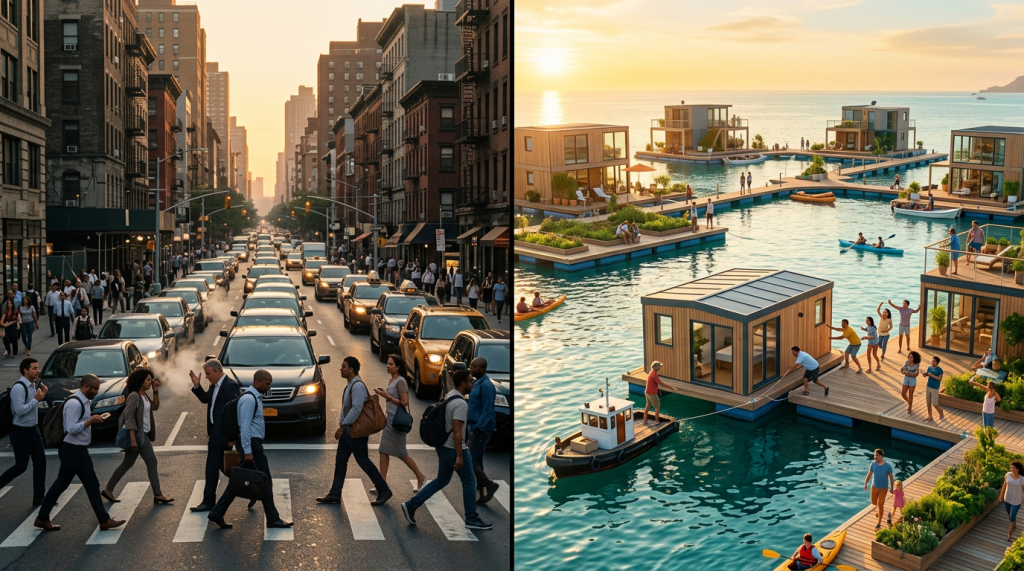
The research debate on the Floating Island project highlighted a central contradiction. The vision was to create self-organised, modular floating communities where residents could physically detach their homes and move if they disagreed with the community’s rules. In theory, this offered a powerful form of “voting with your feet.” In practice, the project remained heavily dependent on French Polynesia and the French state for legal protection, immigration processes, physical security, and critical infrastructure such as undersea internet cables.
This doesn’t invalidate the experiment. It shows that creating genuinely new forms of governance is far more complex than simply declaring autonomy. Most ambitious projects still need to operate within – or alongside – existing legal, economic, and security frameworks, at least during their early stages. Complete independence remains extremely difficult with current technology and global systems.
Lesson 2: New developments on water are never blank slates
One of the clearest points to emerge from the week is that floating cities cannot be treated as empty spaces where anything is possible. Legally, both international waters and territorial waters are already governed by treaties, regulations, and national laws. Environmentally, the ocean is already a living system filled with species, ecosystems, and existing human uses such as fishing routes and traditional practices.
Nathalie Mezza-Garcia stressed that the real opportunity – and responsibility – is not simply to avoid causing harm, but to design projects that can actively improve marine environments. This might include creating new habitats for marine life or improving water quality around the structures. The lesson is that every intervention happens within an existing context, and ignoring that context is both unrealistic and potentially damaging.
Lesson 3: A quiet shift is underway toward bottom-up and entrepreneurial city creation
Across both episodes, we saw growing interest in what are sometimes called startup societies – small-scale experiments in governance where new rules are tested in specific locations, often initiated by private actors, communities, or public-private partnerships rather than national governments. These can include floating developments, special economic zones, digital economic zones, and intentional communities.
The underlying idea is to apply a startup approach to governance: begin small, learn quickly from what works and what doesn’t, and scale successful models. This represents a meaningful departure from the traditional model in which governments plan and deliver new urban areas from the top down. It also raises important ongoing questions about accountability, fairness, and whose interests are ultimately served.
Lesson 4: The future of governance may be heterarchical rather than strictly hierarchical
Nathalie Mezza-Garcia introduced the useful concept of heterarchy – a system in which multiple overlapping layers of governance coexist, rather than one single hierarchy dominating a territory. In this model, people might simultaneously be subject to local community rules, national laws, digital platform agreements, and voluntary contracts.
This already reflects the reality for many people who move between countries, belong to online communities, or participate in both physical and digital spaces. The idea challenges the long-held assumption that one government must hold ultimate authority over a defined area. Instead, we may see more fluid arrangements in which people have greater ability to choose – or move between – different sets of rules, provided the systems are designed to allow that movement.
Lesson 5: Technical and legal innovation is not enough without genuine stakeholder alignment
Perhaps the most consistent lesson across both the research debate and the interview was that good ideas frequently fail when they do not adequately account for history, culture, local communities, and politics. The original Floating Island project in French Polynesia encountered strong local opposition, partly because it did not sufficiently understand or respect the deep cultural relationship local people have with the ocean, nor the region’s history of colonisation.
By contrast, Nathalie Mezza-Garcia shared a more positive example from her work on the Catawba Digital Economic Zone, where sustained, respectful engagement with the local Indigenous community made a meaningful difference to the project’s reception and operation. The broader lesson is clear: building new cities or new governance systems is as much a social and political task as it is a technical or legal one. Without meaningful alignment with the people already living in and around a place, even well-designed projects are likely to face serious resistance.
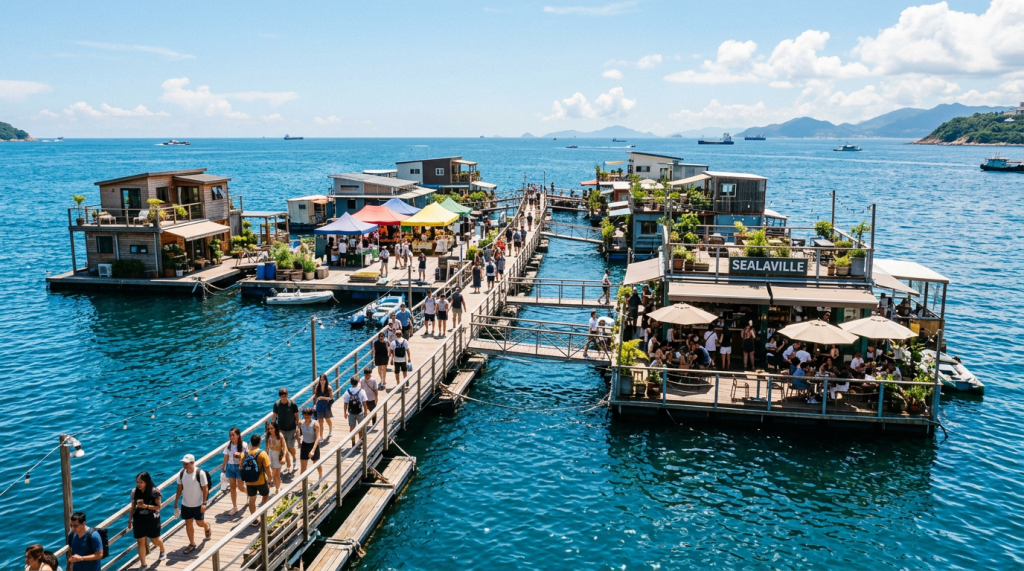
Taken together, these lessons suggest that floating cities, startup societies, and other new governance experiments offer real possibilities for more adaptable and responsive ways of organising communities. At the same time, they are not simple solutions. They operate within existing legal, environmental, economic, and cultural realities, and they succeed or fail based on far more than the quality of their technical design.
The most promising path forward appears to be one that combines genuine innovation with humility, deep local engagement, and a willingness to adapt when confronted with political and social realities. If we want these experiments to contribute positively to the future of cities, we will need to pay close attention not only to what is technically possible, but also to what is socially and politically sustainable.
Next week we are discussing, housing affordability and capacity, and land-use and zoning reforms with Keith Cooke!
Share your thoughts – I’m at wtf4cities@gmail.com or @WTF4Cities on Twitter/X. Subscribe to the What is The Future for Cities? podcast for more insights, and let’s keep exploring what’s next for our cities.


Leave a Reply