
What if most of what we think we know about planning successful cities is actually getting in the way of their success?
This week on the What is The Future for Cities? podcast we investigated one of the most important – and often misunderstood – ideas in urbanism: that cities are, at their core, labour markets.
On Tuesday in episode 429R we explored this concept through a research debate based on Alain Bertaud’s chapter “Cities as Labour Markets” from the book Order Without Design: How Markets Shape Cities. Then on Thursday we had the privilege of speaking directly with Alain Bertaud himself in episode 430I. Across both episodes, a clear picture emerged: successful cities are not primarily the result of brilliant master plans. They are the result of millions of individual decisions, enabled by well-functioning labour markets and supported (but not over-controlled) by thoughtful planning.

Lesson 1: Cities are labour markets first – everything else is built on top of that
The research debate opened with a powerful analogy: an ant colony looks perfectly engineered, yet no architect designed it. It emerges from countless small decisions. Human cities, however, are often treated as if they require a master planner. The core argument from Bertaud’s work is that a city’s primary function is to connect people to economic opportunity. A well-functioning labour market – where people can access a wide range of jobs within a reasonable commute – is what creates the wealth that then funds everything else we love about cities: culture, amenities, innovation, and public spaces.
The research video highlighted a hard constraint: the roughly 60-minute commute limit. When planning fragments the labour market (through poorly located housing or jobs), it doesn’t just create traffic – it reduces productivity and opportunity. One striking data point stood out: a 10% increase in the number of jobs accessible within an hour can boost a worker’s productivity by around 2.4%. Cities that make it harder for people to reach jobs are, quite literally, making their residents poorer.
Lesson 2: Planners should be surveyors, not master builders
Alain Bertaud draws a clear distinction that challenges much of conventional planning education. He argues that the first job of planning is not to design the city in detail, but to clearly separate what is public from what is private. Planners, in his view, are more like surveyors. Their role is to define and protect public goods – streets, parks, views, and access to shared spaces – so that everyone can benefit from them. When planners try to control too much of the private realm (through overly prescriptive zoning or detailed land-use plans), they often reduce the very accessibility and flexibility that make cities dynamic.
Many well-intentioned plans fail not because planners lack intelligence, but because they try to do too much. They attempt to engineer outcomes instead of enabling the conditions for a healthy labour market to function.
Lesson 3: Projections are useful tools, but dangerous when turned into regulations
Bertaud explained that planners must constantly monitor reality because projections almost always turn out to be wrong. He gave a clear example: in the 1990s and early 2000s, electricity consumption per person was falling thanks to more efficient appliances. Planners could have reasonably projected stable or declining demand. Then came computers, data centres, and now AI – and demand patterns shifted dramatically.
The danger, he emphasised, is treating a projection as a fixed rule. Once you say “we projected X, therefore we will regulate Y”, you lose the ability to adapt. Good planning requires humility: make projections, but review them regularly and adjust infrastructure and policy as new information emerges. Rigidity, not uncertainty, is often the bigger threat to cities.
Lesson 4: A real labour market is defined by the freedom to change jobs
Bertaud offered a sharp definition that stayed with us: a labour market is not simply the existence of jobs. It is the ability of people to change jobs. He illustrated this with the Soviet Union, where unemployment was virtually non-existent, yet there was no real labour market. People were assigned jobs and often stayed in them for life. The result was competence without innovation – people did their jobs, but had little incentive or opportunity to move toward roles where they could be more productive or fulfilled.
This insight connects directly back to Lesson 1. A city only delivers the full benefits of agglomeration when workers can match their skills to opportunities across the entire urban area. When regulations, poor transport, or rigid housing markets trap people in the wrong locations or the wrong jobs, the labour market becomes fragmented – and the city becomes less productive and less attractive.
Lesson 5: The most valuable things in cities often emerge from spontaneous order, not top-down design
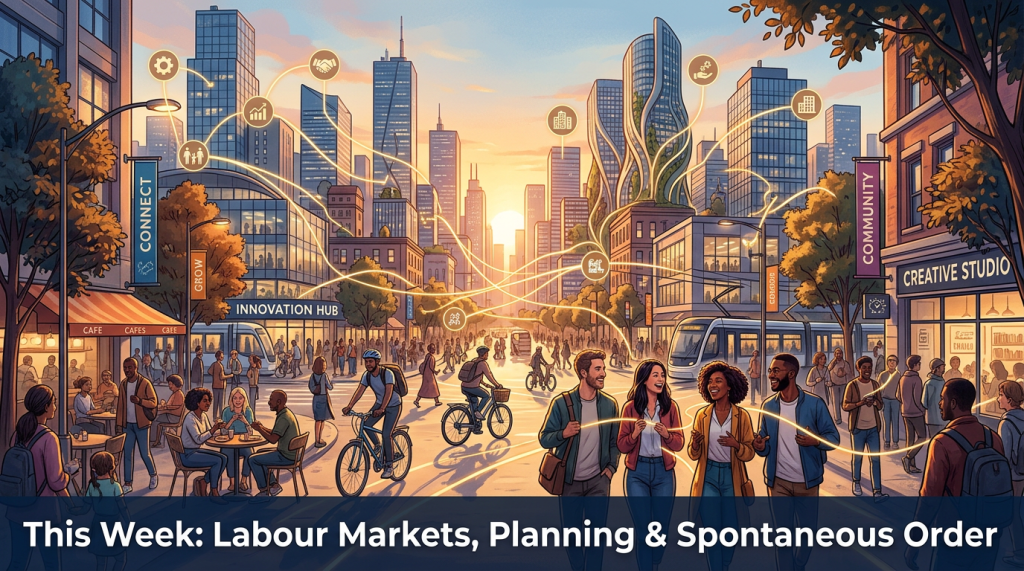
Across both the research debate and the full interview, one theme kept returning: cities thrive when they allow space for spontaneous order and serendipity. Bertaud repeatedly stressed that we should observe what people are actually doing before intervening. Young people moving to larger cities, even when planners wish they would stay in smaller ones, is not a problem to be solved – it is information. People are voting with their feet based on where they see the best opportunities and the richest networks.
He also highlighted the importance of randomness: the unplanned encounters, the conversations that happen because people are physically close, and the ideas that emerge when different specialisations collide. These things are difficult to plan for, yet they are central to why cities have been engines of progress for centuries.
This doesn’t mean planning has no role. It means planners should focus on enabling conditions (good mobility, clear public-private boundaries, adaptable infrastructure) rather than trying to dictate exact outcomes.

This week reinforced a consistent message from Alain Bertaud’s work: the health of a city is best measured by how well it functions as a labour market and how easily people can connect with opportunity and with each other. Overly ambitious master plans often fail because they underestimate the complexity of human decisions and the speed at which technology and preferences change. At the same time, completely hands-off approaches can lead to fragmented cities where the poorest residents are pushed to the periphery and cut off from jobs.
The most effective path seems to lie in humble, observant planning – one that protects public goods, maintains mobility, monitors reality, and leaves enough freedom for the spontaneous order of the market and civil society to do what it does best.
If this week’s episodes taught us anything, it is that cities are not problems to be solved by experts alone. They are complex, adaptive systems powered by the choices of millions of people. Our job, as planners, policymakers, and citizens, is to create the conditions where those choices can lead to better outcomes for everyone.
Next week we are discussing floating cities and start-up societies with Nathalie Mezza-Garcia!
Share your thoughts – I’m at wtf4cities@gmail.com or @WTF4Cities on Twitter/X. Subscribe to the What is The Future for Cities? podcast for more insights, and let’s keep exploring what’s next for our cities.


Leave a Reply