
What if instead of building ever-higher walls to keep water out, we designed our homes and cities to rise gracefully with it?
This week on What is The Future for Cities? podcast we explored exactly that question through two episodes. Episode 427R delivered a lively research debate on the 2016 paper “Thriving with Water: Developments in Amphibious Architecture in North America” by Elizabeth English, Natasha Klink, and Scott Turner. Episode 428I then brought us a deeply moving conversation with Elizabeth English herself – founder of the Buoyant Foundation Project, professor at the University of Waterloo School of Architecture, and one of the world’s leading voices on climate-adaptive housing. Together, these episodes didn’t just teach us about a clever building technique. They offered a profound philosophical and practical reorientation: what if water is not our enemy to be conquered, but a partner we must learn to live with?
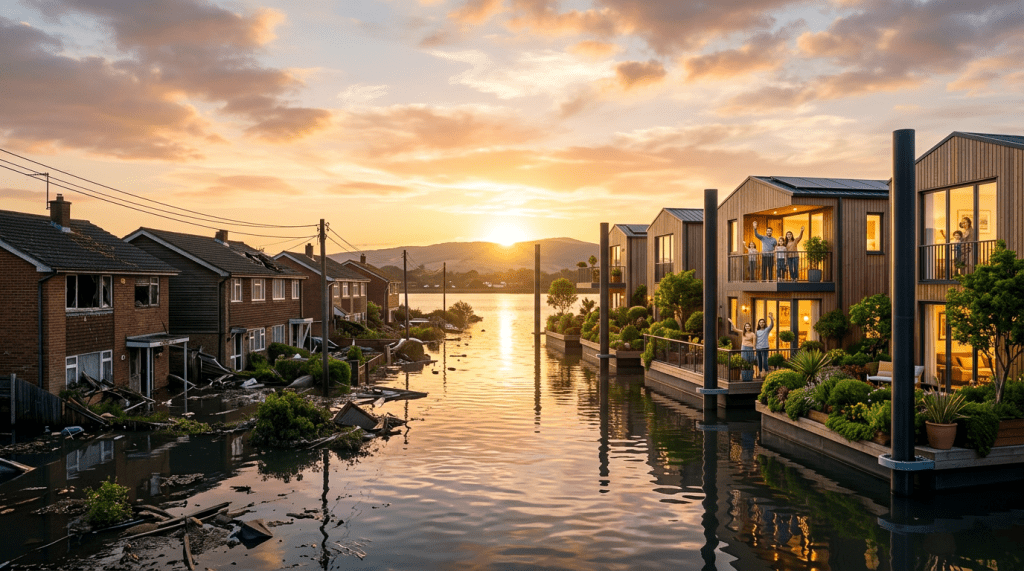
Lesson 1: Why fighting water is a losing battle – and what to do instead
For centuries, flood management has followed a “control and conquer” model: massive levees, rigid flood walls, and houses permanently raised on stilts. The assumption was simple – keep water out at all costs. Yet as sea levels rise and extreme weather intensifies, this approach is proving not just inadequate but dangerously flawed. Levees fail (there are only two kinds, as the old saying goes: those that have failed and those that will fail). Static elevation creates dangerous wind uplift, turning homes into sails. And entire communities are repeatedly traumatized or forced to relocate.
Elizabeth English articulates this alternative with quiet conviction: we must stop trying to put “chains on the water.” Instead, we should get out of the way and work collaboratively with it. Amphibious architecture embodies this philosophy. These are not houseboats. They are ordinary homes that remain firmly on dry land until a flood arrives – at which point they rise safely on vertical guidance posts, protecting both the structure and everything inside.
This shift has profound implications for urban planning. Instead of viewing water as an enemy to be defeated, we can see it as a partner – sometimes challenging, but ultimately a source of life, livelihood, and even spiritual connection, as indigenous perspectives reveal.
Lesson 2: Static elevation is dangerously flawed
The 2016 paper and the debate explored in episode 427R highlight the urgency of rethinking flood resilience. Historically, humans have settled in floodplains for fertile soil, river transportation, and moderate climates – we cannot simply abandon these regions. The default adaptation strategy of static elevation (raising houses permanently on stilts) has a fatal flaw: wind vulnerability. When a house is raised 10 feet, wind rushes underneath and creates massive uplift, essentially turning the structure into an airplane wing. Data shows that increasing roof height from 3 meters to 10 meters raises expected annual wind loss by 66%.
Amphibious homes avoid this by staying low to the ground most of the time. The retrofit process involves excavating underneath existing floor joists, inserting a sturdy steel subframe packed with buoyancy blocks, and securing the corners to deep-driven vertical guidance posts. When a flood hits, the house slides vertically up those posts and floats on the water, then drops precisely back into place when the water recedes. Flexible coiled utility lines (like umbilical cords) stretch and retract to maintain power, water, and sewage without damage.
The debate also addressed real concerns such as heavy debris during dynamic floods, but the guidance posts are engineered with high-strength steel and reinforced housings to withstand extreme lateral impacts. The cost of inaction is staggering – over the last 20 years floods have displaced 1.1 billion people and caused $1.65 trillion in damages – making proactive, adaptable solutions not just desirable but essential.
Lesson 3: Your house doesn’t have to be a boat to survive a flood
One of the most reassuring and practical insights from the interview is this: it’s not permanently floating. It floats only when there’s a flood there. The rest of the time, it’s an ordinary house.
This design choice is deliberate and powerful. Families continue living normal daily lives – walking on solid ground, enjoying street-level access, and maintaining the familiar character of their neighbourhood – until the moment protection is needed. When the water rises, the home lifts safely above the surge, keeping possessions dry and intact. When the water recedes, everything returns exactly to its original position with no lasting disruption.
This approach dramatically reduces the trauma that comes with traditional flood responses. There is no need to constantly live elevated, no permanent change to the streetscape, and no forced relocation. It offers protection without sacrificing liveability or community identity. The research and interview both emphasize that this “ordinary house most of the time” quality is what makes amphibious architecture not just technically clever, but genuinely humane.
Lesson 4: Disasters aren’t natural – they’re the result of our own choices
Perhaps the most powerful reframing came from Elizabeth English herself. “Disasters are not natural. Nature creates hazardous events, but these hazards become disasters because of the choices that we have made to put ourselves in jeopardy.”
This single sentence shifts everything. It removes the fatalism that often surrounds climate discussions and replaces it with agency and accountability. We choose to build on fertile floodplains, scenic coastlines, and riverbanks because those places are wonderful. The problem is not the water – it is the mismatch between how we have built and how water naturally behaves.
This perspective carries profound implications for justice. The communities hit hardest by repetitive flooding – often indigenous, low-income, or otherwise marginalized – are frequently the very populations that contributed least to climate change. Elizabeth’s work prioritizes these groups, not as passive recipients of aid but as active partners in designing solutions that protect both lives and continuity of place.
Lesson 5: Building resilience that actually works
For cities already locked into centuries of levees, flood walls, and control infrastructure, the path forward is not to tear everything down overnight. It is to integrate adaptive, nature-based solutions while listening deeply to those who have lived in relationship with water for millennia.
This same wisdom informs how we make resilience truly accessible. A major barrier has been cost and regulation, but the episodes offered inspiring solutions that dramatically lower the barrier. In Bangladesh and Vietnam, projects replace expensive imported EPS foam with thousands of recycled plastic water bottles bound into buoyancy blocks. Steel gives way to locally harvested bamboo. Communities contribute “sweat equity” labour. Costs drop to roughly $14,000 CAD while creating local jobs and drawing on the ingenuity already present in these places.
These are not second-best compromises. They are smart, practical adaptations that fit the specific environment and the local character and ingenuity of the communities living there. What works for a rice-farming village in the Mekong Delta is deliberately different from what works for a community in Manitoba facing spring ice breakup. The episodes emphasized that true resilience is never one-size-fits-all – it must be shaped by the actual conditions on the ground and the people who will use these homes every day.
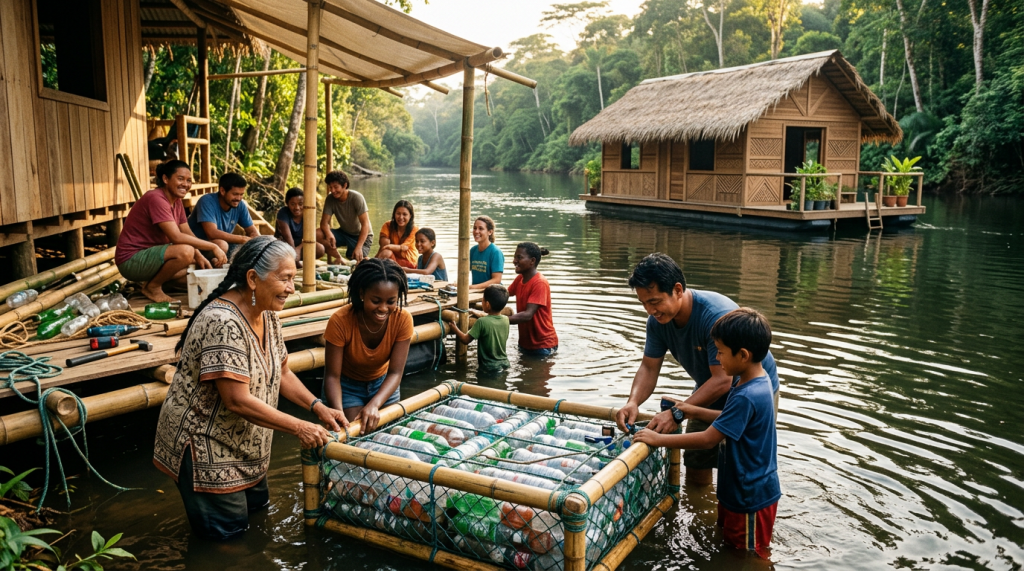
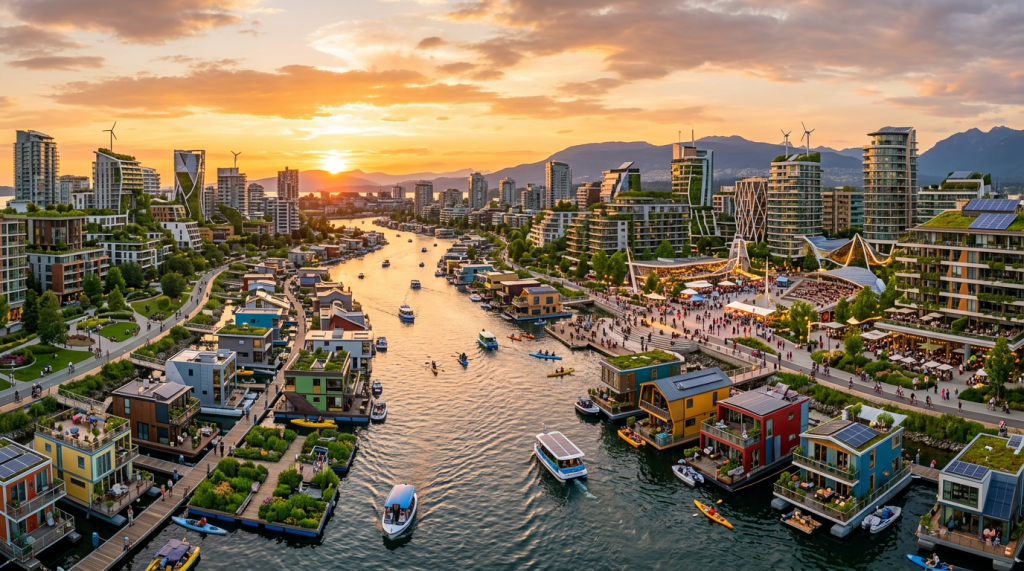
These five lessons converge on a clear, hopeful message. Amphibious architecture is not a universal fix, but it is a powerful, proven, and increasingly accessible tool. It preserves the dignity of place, protects the most vulnerable, and models the humility we need in an era of accelerating climate change. By leveraging local ingenuity and redesigning our built environment to move with rather than against water’s natural rhythms, we can create cities that do more than survive floods – they can thrive in partnership with the element that gives us life.
The technology exists. The ingenuity exists. The only question that remains is whether we will choose to listen and adapt – or continue pouring resources into strategies that have already proven they cannot hold back the tide.
What does living with water mean for the place where you live?
Are there neighbourhoods near you that could benefit from amphibious or adaptive design?
Have you witnessed the limitations of traditional flood defenses firsthand?
Next week we are discussing the importance of market-oriented urban development and labour markets with Alain Bertaud!
Share your thoughts – I’m at wtf4cities@gmail.com or @WTF4Cities on Twitter/X. Subscribe to the What is The Future for Cities? podcast for more insights, and let’s keep exploring what’s next for our cities.


Leave a Reply