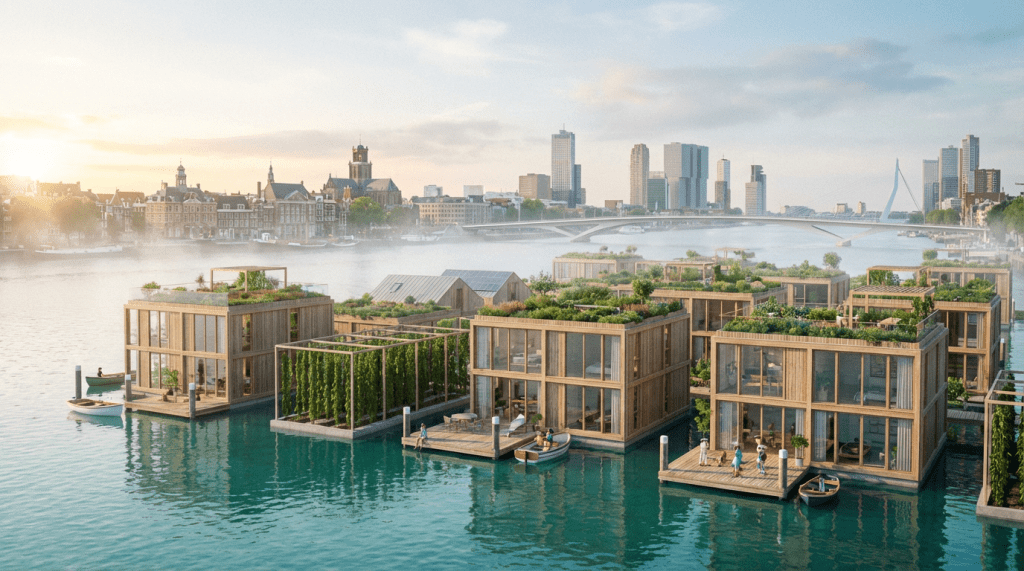
For the past week the What is the future for cities? podcast has lived entirely on water. Episode 383R brought a global data-driven debate about where floating urban development is needed most urgently based on the Potential of floating urban development for coastal cities article, from Barbara Dal Bo Zanon, Bart Roeffen, Karina Czapiewska, and Rutger de Graaf. Episode 384 delivered a masterclass with Rutger de Graaf, co-founder and managing director of Blue21, the Dutch company that has been designing and delivering floating projects for almost two decades.
Two episodes, dozens of built examples, and a mountain of fresh evidence later, five big insights stand out clearly about floating cities and communities.
1. At water depths greater than eight metres, floating is already cheaper than traditional land reclamation – and the crossover point keeps dropping
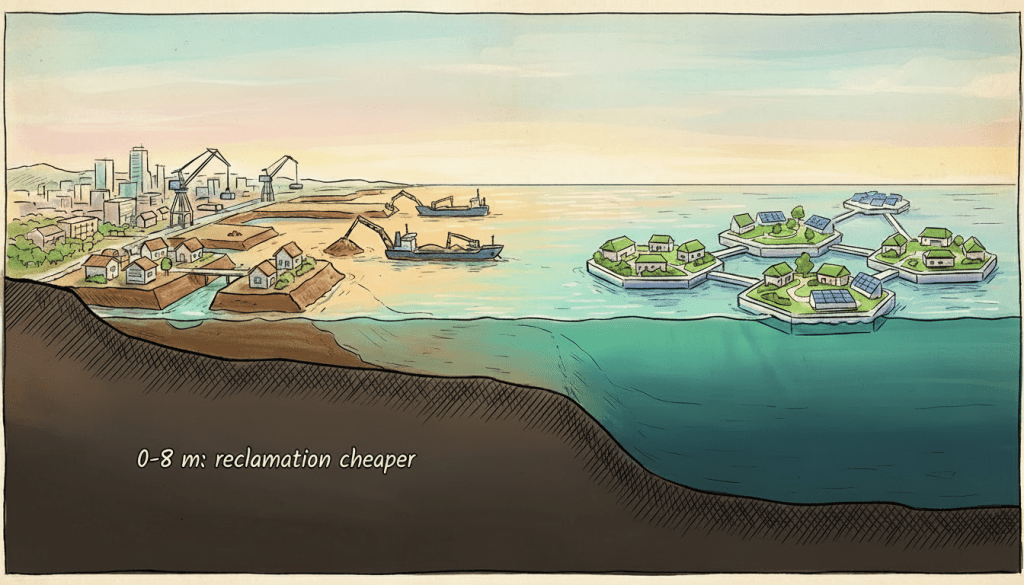
Coastal cities have historically expanded by mining marine sand and pumping it in front of the shoreline. That method is reaching its economic and ecological limits. According to current cost comparisons shared in the interview, when water depth exceeds roughly eight metres, a well-designed floating platform becomes the lower-cost option. More importantly, water carries almost no speculative land value. In many cities today the price of the plot can represent 50 % or more of a new home’s total cost. Remove that variable and even a platform that costs 5-10 % more to build than a conventional foundation still delivers a cheaper home. Scaling modular platforms and factory-built housing is pushing the numbers even lower, fast.
2. Floating districts can act as living breakwaters that protect existing land-based cities
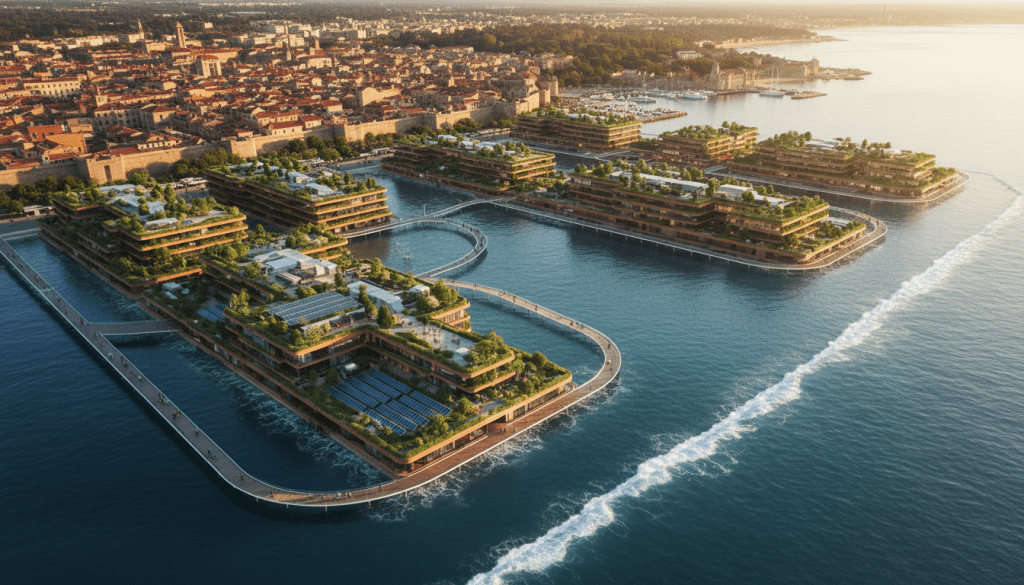
The most surprising revelation of the week was not that floating structures adapt to rising water – everyone expected that. The surprise was that properly placed floating communities can significantly reduce wave energy before it ever reaches the coast. During extreme storms it is the combination of higher sea level plus wave impact that breaches defences. A band of floating development absorbs much of that wave energy, meaning the old city behind it experiences far less storm surge pressure. Add integrated seaweed or algae systems and the same floating district starts sequestering CO₂ and improving water quality for the entire region.
3. Water offers a unique chance to escape the lock-in of centralised infrastructure and redesign urban systems from scratch
On land, new buildings are legally required to connect to century-old sewer, water and electricity networks. On open water there is no such legacy system. That blank slate has allowed projects to integrate decentralised solutions from day one: rainwater harvesting tanks under homes, small wastewater plants that discharge cleaner water than they take in, seawater batteries, rooftop food production, and modular energy storage. The result is a shift in citizenship itself. Residents move from being passive consumers who receive bills to active co-producers who own, operate and maintain critical systems together with their neighbours. Several projects in the Netherlands are already running exactly this way.
4. A global timing paradox exists: the cities facing the greatest urgency often have the least local expertise, while the places with expertise face far less immediate pressure
The multi-criteria analysis presented in episode 383R is uncompromising. Using only flood risk and population growth, Guangzhou, Mumbai and Lagos top the list of cities that need floating solutions most. Sixty-four percent of the highest-urgency locations are in Asia. The Netherlands does not appear in the top 25. Yet almost all maritime classification experience, building codes for floating structures, large-scale investment frameworks and proven supply chains are currently concentrated in north-west Europe. The research debate crystallised the dilemma: perfect complex, fully circular prototypes in low-risk, high-capacity locations and then transfer them – or deploy simpler, faster versions immediately where subsidence and sea-level rise are already catastrophic? Both positions are defensible; neither is comfortable.
5. Floating urban development may create one of the largest new job sectors of the century – blue-green jobs that are local, hands-on and hard to automate
While artificial intelligence threatens many existing roles, the construction, operation and harvesting of floating cities is generating entirely new categories of work: platform assemblers using local materials in the global south, aquatic farmers, underwater-drone technicians monitoring ecosystems, modular housing production workers, seaweed and algae processors, desalination technicians, and community energy managers. Rutger de Graaf calls them “blue-green jobs”. They are distributed rather than centralised, require human judgment and physical presence, and can be created in almost any coastal nation. In an era of technological unemployment, an emerging economic sector tied directly to climate adaptation offers a rare note of genuine economic hope.
After this week spent entirely on water, the overarching picture is no longer one of retreat or endless defence against the sea. Rising water levels are indeed locked in for decades regardless of future emissions. Yet the evidence now shows a third path: expanding onto the water in ways that can be more affordable, more regenerative, more socially empowering, and – almost incredibly – protective of the cities that already exist.
Real neighbourhoods are already operating, social-housing corporations are signing contracts, and mayors from Singapore to the Maldives are adding floating districts to their masterplans. The conversation has moved from “is this possible?” to “how do we make it fast enough and fair enough?”
Episodes 383R and 384 are both available now on every platform. If you only have time for one, start with 384 – it is 70 minutes of grounded vision that leaves most listeners more hopeful about climate adaptation than when they began.
So here’s the real question this week leaves us with:
If floating districts can be cheaper, greener, and actually shield existing coastal cities from storms – why are we still waiting to build them at scale?
Next week we are investigating new forms and experiments with governance, with Niklas Anzinger!
Share your thoughts – I’m at wtf4cities@gmail.com or @WTF4Cities on Twitter/X.
Subscribe to the What is The Future for Cities? podcast for more insights, and let’s keep exploring what’s next for our cities.


Leave a Reply