“A city isn’t an animal. It’s a star.”
That single line from this week’s research debate on Louis Bettencourt’s landmark paper stopped me in my tracks. It perfectly captures the shift in thinking we explored across two very different but deeply connected episodes of What is The Future for Cities? podcast. On Tuesday we unpacked the mathematical origins of scaling in cities in episode 421R. On Thursday, in episode 422I, we sat down with urbanist and futurist Greg Lindsay to talk about cities as engines of creative collisions. Together, they delivered one clear message: cities are not chaotic accidents of history. They are predictable, powerful, open-ended social reactors governed by physics-like laws and human possibility.
1. Cities follow universal scaling laws – and that changes everything
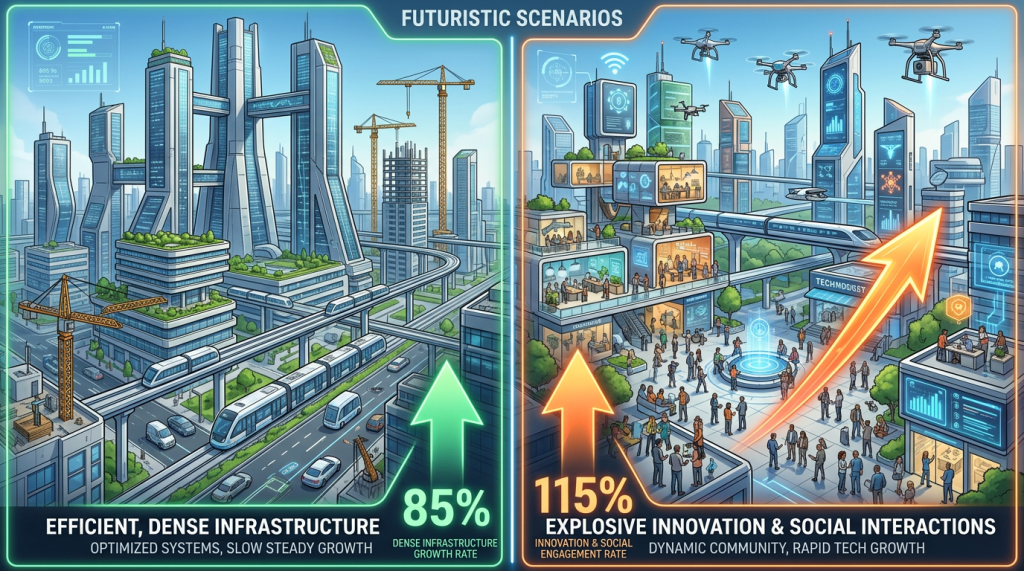
When a city doubles in population, you might expect everything inside it to double too. But Bettencourt’s data from over 3,600 cities worldwide shows something far more elegant. Physical infrastructure – roads, pipes, cables – scales sublinearly: you only need about 85 % more when the population doubles. Meanwhile, socioeconomic outputs – wages, patents, innovation, even social interactions – scale superlinearly: you get roughly 115 % more.
The research debate made this crystal clear: cities are not random collections of people. They are governed by strict, predictable network physics. Density creates efficiency in infrastructure while simultaneously accelerating the pace of human connection. This isn’t opinion – it’s mathematics that holds across cultures, histories, and continents. Understanding these laws gives us a diagnostic tool instead of guesswork when planning urban growth.
2. Cities are stars, not organisms – and that’s why they don’t die like living things
Traditional metaphors compare cities to biological organisms: veins as roads, heart as downtown. The problem? Organisms mature, plateau, and eventually die under their own metabolic weight. Cities do the opposite. As Greg Lindsay put it, echoing Bettencourt: cities are fusion reactors. Gravity (density) pulls people together; the friction of those collisions creates heat – ideas, wealth, innovation.
Biological systems evolve to minimise energy dissipation. Cities actively increase it to maximise social interactions. This is why bigger cities, when infrastructure keeps up, don’t collapse – they keep getting better. Higher wages, more patents, greater opportunity. The superlinear scaling we heard about on Tuesday is exactly what powers the “stupendous amounts of opportunity, variety, and serendipity” Lindsay described on Thursday. Cities are the only human settlement form that improves with scale.
3. The future of cities is maintenance and adaptive reuse, not endless new construction
We have more cities now than we will need in the coming decades, given global demographic trends. Lindsay was blunt: this is the final build-out phase of human urbanism. After this, our job is maintenance, repair, and thoughtful adaptation – especially in the face of climate change.
Most buildings in many countries are already in the “wrong” climate zone for the future they face. Rather than mindlessly producing more built environment (the “slaves at the mill” problem), we need extreme adaptive reuse, hyperlocal supply chains, and bio-regional thinking. Lindsay highlighted practical examples: passive-house retrofits, communal social spaces created by rethinking laundry rooms on rooftops, and turning existing structures into fit-for-purpose buildings. The scaling laws reinforce this – once you hit certain density thresholds, adding more infrastructure becomes exponentially more expensive. Smart maintenance keeps the reactor running efficiently.
4. Serendipity is the ultimate urban superpower – and we can engineer more of it
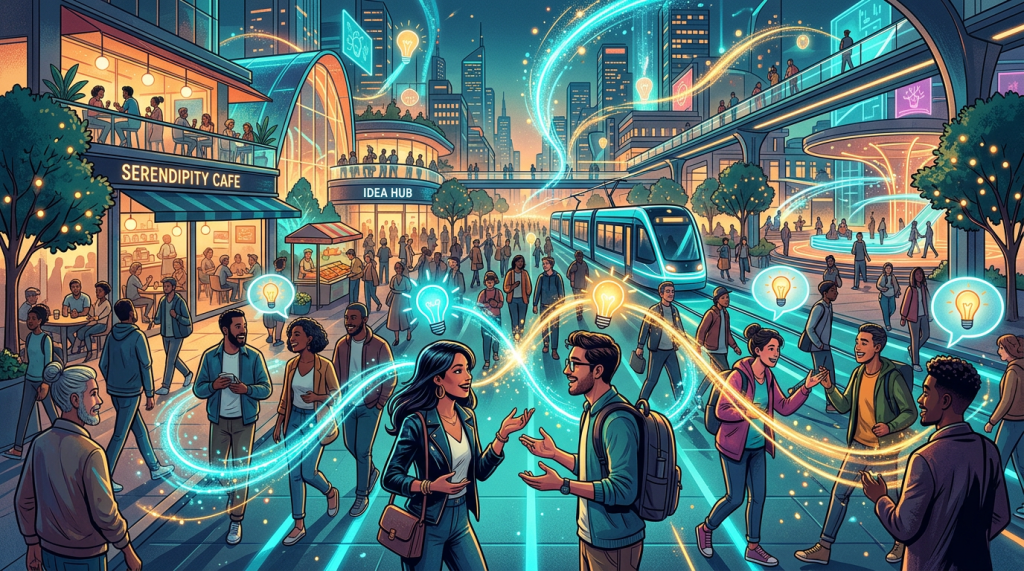
Lindsay’s favourite unwritten book title? Engineering Serendipity. Cities compress people in space and time through their networks, producing new connections that no one can plan in advance. This is the real value of urban life: the chance encounters, the creative collisions, the unexpected opportunities.
The Bettencourt paper gives this a mathematical backbone – superlinear scaling is the measurable result of those collisions. Lindsay took it further: how do we design 15-minute neighbourhoods that still connect to the full “galactic” scale of a city within 30–60 minutes? How do we create third places, new programming, and social norms that pull people off screens and into real-world interactions? In an age of loneliness epidemics and AI companions, maximising serendipity isn’t a nice-to-have – it’s the defining struggle of modern civilisation.
5. Abundance thinking must replace scarcity mindsets – or cities will fracture
Both episodes surfaced the same tension: spatial mismatch, bounded human effort, and the fragile limits of real people navigating real infrastructure. Some cities have “fantastic bones” yet underperform because human capital isn’t fully activated. Others push past their theoretical maximum (Gmax in Bettencourt’s terms) and start to fracture under mobility costs and inequality.
Lindsay challenged us to shift from scarcity politics – borders, NIMBYism, fear of newcomers – to abundance thinking. Reinvest in depopulating towns with great infrastructure by welcoming global talent. Prioritise quality of life and economic opportunity together. Recognise that cities should be places for everyone, not gated communities. The scaling laws show the physics works on average, but the outliers (Riverside, Bridgeport, countless shrinking towns) remind us that ignoring human limits and segregation at the neighbourhood level creates real suffering. The math doesn’t excuse us from equity – it demands we get the mixing population right.
This week’s episodes didn’t just describe cities – they gave us a new lens. We learned that urban evolution is neither random nor purely political. It is governed by elegant scaling laws, powered by human fusion, and sustained through deliberate maintenance and serendipity engineering.
So, when you look at your own city, are you seeing a chaotic scatter of puzzle pieces or the precise mathematical fusion of a human star?
Have you seen your city hit a scaling tipping point – or successfully engineer more serendipity?
The future of cities isn’t something that happens to us. It’s something we build together – one thoughtful collision at a time.

Next week we are discussing micromobility and urban transportation with Ben Wolf!
Share your thoughts – I’m at wtf4cities@gmail.com or @WTF4Cities on Twitter/X. Subscribe to the What is The Future for Cities? podcast for more insights, and let’s keep exploring what’s next for our cities.


Leave a Reply