
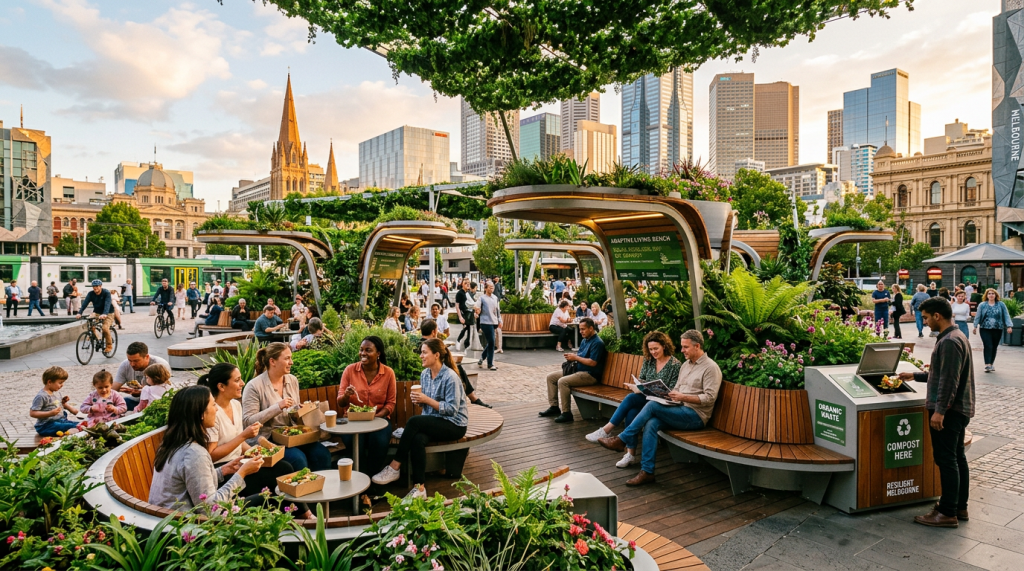
This week the What is The Future for Cities? podcast moved from big-picture African creative economies to the small but powerful scale of everyday street furniture. We examined how ordinary benches, shelters and bus stops can evolve into active participants in urban resilience in episode 417R and 418I. Rather than remaining passive objects, these elements can help cities manage heat, handle stormwater, cycle nutrients and strengthen community ties. The two episodes together painted a clear picture: the future of cities depends not only on grand infrastructure but on clever, multipurpose designs that make resilience part of daily life.
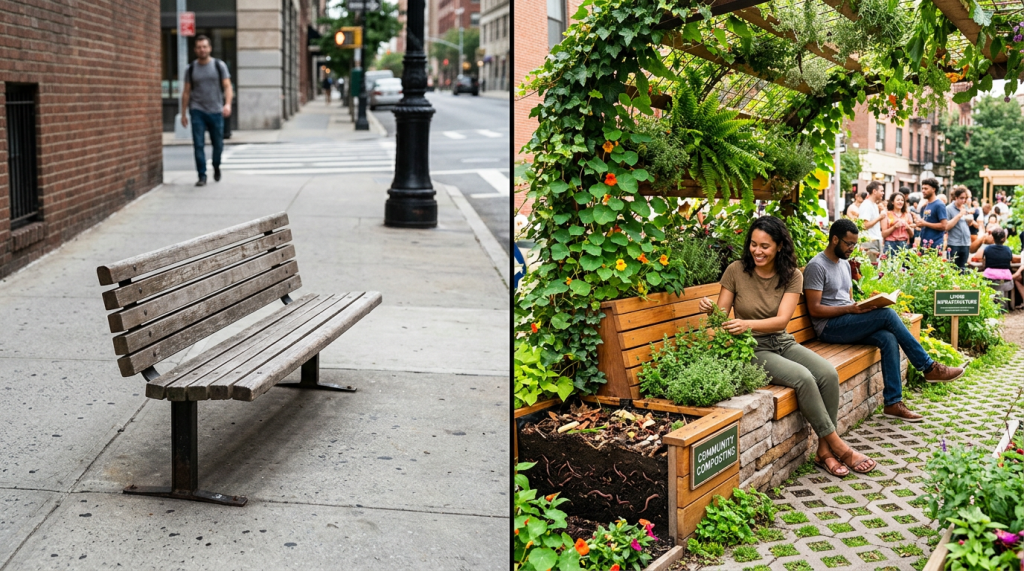
Debating adaptive urban furniture
Tuesday’s research episode (Ep 417R) centred on the 2025 paper by Dagmar Kuta and Viktor Mican, which explores adaptive urban furniture and its role in the climate resilience of public space. The debate was lively because of two clear pathways: a top-down institutional approach (standardised city-wide guidelines and modular systems) and a bottom-up community-driven model (temporary, participatory installations shaped by local residents).
One side argued that only institutional standardisation can deliver the scale and speed cities need. Urban heat islands turn streets into thermal batteries; a coordinated network of shading structures, evaporative cooling elements and stormwater-capturing planters is required to lower ambient temperatures across whole neighbourhoods. Standardised designs secure funding, fit within existing regulations and guarantee long-term maintenance contracts.
The opposing view countered that cultural acceptability is non-negotiable. When residents feel an object has been imposed from above, it risks vandalism and neglect. Community-led projects, such as the temporary parklets in Budapest’s Józsefváros district or participatory budgeting in Ostrava, create ownership. People look after what they helped design. The discussion highlighted a practical tension: high-tech solutions (IoT-enabled “city trees” with moss filters) can cool air by several degrees but often feel alien. Low-tech elegance, like the Belgian water bench made of porous concrete that passively absorbs 280 litres of rainwater and slowly releases it to plants, proves antifragile because it needs no electricity or complex maintenance.
However, what both sides agreed on was that public space is being redefined. A bench is no longer just somewhere to sit; it can become an active piece of living infrastructure that contributes to urban resilience.
The worm bench project and more with Zoe Wang
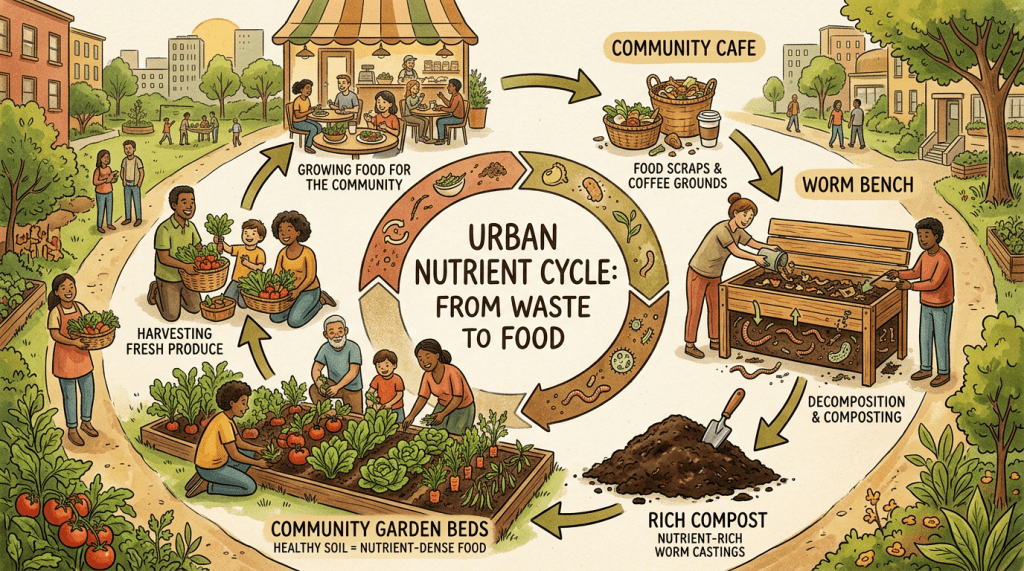
Thursday’s interview (Ep 418) brought the theory to life through Zoe Wang’s work as a landscape architect and urban designer. Wang is currently piloting the “worm bench” in Melbourne as part of the Fishermen’s Bend Digital Innovation Challenge. The bench integrates outdoor seating with a composting system: residents or nearby cafés feed food scraps into enclosed worm farms, sensors track moisture, temperature, pH and odour, and a real-time dashboard tells users exactly what the living system needs. The resulting compost feeds adjacent garden beds that provide shade, grow food and create gathering spots.
Wang explained that cities currently operate extractive systems: waste bins, trucks and distant landfills move nutrients out of the city while farms suffer soil degradation. The worm bench closes that loop locally. One piece of street furniture replaces multiple single-purpose systems, using the same amount of material and space far more efficiently. It turns waste into soil, supports planting, offers shade and becomes a social hub—all at once.
Importantly, the design addresses common objections to composting in public space. The worms stay hidden in darkness, double enclosures and careful layering prevent odours, and the bench looks like ordinary street furniture from a distance. After three months of testing, nearby businesses and residents reported no smell and easy adoption. Zoe emphasised that the sensors remove uncertainty, translating complex living processes into simple instructions that anyone can follow.
The challenge of the transition period
Both episodes returned repeatedly to the same uncomfortable reality: the transition between today’s extractive cities and tomorrow’s resilient ones will be difficult. Wang was candid that while she is hopeful humans will adapt, the in-between period will bring real suffering—extreme heat affecting outdoor life in Melbourne, shifting food and water security, and rapid technological change that can leave people feeling disconnected. AI and sensing technologies offer tools, but they do not magically smooth the social and emotional costs of change.
The research debate added another layer: even the best adaptive furniture can fail if maintenance lapses or if communities reject it. Institutional models struggle with bureaucracy and rigid regulations; community models risk fading enthusiasm once the initial excitement passes. The episodes suggested that resilience is not automatic. It requires deliberate design choices that make regenerative behaviours easy, beautiful and routine rather than extra effort.
Practical roles for designers, communities and technology
The clearest practical lesson came from Zoe’s reflection on the designer’s role. Landscape architects and urban designers can embed ecological processes directly into everyday spaces so that caring for the city becomes part of normal routines. They can make worm farms look like elegant benches, turn stormwater management into attractive garden beds, and ensure living systems feel welcoming rather than confronting.
Technology helps here—not as flashy gadgets but as quiet enablers. Sensors and dashboards reduce the guesswork of maintaining living infrastructure. At the same time, community participation creates antifragility: when residents help choose and care for a bench, they become stewards rather than passive users. The worm bench pilots succeeded because businesses, residents and collaborators all stepped forward with energy and local knowledge.
Wang’s closing message was hopeful and grounded. Each of us, whatever our role, can shape the transition in small but meaningful ways. When we design with nature’s cycles, collaborate across sectors and make regenerative choices accessible, even a difficult journey can become a beautiful one.
This week reinforced a single powerful idea: the smallest pieces of urban furniture can carry outsized responsibility for city-wide resilience. A bench that composts, shades and gathers people is no longer a luxury; it is infrastructure as important as roads or pipes. The episodes (417R and 418I) showed that success depends on balancing scale with acceptance, technology with simplicity, and top-down direction with bottom-up ownership. The worm bench in Melbourne is still a pilot, yet it already demonstrates what is possible when design, ecology and community align. As more cities face hotter summers, heavier rains and tighter resource constraints, adaptive urban furniture offers a practical, scalable path toward antifragile public spaces that work with nature instead of against it.
Have you seen clever multipurpose furniture where you live?
What small change in your own neighbourhood could make public space more regenerative?
Next week we are debating green growth with degrowth, with the help of Josh Dorfman!
Share your thoughts – I’m at wtf4cities@gmail.com or @WTF4Cities on Twitter/X. Subscribe to the What is The Future for Cities? podcast for more insights, and let’s keep exploring what’s next for our cities.
 What is The Future for Cities? Podcast
Leave a comment