This week on the What is The Future for Cities? podcast we examined one of the most practical and urgent questions for coastal urban areas: when the water is rising, should we keep building ever-higher concrete walls (grey infrastructure) or pivot to living, growing systems like dunes and mangroves (green infrastructure)? Episode 411R debated Haoluan Wang’s 2025 study that uses real cost-benefit ratios and public willingness-to-pay data from South Florida. Episode 412I brought landscape designer Louis de Jaeger, from the Commensalist, into the conversation, expanding the discussion from coastal protection to city-wide regeneration through food forests and layered nature. Together the episodes delivered a clear, evidence-based message: green and regenerative approaches are not just nicer for the environment — they are often the smarter economic and practical choice.
Lesson 1: Green coastal infrastructure frequently delivers superior economic returns
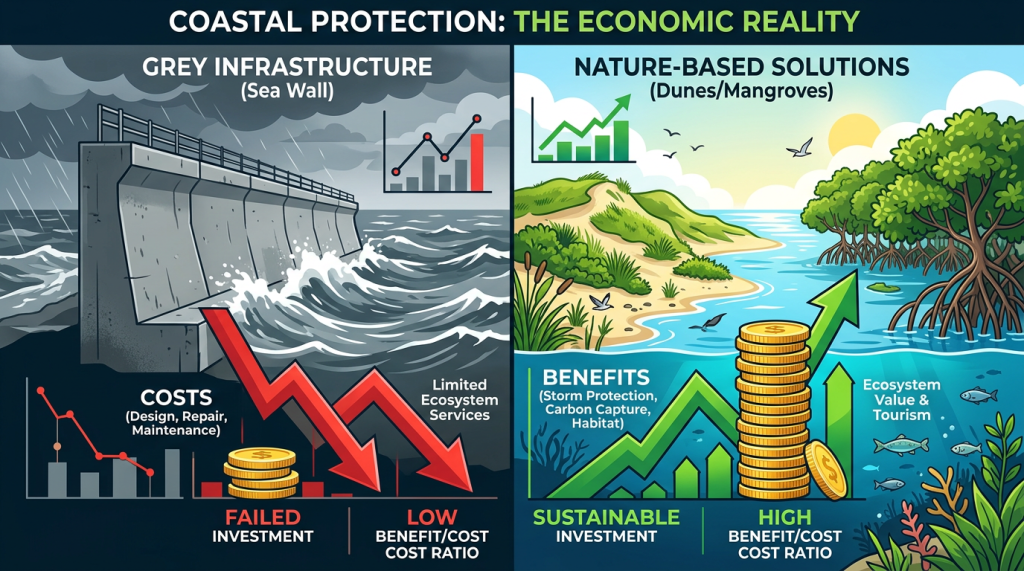
Wang’s study compared benefit-cost ratios (BCR) over a 50-year lifespan for coastal adaptation in South Florida. Coastal dunes stabilized by vegetation achieved a BCR of 5.64. Mangroves came in at 4.7. Traditional sea walls managed only 2.02. For every dollar spent on dunes, society gets nearly six dollars back in flood protection plus ecosystem services. The public is also willing to pay significantly more in taxes for green options — about $63 extra per year compared with grey. Construction costs tell the same story: dunes cost roughly $2 million per mile while sea walls run close to $8 million. The numbers make it hard to argue for concrete as the default.
Lesson 2: Bringing nature back in multiple layers heals nature deficit disorder and boosts daily livability
Louis de Jaeger explained that humans suffer from nature deficit disorder — we have become so disconnected that we now need scientific studies to prove what our bodies already know: nature is good for us. The key insight is layers. A single wall of trees helps, but multiple layers (ground cover, shrubs, small fruit trees, taller canopy) create far greater benefits: cooling, biodiversity, productivity, even higher spending in shopping streets with trees. Cities like Medellín lowered temperatures by 2°C simply by planting millions of trees.
Lesson 3: Food forests are long-term regenerative infrastructure that keep giving for generations
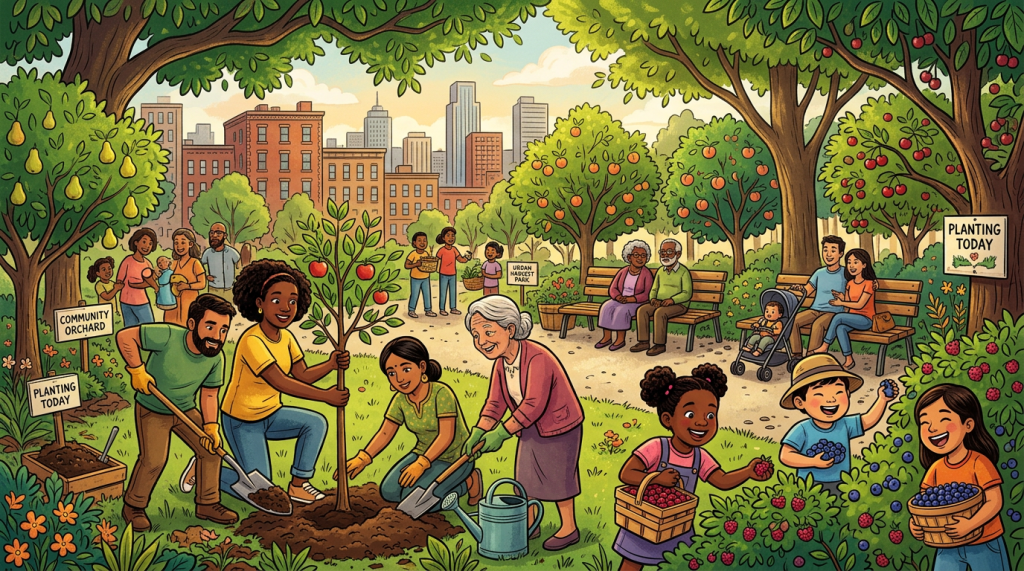
A food forest, once planted, becomes an appreciating asset. Unlike annual vegetable gardens that require constant replanting, a well-designed food forest can produce for your lifetime and your grandchildren’s. It works in vertical layers — strawberries at ground level, berry bushes, small fruit trees, larger nut trees — maximising sunlight and creating a self-sustaining system. In cities this means edible parks, school grounds, and street plantings that provide free food, community connection, and resilience. De Jaeger showed examples where strawberry bushes planted next to a police station turned strangers into friends through shared harvesting.
Lesson 4: True regeneration creates systems that improve and grow stronger over time
Sustainability often means “maintain the status quo.” Regeneration means systems that actually get better. De Jaeger gave the perfect coastal example: a mangrove forest. Plant the seeds (almost free), and every year the trees grow taller, roots deepen, sediment accretes, and storm protection improves. A sea wall starts degrading the day concrete is poured. Mangroves and dunes become more effective with time if properly managed. This is the definition of an appreciating asset rather than a depreciating one.
Lesson 5: Local action and a village mindset turn regeneration from theory into reality
Both episodes ended on hope through action. The research showed public willingness to pay for green solutions when people understand the co-benefits. De Jaeger stressed that the antidote to feeling overwhelmed is small, visible steps: plant one food tree, turn a school ground into an edible garden, replace a parking spot with a fruit tree. He wants cities to feel like villages — walkable, green, connected, where you can step out in your bathrobe for fresh eggs or fruit. That village feeling, layered with regenerative nature, creates the highest-ROI urban future possible.
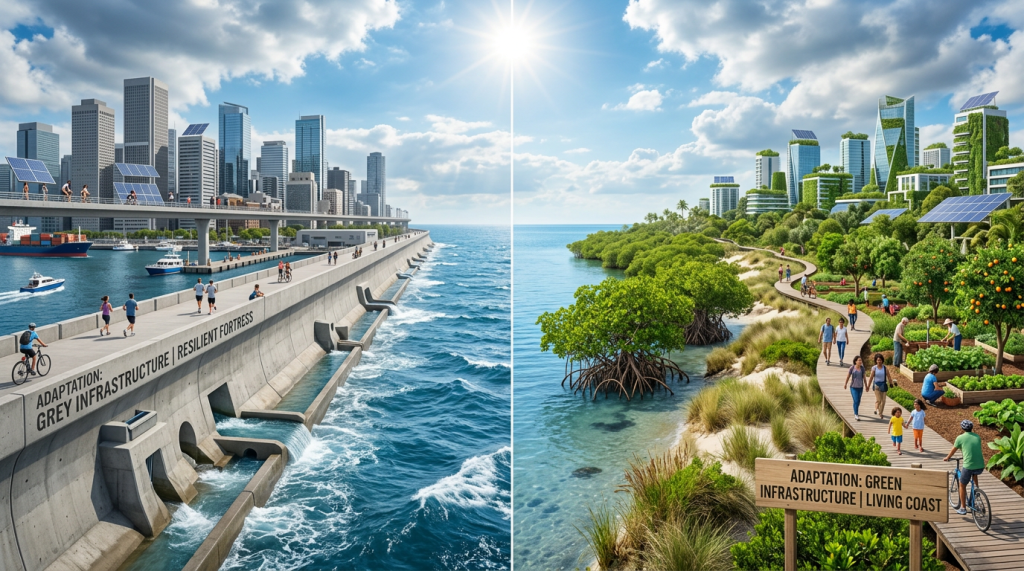
This week replaced the usual grey-vs-green standoff with a practical roadmap: green and regenerative approaches are not idealistic luxuries — they are often the higher-return, longer-lasting, and more livable choice. Coastal cities that choose dunes and mangroves over endless concrete get better flood protection plus recreation, cooling, and biodiversity. Cities that plant food forests and layered nature get resilience, community, and daily joy.
The water is rising and the concrete walls are cracking. The data and the lived examples both point the same way: regeneration is the smarter investment.
The future belongs to the cities brave enough to plant instead of pour.
What’s one small regenerative step you could take — or push for — this month?
Next week we are investigating autonomous vehicles with Cormac McKay!
Share your thoughts – I’m at wtf4cities@gmail.com or @WTF4Cities on Twitter/X.
Subscribe to the What is The Future for Cities? podcast for more insights, and let’s keep exploring what’s next for our cities.
 What is The Future for Cities? Podcast
Leave a comment