This week on the What is The Future for Cities? podcast we examined one of the most practical and hopeful questions in urban and business thinking: can doing good for the planet actually drive real financial success? Episode 407R debated Jasper Steinhausen’s book Making Sustainability Profitable, mapping the journey from costly compliance to genuine value creation. Episode 408I brought Steinhausen himself into the conversation for a wide-ranging interview on cities as the real engine of progress. The two episodes together delivered a clear message: the green transition is no longer a luxury tax – it is one of the biggest opportunities of our time if we approach it with the right mindset and local courage. Here are the five key lessons that stood out.
Lesson 1: The impact curve shows sustainability can move from cost to profit driver
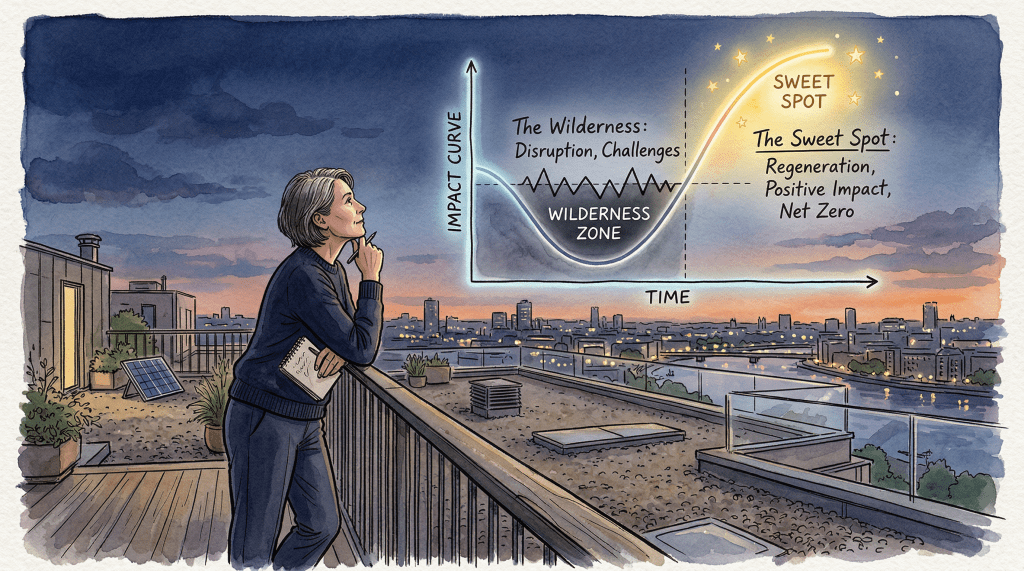
Steinhausen’s impact curve is the central framework. On the left is “business as usual” – low impact, standard returns. As organisations try to become greener they enter the “wilderness”: higher effort, little or no extra return, often even a dip in profitability. This is where most companies sit today, stuck in compliance and administrative burden. But the curve eventually rises sharply into the “sweet spot”, where circular practices deliver higher returns, innovation and resilience. The debate made it crystal clear: staying in the wilderness is the real risk, not the journey across it.
Lesson 2: Most organisations are trapped in the expensive “wilderness” of compliance
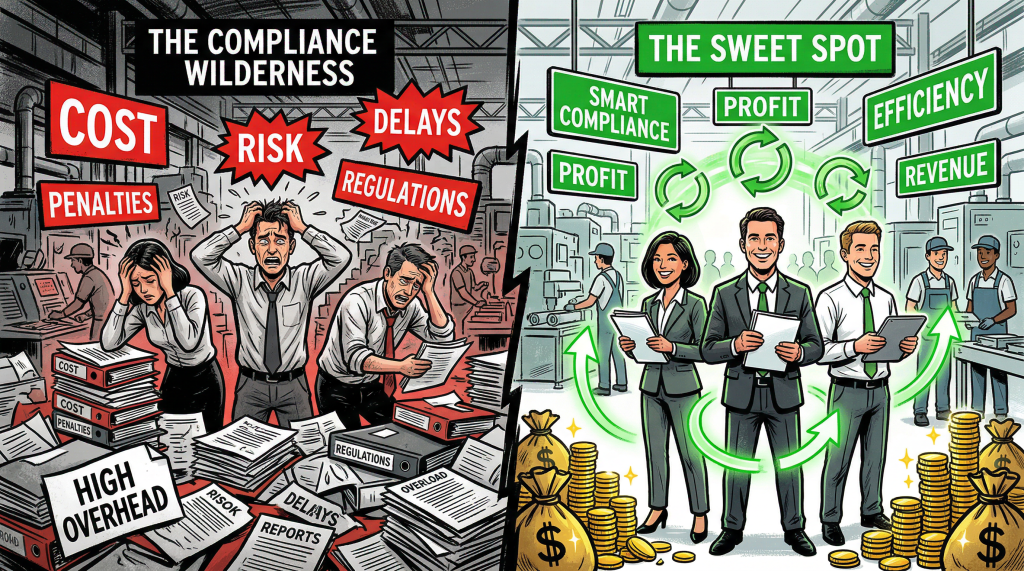
The wilderness is not a myth – it is the current reality for the majority. Companies invest in certifications, carbon accounting and “less bad” measures that create cost without creating customer value. Steinhausen calls these the “fatal five mindsets”, including the belief that green products must cost more. The lesson is blunt: compliance-only approaches drain resources and talent while delivering almost no competitive edge. The data from thousands of European SMEs shows that real circular shifts reduce costs and boost productivity, but only once leaders stop treating impact as a side project.
Lesson 3: Circular thinking turns waste into competitive advantage
Real examples proved the point. Fire Rich moved to 70 % post-consumer recycled plastic and built the world’s first closed-loop food-tray system, protecting themselves from virgin-plastic price swings. Oculus, a standard sign company, started reclaiming old aluminium signs and achieved its best financial year ever by cutting raw-material costs dramatically. These cases show that viewing waste as an asset is not idealism – it is smart supply-chain strategy. When you design for disassembly and recovery, costs go down and resilience goes up.
Lesson 4: Cities are the real engine of progress – the public-private dance
Steinhausen was clear: while national politics often stalls, cities are where bold, pragmatic action happens. They are closer to citizens, closer to results, and better at forming cross-party coalitions that actually deliver. He described a necessary “dance” between public foundations (basic research, regulation, long-term vision) and private entrepreneurship (turning ideas into market-ready solutions). Cities that understand this partnership move fastest.
Lesson 5: The antidote to feeling stuck is bold local action and a North Star vision
Steinhausen’s most inspiring message was simple: the antidote to depression is action. When we shift from “how do we minimise harm?” to “how do we create positive impact?” everything changes. We stop arguing about who carries the burden and start asking who gets the benefit. He called for a clear North Star – a compelling vision of greener, healthier, smarter, cheaper and safer cities – that gives everyone a reason to move. Local action, even small steps, builds momentum and hope faster than waiting for perfect national plans.
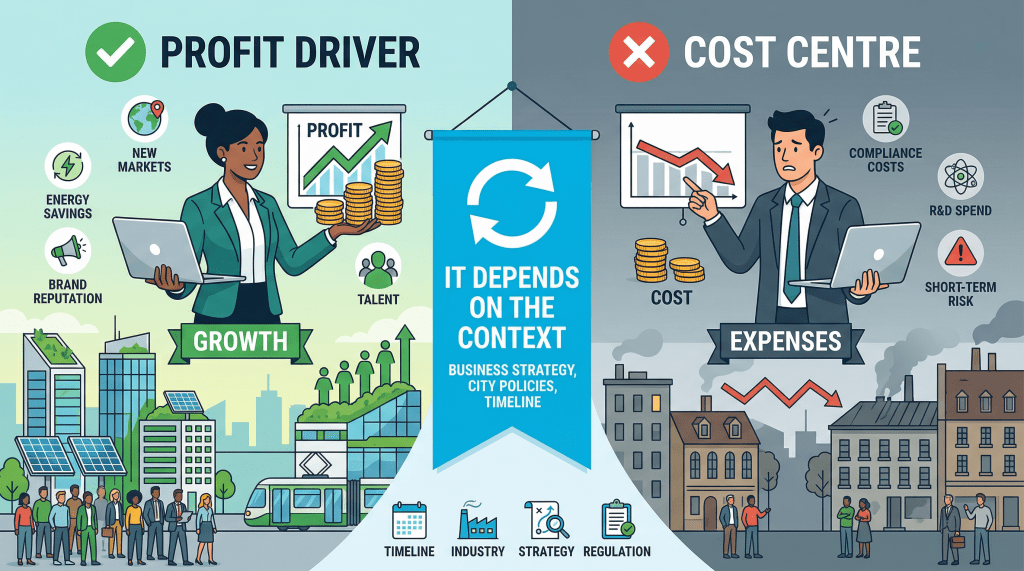
This week’s episodes replaced the usual doom-and-gloom narrative with something far more useful: a practical roadmap. Sustainability can be not a cost centre or a moral luxury – it can be a powerful platform for innovation, cost reduction, talent attraction and genuine competitive advantage. The wilderness is real, but so is the sweet spot on the other side. Cities are perfectly placed to lead the crossing because they can combine public vision with private agility. The only question left is whether we choose to stay stuck or start acting. The future belongs to the places and organisations that decide to treat impact as the ultimate value driver.
What small action could you take – or push for – this month to move toward the sweet spot?
Next week we are investigating whether economic growth is required for human prosperity with Casey Handmer!
Share your thoughts – I’m at wtf4cities@gmail.com or @WTF4Cities on Twitter/X.
Subscribe to the What is The Future for Cities? podcast for more insights, and let’s keep exploring what’s next for our cities.
 What is the future for cities? podcast
Leave a comment