This week on the What is The Future for Cities? podcast we paired a data-driven research debate with an inspiring interview that felt like the perfect practical response. Episode 405R examined the 2020 paper “The global homogenisation of urban form” by Lemoine-Rodríguez, Inostroza and Zepp, which analysed 194 cities over 25 years using satellite imagery. Episode 406I featured Toronto architect Alexander Josephson, founder of Cumulus and Partisans. Together they delivered a clear warning: globalisation is quietly erasing the distinct shapes and characters of cities worldwide. But they also delivered hope – this trend is not destiny if residents and designers choose to fight for local identity. Here are the five key lessons that stood out.
Lesson 1: Global homogenisation of urban form is real, measurable and accelerating
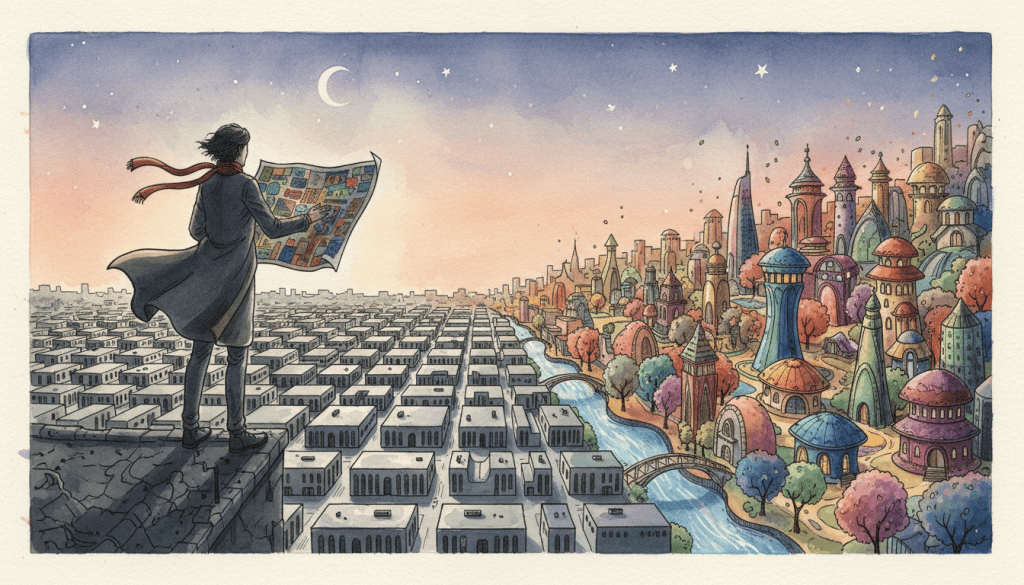
The research is stark. In 1990 the 194 cities were spread fairly evenly across four spatial types: compact gray (dense concrete blocks), fragmented complex (classic sprawl), ragged small (starburst edges with green fingers) and transitional (the middle ground). By 2015 more than half – 98 cities – had shifted into that single transitional category. Small and medium cities changed fastest. Regional differences that once let you recognise a city from space are blurring fast. The data reveals a powerful trend, but the real question is whether we accept it as inevitable.
Lesson 2: This convergence produces monotonous places that lose local fit
Alex Josephson put it plainly: the globalisation of design is also the homogenisation of urban design, and everything is starting to look the same. He finds it monotonous rather than risky, but the research shows deeper consequences. Transitional form sits in an uncomfortable middle: denser than sprawl but more fragmented than traditional compact cities. The result is more urban heat islands, greater reliance on cars and air-conditioning, and a monoculture that makes cities vulnerable to climate shocks. When every city looks like the same medium-density blob, we lose the niche habitats that support local species and the cultural identity that makes a place feel like home.
Lesson 3: Homogenisation is not inevitable – wealth and local choices can still resist it
The study’s most revealing finding is the stubborn outliers: Houston, Atlanta, Auckland and Perth. These land-rich cities remain fragmented and complex. They have not moved toward the transitional mean. This proves convergence is not universal “urban scaling law” physics. It is shaped by economics, car culture and planning decisions. When people have space and money, they often choose sprawl and privacy. The transitional shift elsewhere is therefore more a symptom of rapid urbanisation under resource constraints than a natural law. Different choices remain possible – if we are willing to make them.

Lesson 4: The antidote is deliberate local investment and fighting for your city’s voice
Josephson’s core message was clear and actionable: you have to invest in your city. He described writing unpaid comic books critiquing Toronto’s condo boom, buying expensive tickets to champion the Hearn power-plant project, and competing for the Innisfil Orbit master plan – all long before any paying client appeared. These acts of long-term activism brought real projects and real influence. He reminded us of the ancient Athenian oath: leave the city greater than you found it. In an era of globalised star architects who drop in short-term solutions, the strongest resistance is deep local knowledge and the willingness to fight for context-specific outcomes.
Lesson 5: Beauty and resilience emerge when cities are allowed to change, mutate and misbehave
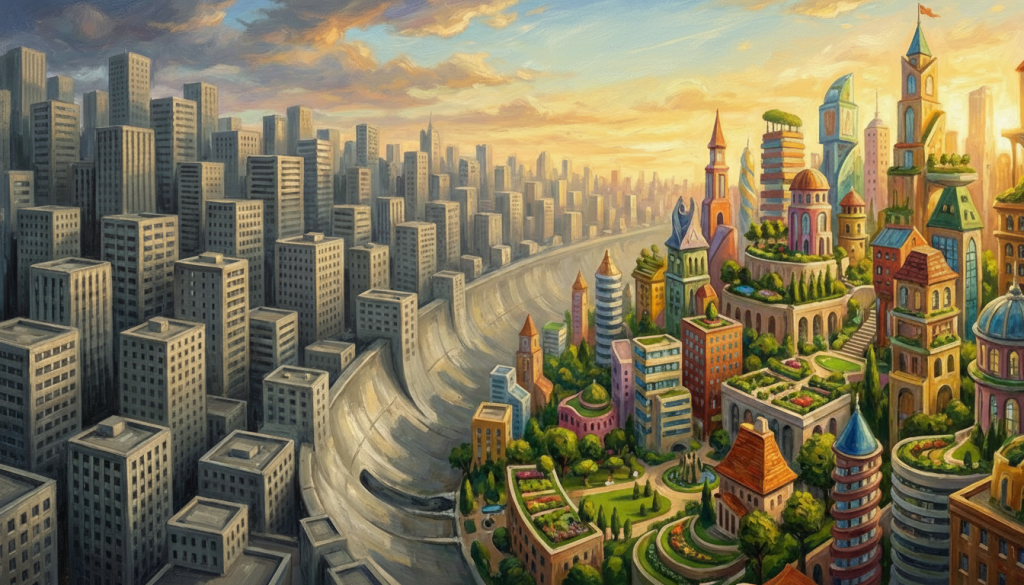
Josephson argued that the greatest urban moments are rarely the result of strict rules. They are the “glitches” – Central Park breaking Manhattan’s grid, the Hearn becoming a city-within-a-building, the Orbit reinterpreting the garden-city idea inside a colonial grid. He wants cities that can change, grow, mutate and allow contradiction. That is the opposite of the smooth transitional mean the research describes. When we let design respond to local climate, culture and topography, we get places that feel alive, joyful and resilient.
This week’s episodes show that the homogenisation we are seeing is not destiny. It is the default path of least resistance under current global pressures. But architects, planners and citizens can choose a different path – one of deliberate local investment, rule-bending creativity and long-term activism.
Have you seen homogenisation creeping into your city, or have you found ways to push back?
The transitional city may be efficient on paper, but distinctive cities are where people actually want to live, invest and belong.
The future belongs to the places whose residents decide they are worth fighting for.
Next week we are investigating whether sustainability can/should be made profitable with Jasper Steinhausen!
Share your thoughts – I’m at wtf4cities@gmail.com or @WTF4Cities on Twitter/X.
Subscribe to the What is The Future for Cities? podcast for more insights, and let’s keep exploring what’s next for our cities.
 What is The Future for Cities? Podcast
Leave a comment