This week on the What is the future for cities? podcast we explored one of the most fascinating intersections in urban thinking: the way the built environment actively shapes human behaviour, emotions and community health. Episode 403R presented a generated debate between two hosts dissecting the 2025 paper Integrating behavioral science into urban planning: a framework for human-centered spatial design by Khogali, Ali and Ramdani. Episode 404I followed with my conversation with Jeff Siegler, founder of Revitalize, or Die and author of Your city is sick. Together, the episodes formed a perfect pair – one theoretical and cautionary, the other practical and passionate. Here are five key lessons that stood out.
Lesson 1: The built environment is never neutral – it is an active psychological agent
Both the research paper and Jeff Siegler insist that cities are not mere backdrops. They are active forces that influence how we think, feel and act. The debate in 403R repeatedly returns to the idea of the “architecture of choice”. Spatial conditions make certain behaviours more probable – walking instead of driving, social interaction instead of withdrawal, trust instead of fear. Siegler puts it bluntly:
“We are just a product of our environment. We simply behave according to our surroundings.”
Poorly maintained or poorly designed places signal danger to our ancient brains, triggering avoidance or adaptation into antisocial patterns. Well-designed places do the opposite: they invite care, connection and healthier choices without us always noticing.
Lesson 2: We must balance deliberate design with individual autonomy
The sharpest tension in the research debate is between two valid concerns. One host argues planners have a moral duty to use behavioural insights – bounded rationality, nudge theory, biophilia – to make the good choice the easy choice. The other warns against “environmental determinism” and the risk of planners becoming behavioural engineers who strip away agency. Siegler lands on the autonomy side but without rejecting design’s power. He wants places that empower people to shape their own lives rather than funnel them into predetermined patterns. The city should set an open stage, not write the script.
The takeaway is not either/or. It is both/and. We can design for probability of positive outcomes (walkable streets, eyes on the street, access to nature) while remaining humble about human unpredictability and protecting room for personal choice.
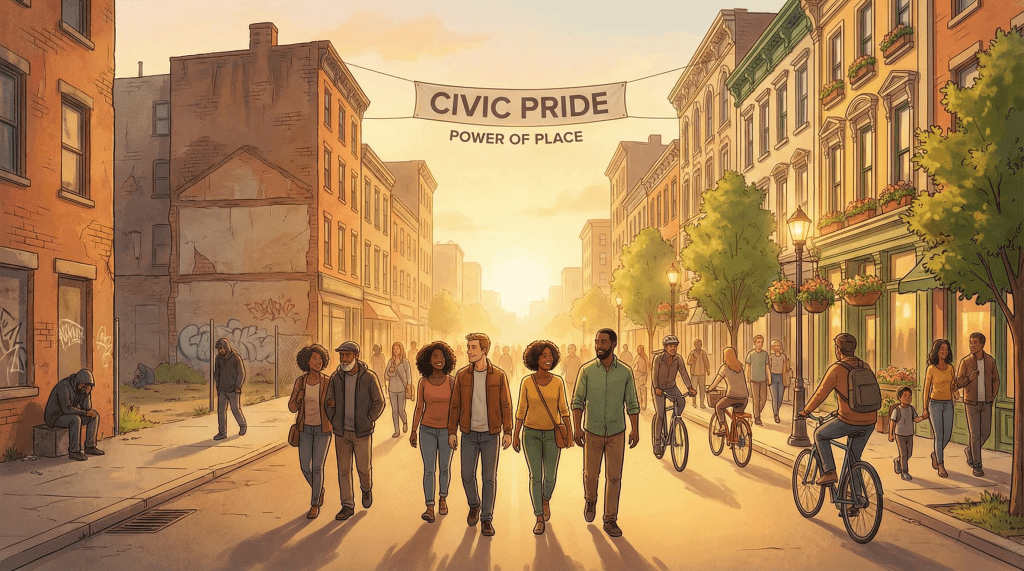
Lesson 3: Civic apathy is rational – pride is cultivated
Siegler’s most memorable framework is the continuum from apathy to pride. Apathy is not a moral failing; it is a rational response to places that are rundown, ugly, disconnected and lacking local ownership. “Why should I get involved?” people understandably ask when their surroundings feel unworthy of care. Pride, conversely, emerges naturally in beautiful, maintained, locally owned environments where craftsmanship and legacy are visible. The research debate echoes this indirectly through concepts like environmental stress theory and social identity theory. When spaces cause sensory overload or fail to facilitate belonging, social cohesion erodes. When they incorporate biophilia and legible wayfinding (à la Kevin Lynch), trust and attachment grow.
Civic health, therefore, begins with making places worth caring about.
Lesson 4: Place affects health more than we discuss – perhaps more than food or genetics
Siegler argues that where we live has an “outsized impact” on physical, mental, social and even fiscal health – more than diet or DNA, yet far less discussed. Long commutes, car dependence, isolation, fast-food landscapes and rundown surroundings all compound stress and limit movement and connection. Walkable, mixed-use, beautiful places do the reverse: they encourage exercise, social interaction, lower stress and fiscal sharing of resources. The research paper supports this through references to protection motivation theory, theory of planned behaviour and empirical walkability studies. Higher walkability scores correlate with better health outcomes because perceived control over movement increases intention to walk.
Preventative urban design, therefore, is preventative medicine at population scale.
Lesson 5: We need interdisciplinary humility and resident-centred decision making
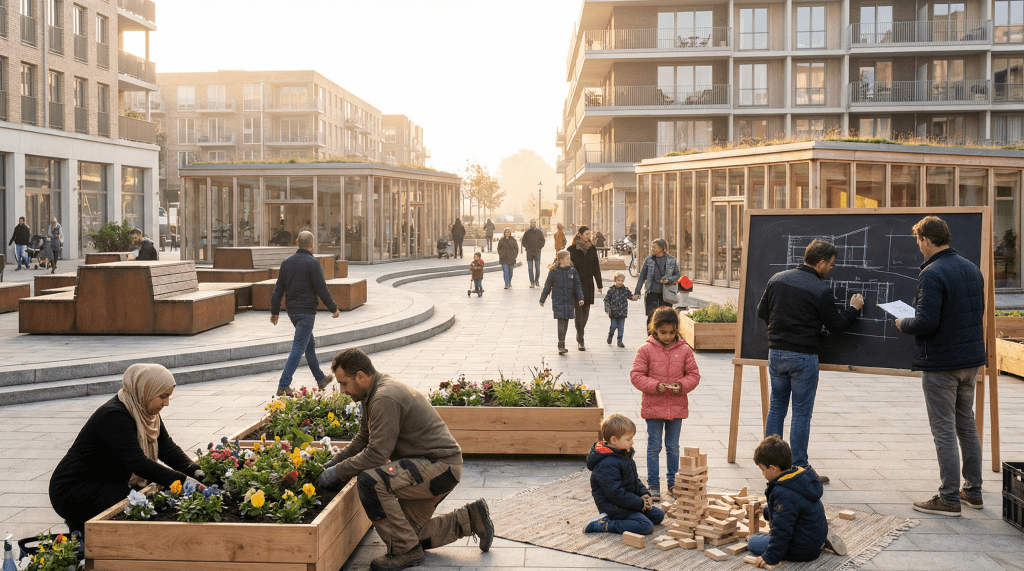
Both episodes call for collaboration beyond traditional silos. The paper stresses bringing psychologists, sociologists and behavioural scientists into the planning room. Siegler wants decision-makers to adopt a simple lens: will this choice make residents more proud, resilient and attracted to our community? Crucially, both warn against overconfidence. Planners are not trained psychologists; models of the human mind are messy. Digital twins and AI can help, but they risk optimising for measurable metrics while missing joy or belonging.
The healthiest path forward is participatory design informed by behavioural evidence yet grounded in lived experience and constant feedback from residents.
Urban planning is ultimately about human flourishing, as episode 403R and 404I proved. Cities can nudge us toward better versions of ourselves without robbing us of agency. They can turn rational apathy into earned pride. They can prevent illness as effectively as they currently contribute to it. Most encouragingly, none of this requires futuristic technology or endless growth. It requires intention, humility and a willingness to put resident wellbeing first – emotionally, psychologically and physically.
If we start asking “Does this make people more proud to live here?” alongside the usual technical questions, the future of cities looks considerably brighter.
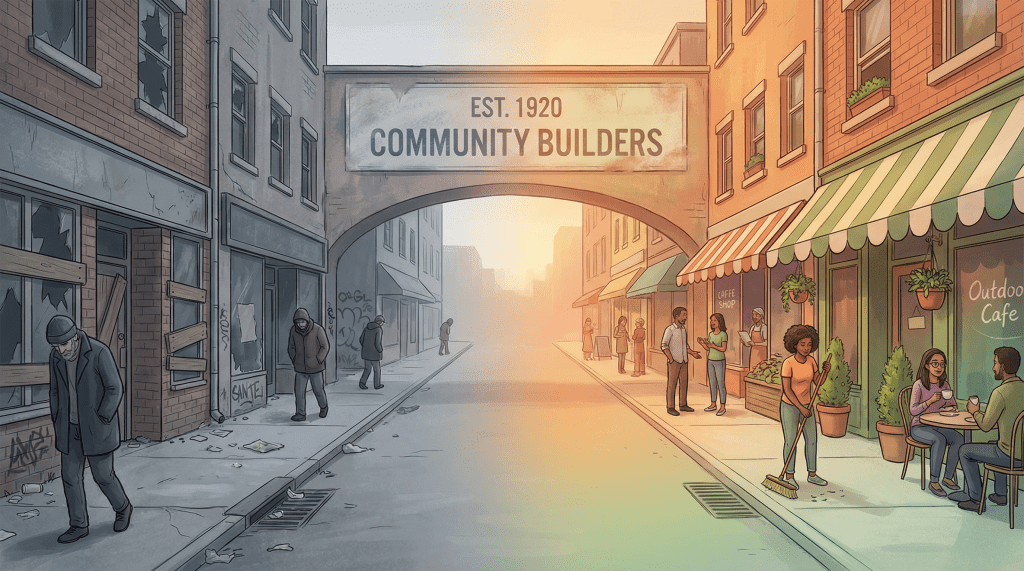
Next week we are investigating the effects of urban homogenisation globally with Alex Josephson!
Share your thoughts – I’m at wtf4cities@gmail.com or @WTF4Cities on Twitter/X.
Subscribe to the What is The Future for Cities? podcast for more insights, and let’s keep exploring what’s next for our cities.
 What is The Future for Cities? Podcast
Leave a comment