Have you ever wondered why some cities explode with opportunity while others, despite early promise, fade into struggle?
This week on the What is The Future for Cities? podcast, we grappled with that exact tension. Tuesday’s research episode (397R) dissected Wim Naudé‘s 2018 chapter “Urbanisation and entrepreneurship in development: Like a horse and carriage?“, debating whether entrepreneurial capitalism is the essential engine of urban progress – or whether its unchecked forces create problems only strong institutions can solve. Thursday’s interview (398I) with Bradford Cross, CEO of Alpha City and Managing Partner at Pronomos Capital and Two Lions, brought practical vision: governance as humble experimentation, entrepreneurial capitalism as a poverty-lifter, and new ways to let specialists execute while nations retain accountability.
Together, these episodes challenged easy answers. Entrepreneurship sparks urban transformation, but history and evidence show it’s not enough on its own. Here are five key lessons we took away – grounded in the debate’s mechanisms, pathologies, and historical warnings, plus Cross’s forward-looking ideas on governance innovation.

Lesson 1: Urbanisation and entrepreneurship are deeply interdependent – no modern economy has developed without both
The research debate opened with a striking claim: no country has ever achieved sustained development without significant urbanisation, and that urbanisation has always been powered by entrepreneurial activity. Cities become hubs where surplus rural labour meets innovative startups, often small household enterprises supplying specialised services to larger firms. This “grease the wheel” mechanism pulls people into denser, more productive environments, raising GDP per capita and cutting deaths from communicable diseases. Cross reinforced this in practice: thriving cities need bottom-up energy where people can access capital and start ventures. Without entrepreneurial clusters, societies stay stuck in rural stagnation. This lesson reminds us that cities aren’t just bigger villages – they’re engines built on the constant interplay of density and innovation.
Lesson 2: Not all entrepreneurship is equal – productive innovation drives progress, while necessity entrepreneurship often traps cities in informal shadows
A sharp point of contention was the quality of entrepreneurial activity. In many developing cities, migrants don’t launch high-growth specialised firms – they fall into “necessity self-employment”: street vending, survival services, even illegal trade. This creates massive informal economies that look busy but deliver low productivity and vulnerability. The debate highlighted how rapid urban growth can generate its own constraints: skyrocketing rents, congestion (costs rising 80% from small to medium cities), and environmental strain. Productive entrepreneurship needs supportive conditions – education, finance, property rights – that necessity-driven activity rarely builds organically. Cross echoed this distinction: true progress comes from entrepreneurial capitalism, not crony or corporate versions that exploit without uplifting. This lesson is a reality check – quantity of startups matters less than creating ecosystems that reward innovation over survival.
Lesson 3: Markets generate real pathologies that they cannot always self-correct – institutions can be useful
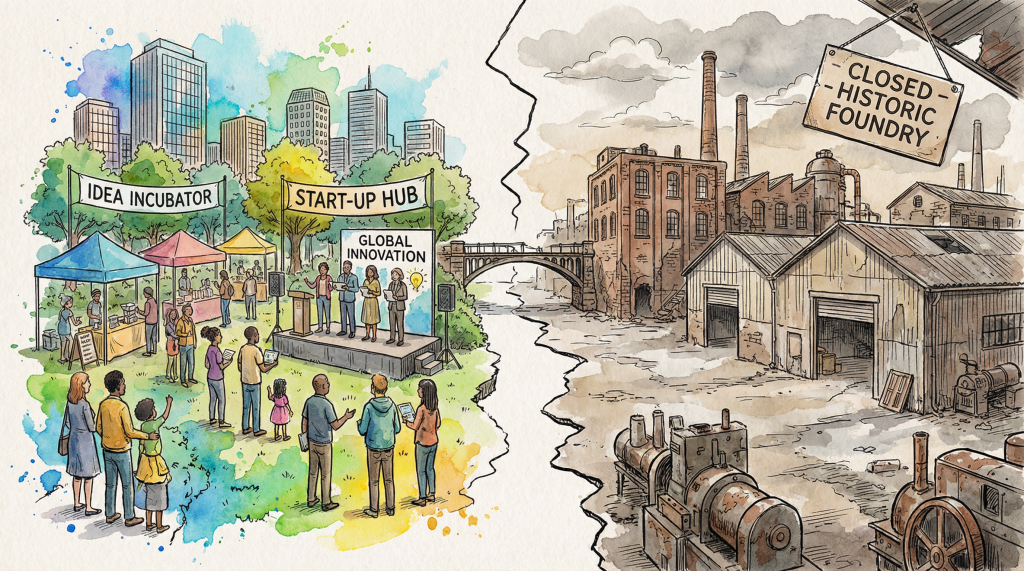
Even when entrepreneurship sparks growth, the debate argued that capitalist urbanisation creates negative spillovers markets struggle to fix alone: severe congestion, rent inflation, rising GHG emissions, and structural inequality. These aren’t just managerial hiccups – they’re baked-in limits that dampen the very productivity gains density promises. Historical evidence drove the point home: Glasgow rose as an entrepreneurial powerhouse in shipbuilding and trade, yet despite robust early governance, it couldn’t adapt to external shocks after 1914. A century later, it faced high unemployment and the UK’s lowest life expectancy. Dynamism proved temporary without institutions resilient enough to manage transitions and social costs. This lesson cautions against over-reliance on market optimism – long-term urban health needs political capacity to steer and cushion.
Lesson 4: Governance should be treated as science – humble experiments, not ideological battles
Cross offered a refreshing counter to polarised politics: approach governance with evidence-based humility. We’ve learned much over thousands of years, but huge gaps remain. Instead of right-versus-left shouting matches, we should run contained, small-scale experiments to test what actually works. This mindset shifts debates from opinions to outcomes. Cities become laboratories where new ideas – zoning reforms, service delivery models, incentive structures – are tried, measured, and scaled or scrapped. Combined with the debate’s warnings about institutional failure, this lesson points to adaptive, learning-oriented governance as the bridge between entrepreneurial energy and lasting progress.
Lesson 5: Decoupling authority from execution could unlock faster, better city-building
The most practical idea from Cross was separating who holds ultimate accountability (nation states) from who actually executes and administers services. Governments retain sovereignty and oversight, but delegate delivery to specialists – entrepreneurs, investors, technologists – who often do it better. Examples include delegated crypto financial zones where private teams build digital systems under central bank rules, or new city projects with clear legal agreements. Politicians set direction and standards; experts handle implementation. This leverages entrepreneurial strengths without abandoning public accountability, addressing the debate’s concern that markets alone can’t manage aggregate costs. This lesson offers a workable hybrid: keep democratic authority, but let capable executors move faster.
Entrepreneurial capitalism and urbanisation are powerful partners in human progress, but they’re not self-sufficient. History shows brilliance can fade without resilient institutions, while today’s experiments suggest we can do better by combining market dynamism with evidence-based governance. The future of cities lies in getting that balance right – encouraging bottom-up innovation while building systems strong enough to manage its consequences.
These episodes (397R and 398I) prompt reflection on urban centres worldwide – from fast-growing hubs in the developing world to historic cities navigating adaptation challenges.
How much more could we achieve globally with bolder, measured experiments?
What’s one governance or entrepreneurial change you’d love to see tested in your city?
Your ideas might spark the next big shift.
Next week we are investigating the root causes and their potential solutions with Hudson Worsley, Matt Gijselman, and Allan Savory!
Share your thoughts – I’m at wtf4cities@gmail.com or @WTF4Cities on Twitter/X.
Subscribe to the What is The Future for Cities? podcast for more insights, and let’s keep exploring what’s next for our cities.
 What is the future for cities? podcast
Leave a comment