
This week the What is The Future for Cities? podcast delivered a compelling examination of one of the most pressing challenges confronting urban populations worldwide: the rapid intensification of heat in cities. Episode 391R provided a concise summary of five recent research papers co-authored by Professor Sebastian Pfautsch, while episode 392I featured an in-depth interview with Pfautsch himself, Professor of Urban Management and Planning at Western Sydney University and President of the Australasian Green Infrastructure Network. Together, these episodes present a clear picture: climate change is accelerating urban heat risks with measurable impacts on public health, infrastructure, daily life, and long-term livability. Yet they also demonstrate that practical, evidence-based interventions are already producing results.

Lesson 1: Climate change is driving an exponential acceleration of extreme heat that is already reshaping urban life
Sebastian Pfautsch emphasised that climate change is not a belief but a fact grounded in evidence such as ice-core data showing atmospheric CO₂ levels never exceeded about 300 ppm over the past million years until human activity pushed them beyond 420 ppm today, heading toward 600 ppm by century’s end if unchecked. Recorded data from Greater Sydney illustrates the local consequences. Between 1859 and 1979, the region experienced 351 days of 35 °C or higher. From 2000 to 2020 alone, that figure rose to 478 days – more extreme heat days in two decades than in the preceding 120 years combined.
Projections indicate that by 2060, parts of Western Sydney could face up to 160 days annually exceeding 35 °C. Night-time temperatures above 25 °C prevent recovery from daytime heat stress, contributing significantly to heat-related illness and mortality. High-density sensor networks reveal stark microclimate variations that official weather stations often miss: on one extreme day, temperatures ranged from 28.2 °C in the Royal Botanic Gardens to 41.9 °C in a densely built-up suburb – a difference of nearly 14 °C within the same city.
Lesson 2: Ordinary infrastructure is a major amplifier of climate-driven heat risk
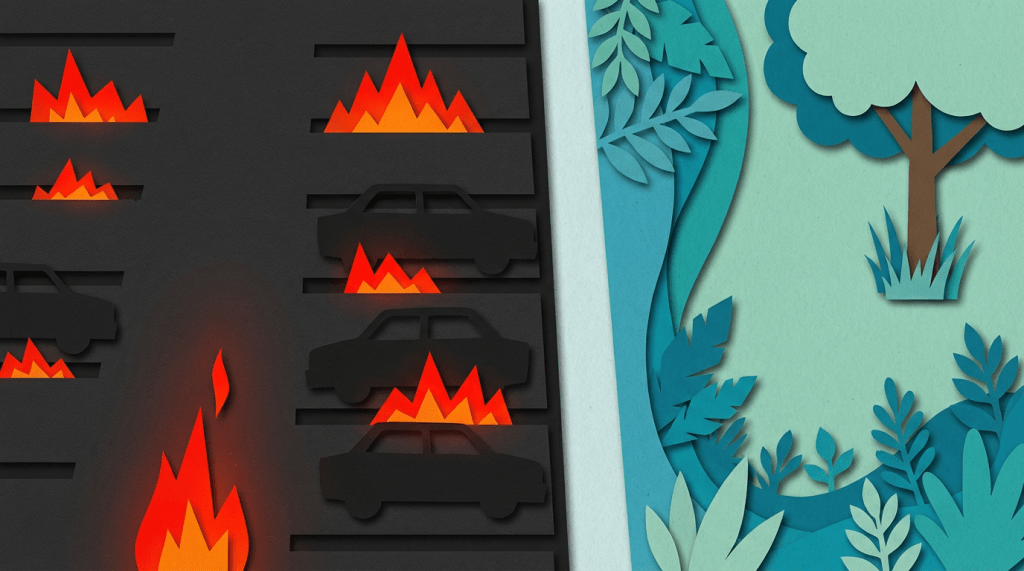
Everyday spaces such as playgrounds and surface-level car parks emerge as significant heat generators. One monitored playground reached 39.2 °C on a hot day – hotter than adjacent streets – making it hazardous for children during peak summer hours. Car parks stand out as the most widespread culprit. Surveys in Western Sydney found that 92 % are sealed with low-albedo black asphalt, with surface temperatures frequently reaching 60–69 °C. In contrast, nearby grass surfaces remain around 28 °C, highlighting a difference of up to 41 °C created solely by material choice. This radiant heat elevates perceived temperatures by as much as 10 °C and poses heightened risks to people closer to the ground, including young children, wheelchair users, and pets. Hot parked cars also trigger prolonged air-conditioning use upon startup, producing unnecessary emissions spikes.
Lesson 3: Effective, immediate interventions are available and proven
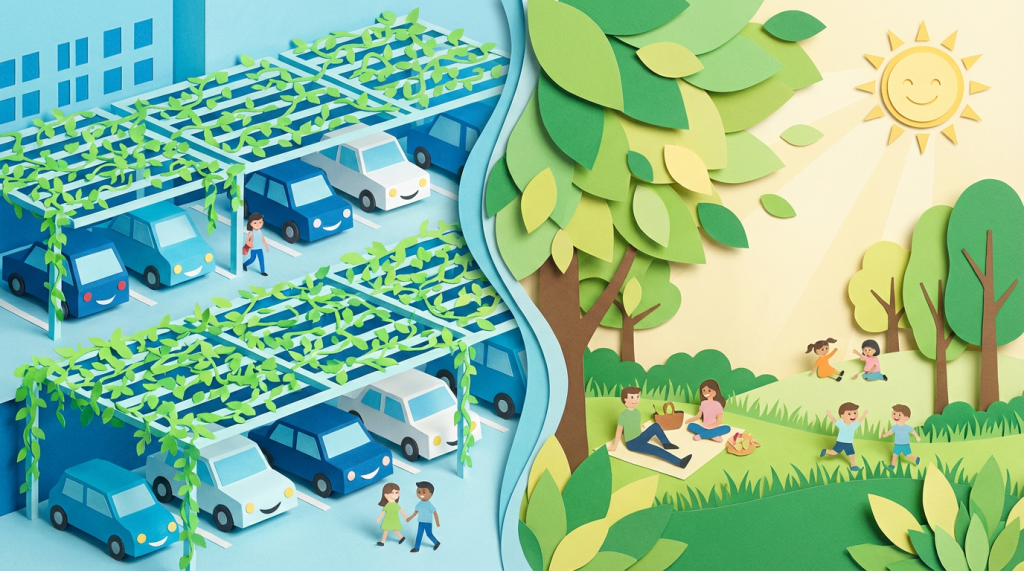
The research and interview highlight a suite of solutions that deliver substantial cooling without requiring decades-long implementation. Reflective coatings reduce asphalt surface temperatures by 6–11 °C on average. Permeable surfaces enable evaporative cooling. A prototype “next-generation cool-green car park” using fast-growing vines on strategically placed trellises cut surface temperatures from nearly 60 °C to below 30 °C – a 50 % reduction – while preserving parking capacity. Other implemented examples include 42 000 m² of cool-coated surfaces, vegetated light-rail track beds in Parramatta, and a redesigned “climate-smart” playground now usable throughout summer. While some approaches (such as irrigation without sufficient canopy) show mixed results, the evidence confirms that targeted interventions yield measurable benefits quickly.
Lesson 4: Progress depends on evidence meeting sustained advocacy
Sebastian Pfautsch noted that eight years ago, terms such as “blue-green infrastructure” and “urban cooling” were rarely discussed. Today, they appear regularly in policy documents and planning processes. High-resolution heat mapping produced by his team has informed amendments to local environmental plans, prioritised tree planting in hotspot areas, and supported more effective resource allocation during heatwaves, including ambulance deployment. Significant policy gaps persist – current Australian car-park standards address only dimensions and traffic flow, with no thermal performance requirements – yet consistent, fact-based advocacy is driving tangible shifts.
Lesson 5: Private land holds the greatest potential – and responsibility
Councils typically manage only 25–30 % of urban land. The remainder is privately owned, and this is where canopy loss is occurring most rapidly. Once a mature tree is removed – often for development, pools, or subdivision – the space is unlikely to support an equivalent tree within a generation. Protecting and incentivising private canopy cover – through mechanisms such as rate rebates for maintaining over 20 % tree coverage – is therefore essential. Private trees represent some of the most critical cooling infrastructure available, and their preservation requires collective action beyond government alone.
There no doubt: urban heat is intensifying faster than anticipated, yet the tools to mitigate it are within reach. The combination of rigorous measurement, tested prototypes, and policy influence shows that meaningful change is possible when evidence is acted upon decisively. Cities that prioritise blue-green infrastructure, thermal performance in design standards, and canopy protection on private land will be far better positioned to protect residents as temperatures continue to rise.
Both episodes offer a clear-eyed view of the challenge alongside practical pathways forward. Listen to episode 391R for the research foundations and episode 392I for the full discussion on implementation and mindset.
Which intervention or policy shift feels most achievable in your own city?
Support or initiate community efforts to install shade structures, permeable surfaces, or vine trellises in car parks and public spaces. Push for updates to local planning documents that incorporate heat-resilient design – such as mandatory thermal performance for new infrastructure. Share the episodes with neighbours, councillors, or workplace decision-makers to build broader awareness and momentum.
Next week we are investigating the government’s role and specific initiatives from Victoria with Harriet Shing!
Share your thoughts – I’m at wtf4cities@gmail.com or @WTF4Cities on Twitter/X.
Subscribe to the What is The Future for Cities? podcast for more insights, and let’s keep exploring what’s next for our cities.
 What is The Future for Cities? Podcast
Leave a comment