
This week the What is The Future for Cities? podcast returned to one of the most successful urban regeneration projects in North America: Toronto’s St. Lawrence neighbourhood. Episode 381R replayed the still-raging academic debate on DeLeo & Gordon’s case study on Directions for new urban neighbourhoods: Learning from St. Lawrence – was its longevity due to visionary politics and design, or to a bullet-proof financial structure? Episode 382I brought Carolyn Whitzman, one of Canada’s sharpest housing researchers and a long-time St. Lawrence resident, to explain why the model remains astonishingly relevant half a century later.
Together the episodes deliver a clear message: we once knew exactly how to build dense, lively, financially resilient downtown neighbourhoods – and then, inexplicably, we stopped. Here are the five biggest lessons we re-learned this week.
Lesson 1: Political courage plus competent execution beats ideology alone
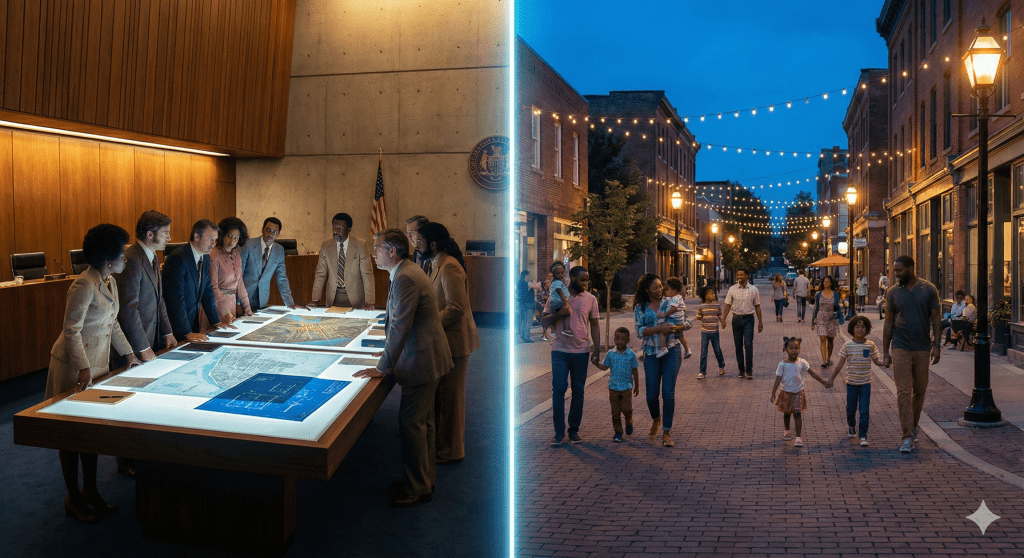
The debate in 381R is fierce: some credit the 1972 reformer council (Mayor David Crombie, the “tiny perfect mayor”) and their refusal to accept another high-rise public-housing ghetto; others point to the self-financing land-bank model that made the project politically untouchable. The truth is both were essential. Without the 1972 political earthquake there would have been no project; without the clever financial engineering the project would have been killed by a later administration. Carolyn Whitzman confirms this in 382I: visionary leadership opened the door, but the land-lease structure and phased revenue model kept it open for 50 years. Lesson? Great urbanism needs both a compelling “why” and an unbreakable “how”.
Lesson 2: Mandate physical integration from day one – the street grid is non-negotiable
St. Lawrence succeeded because planners forcibly re-imposed the historic 19th-century Toronto street grid on 56 acres of derelict railway land. No superblocks, no podium towers set back in parking craters. The result: pedestrian life at grade, corner shops, eyes on the street, and instant connectivity to the rest of downtown. Carolyn still marvels that you can walk from St. Lawrence to the financial district without ever feeling you left a real neighbourhood. Modern projects routinely ignore this rule and pay for it with dead street frontages and isolated residents. Lesson: if you don’t stitch the site into the existing city fabric on day one, you will never fix it later.
Lesson 3: Self-financing land banks turn public risk into long-term public wealth
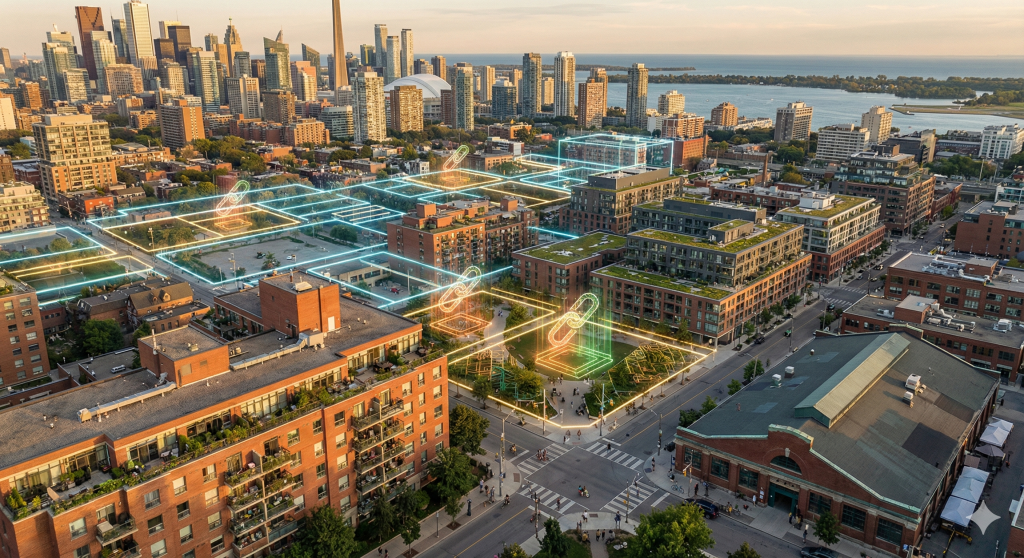
Toronto bought the land cheap in the 1970s dollars, retained freehold title, and either ground-leased or sold parcels under strict design covenants. The city recovered its entire acquisition cost and still earns ongoing ground rent. That single move made St. Lawrence immune to the budget cuts that killed pure public-housing elsewhere. Carolyn points out that most cities sold their public land in the neoliberal 1990s and now beg developers for a few “affordable” units in return. Lesson: keep the land in public hands and you keep the upside – forever.
Lesson 4: Enforce tenure diversity by covenant, not by hope
From the start the city required roughly one-third co-op, one-third public rental, one-third market (initially family-sized condominiums). That ratio was locked in by legal agreement on every parcel. When political winds changed, later councils could not unpick the mix without buying back land at market rates – effectively impossible. The result is a neighbourhood that has stayed remarkably stable in tenure and demographics for five decades. Modern “inclusionary zoning” schemes that merely ask for 10–20 % affordable units look timid by comparison. Lesson: bake the desired future into the deeds, not the policy documents.
Lesson 5: Good bones buy time – even when services lag
The debate in 381R notes that St. Lawrence waited over a decade for its community centre and second school. Yet the neighbourhood never tipped into decline. Why? Because the streets, parks, and mixed daily life were already working. Carolyn still describes walking to the local café where “everybody knows your name” – a direct outcome of the original urban design choices. Modern projects often front-load expensive community centres while delivering anti-social built form; St. Lawrence proves you can (and sometimes should) do it the other way round. Lesson: get the urban design right first and the social infrastructure can catch up later without disaster.
Fifty years on, St. Lawrence remains walkable, lively, financially self-sustaining, and remarkably unchanged in character. Meanwhile most new downtown developments deliver isolated towers, empty podiums, and tenure segregation. The evidence is overwhelming: we already solved dense, humane, mixed downtown living in the 1970s as we discussed in episodes 381R and 382I. We just chose not to repeat it.
Carolyn Whitzman’s closing challenge in 382I is blunt:
“If we had built about 10,000 St. Lawrences, we wouldn’t have the problems that we have now.”
The blueprints, financing models, and political playbook all exist. The only missing ingredient is the will to use them again.
What would it take to build the next St. Lawrence in your city?
Next week we are floating cities and communities with Rutger de Graaf!
Share your thoughts – I’m at wtf4cities@gmail.com or @WTF4Cities on Twitter/X.
Subscribe to the What is The Future for Cities? podcast for more insights, and let’s keep exploring what’s next for our cities.
 What is the future for cities? podcast
Leave a comment