This week on the What is the future for cities? podcast, we released two episodes that push the boundaries of how cities might be governed tomorrow. Episode 379R presented a sharp debate on Aiman Erbad‘s 2025 book chapter about Decentralized Autonomous Organizations (DAOs) adoption for smart-city governance, weighing radical participation against serious risks of exclusion and privacy threats. Then, episode 380I featured Adam Miller, founder of MIDAO – the company that helped the Marshall Islands become the first sovereign nation to legally recognise DAOs – sharing practical insights on transparency, ownership, and the potential end of the nation-state monopoly. Together, they force us to ask: can blockchain finally deliver the participatory, transparent city we’ve dreamed of, or does it create new divides?
Lesson 1: DAOs promise high-transformation governance – but only if inclusion is solved first
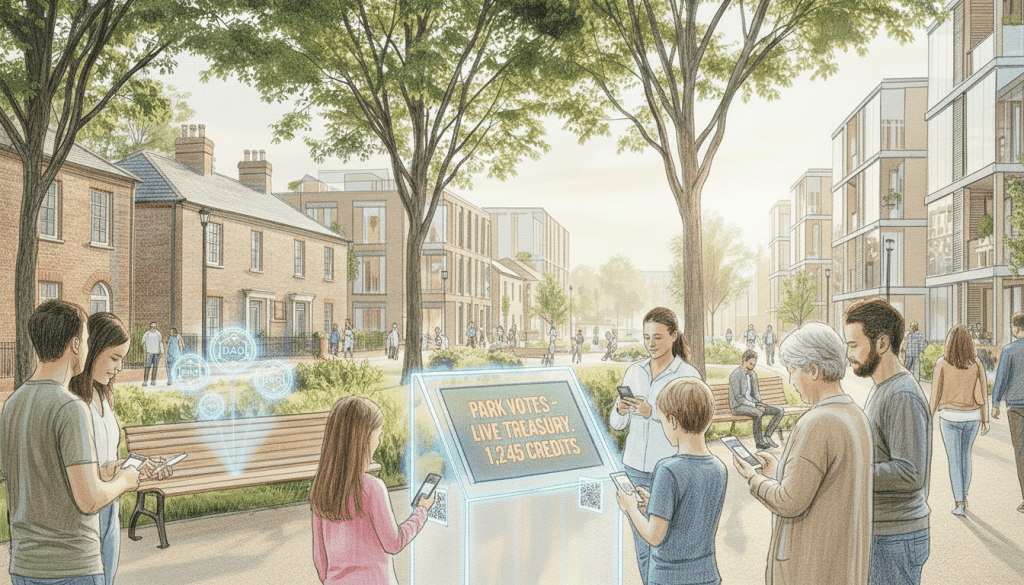
The debate in 379R contrasts low-transformation smart-city administration with the high-transformation leap DAOs could enable: smart-contract rules that distribute power, micro-incentives (bounties) for civic actions, and trustless transparency. Yet experts repeatedly flag the digital divide – seniors, low-income residents, and non-digital natives risk total exclusion from token-based voting and complex interfaces. Miller acknowledges the challenge but reframes it as solvable through better onboarding and education rather than a fatal flaw.
The lesson? Revolutionary participation tools are meaningless if half the city can’t use them – true transformation demands accessibility by design.
Lesson 2: Transparency without human trust is now technically possible
Traditional governance relies on trusting officials to report accurately. Miller in 380I describes a world where every vote and euro is mathematically verifiable on-chain: “Transparency without the need to trust any human being… an immutable paper trail.” Even in an AI-deepfake era, blockchain offers independent verification. The debate counters that full transparency can clash with privacy needs, but Miller suggests programmable options.
The takeaway: cities could finally eliminate “trust me” governance – if citizens accept the trade-offs.
Lesson 3: Real ownership beats symbolic participation
Episode 379R highlights how DAOs restructure incentives – turning passive residents into active stakeholders. Miller takes this further with concrete examples from Japan, where small communities use DAOs to govern shared commons (parks, resources) funded by voluntary micro-taxes they control themselves. “Perhaps it’s important that people do feel ownership by actually having ownership.”
The lesson: when citizens hold the treasury keys and decide spending, engagement stops being a checkbox and becomes skin in the game.
Lesson 4: Cities could compete on governance like companies compete on salary
Miller’s boldest idea in 380I is letting citizens choose their preferred governance flavour – hyper-transparent Singapore-style or privacy-first Swiss-style – and letting cities compete to attract residents. “Program in options and let people choose… that creates competition.” The debate warns this risks a race to the bottom on regulation, but Miller sees healthy market pressure driving innovation.
The takeaway: the nation-state monopoly on sovereignty (only ~150 years old) may fracture, with cities becoming governance products citizens vote for with their feet – or their tokens.
Lesson 5: DAOs are infrastructure, not ideology – use them where they solve real problems
Both episodes agree DAOs aren’t a silver bullet but a new toolset. The debate stresses starting small – pilot projects, education campaigns, robust regulation – to manage risks. Miller’s work in the Marshall Islands shows sovereign nations can legally recognise DAOs today, giving limited liability while keeping flexibility. The lesson: treat DAOs like any infrastructure – test rigorously in neighbourhoods (parks, housing co-ops, local budgets) before scaling city-wide. Success depends less on crypto enthusiasm and more on solving concrete pain points: corruption, apathy, and the feeling that “my vote doesn’t matter.”

These five lessons reveal a spectrum: from cautious warning (solve inclusion first) to radical possibility (cities as competing governance platforms). The 379R debate keeps us honest about risks; Miller shows the technology is already here and being used by sovereign nations and Japanese villages alike. The future of urban governance may not be one perfect system – but a marketplace of experiments where citizens finally get real choice.
What DAO experiment would you pilot in your neighbourhood first?
Check out episodes 379R and 380I to explore more, then share below or tag @WTF4Cities.
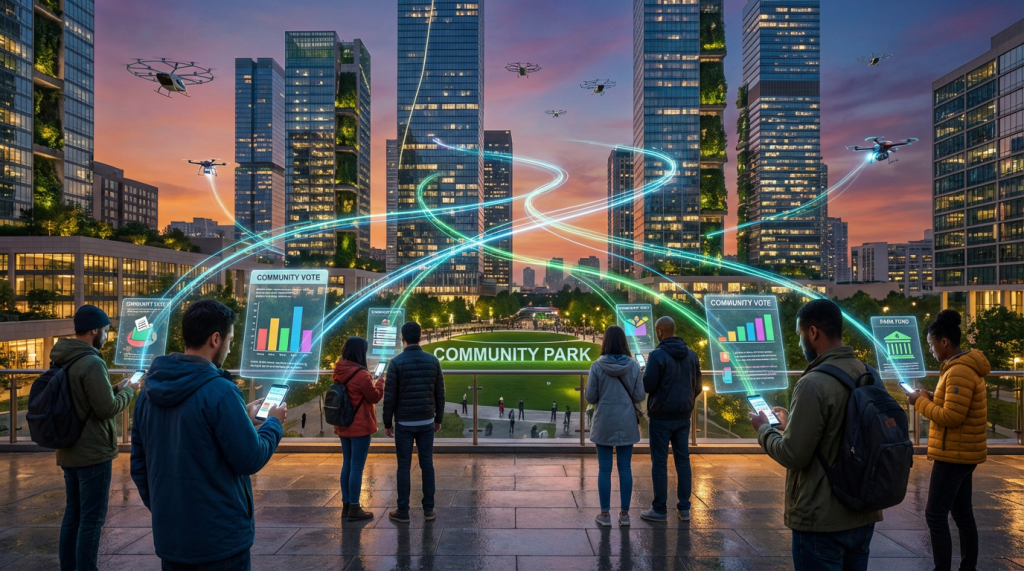
Next week we are investigating decentralised autonomous organisations – a.k.a. DAOs – for better urban management, with Adam Miller!
Share your thoughts – I’m at wtf4cities@gmail.com or @WTF4Cities on Twitter/X.
Subscribe to the What is The Future for Cities? podcast for more insights, and let’s keep exploring what’s next for our cities.
 What is The Future for Cities? Podcast
Leave a comment