This week on the What is The Future for Cities? podcast, we embarked on a fascinating journey through urban evolution, exploring how cities have shaped humanity’s past and will guide its future. Episode 327, a research summary of Cities through the ages: One thing or many? by Michael E. Smith and José Lobo, delved into the historical dynamics of cities as both unified systems and diverse hubs. Episode 328, an interview with Howard Bloom, author and founder of the Howard Bloom Institute, offered a visionary perspective on cities as beacons of human progress, from bacterial origins to interplanetary futures. Here are five key lessons from this week’s episodes that illuminate the past, present, and future of urban life.

Lesson 1: Cities are both one thing and many
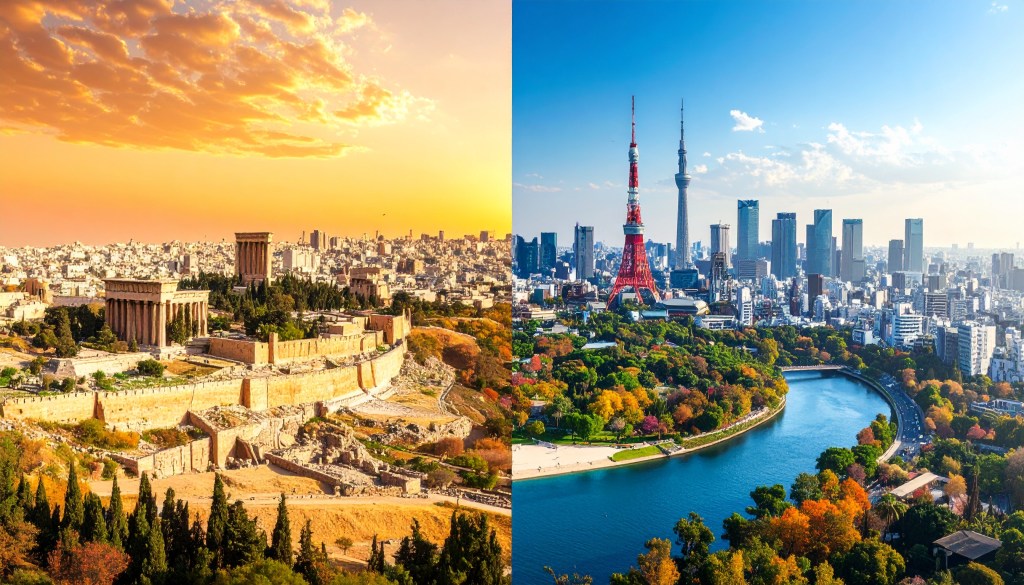
Smith and Lobo’s research in Episode 327 introduces a dual lens for understanding cities: as singular systems of “energized crowding” and as multifaceted hubs of political, economic, and cultural activity. The concept of energized crowding—intense social interaction driven by size, density, and diversity—unifies cities across time, from ancient Ur to modern Tokyo. Yet, cities also vary as political centers (e.g., Rome, driven by rulers) or economic engines (e.g., medieval Glasgow, fueled by trade). This duality challenges us to see cities as complex ecosystems, not just one-dimensional entities. For urban planners, this means balancing social vibrancy with diverse functions to create resilient cities. Understanding this dual nature helps us appreciate why cities endure as humanity’s greatest social experiment.
Lesson 2: Historical patterns inform future urban design
Episode 327 highlights how historical cities offer timeless lessons for modern urban planning. Smith and Lobo note that ancient political cities, like Rome, often relied on centralized power, creating “primate cities” that dwarfed others but stifled regional growth. Economic cities, like Dutch commercial towns, thrived on trade and innovation, fostering broader prosperity. However, pre-industrial cities faced Malthusian limits, where population growth outpaced resources, unlike today’s post-industrial cities driven by economic expansion. These patterns suggest that future cities must avoid over-centralization and prioritize sustainable growth. By learning from the past—scaling laws, neighborhood universality, and commercialization—we can design cities that harness social and economic synergy without repeating historical pitfalls.
Lesson 3: Cities are paradise for social synergy
In Episode 328, Howard Bloom describes cities as “paradise” for social connection, where even “geeks and outcasts” find community. He recounts his experience in New York’s Tea Lounge, a “community living room” where diverse people connected, sparking creativity and purpose. Bloom’s insight aligns with Episode 327’s emphasis on energized crowding, where face-to-face interactions build trust and drive innovation. He argues that cities, producing 70% of U.S. GDP, are vital nodes in a global web, countering rural narratives that undervalue urban contributions. This lesson underscores the need for urban spaces—like cafes or parks—that foster serendipitous encounters. Future cities should prioritize such “living rooms” to nurture social bonds and combat alienation.
Lesson 4: Technology reshapes cities and humanity
Bloom’s interview in Episode 328 frames technology as a transformative force for cities and human evolution. He draws parallels between ancient innovations (e.g., writing, which Plato feared would ruin minds but enabled Alexandria’s 10,000-volume library) and modern tools like AI. Bloom debunks apocalyptic AI fears, comparing them to bacteria’s multicellularity, which enhanced rather than erased life. AI, he suggests, can streamline urban systems—think automated city billing or data-driven planning—making cities smarter. Episode 327 complements this by noting how commercialization in ancient cities laid the groundwork for economic innovation. Together, these insights reveal that technology, from stone tools to 5G, is a dance: we create tools, and they reshape us, enabling cities to break nature’s limits.
Lesson 5: Urban futures require audacious vision
Bloom’s vision in Episode 328 is nothing short of audacious: cities must lead humanity beyond Earth, greening Mars with mini-parks in space vehicles. He sees cities as defying gravity, much like plants that conquered land 1.5 billion years ago, embodying the principle that “nature favors those who oppose her most.” This aligns with Episode 327’s observation that cities have always been arenas for innovation, driven by social interaction and diverse functions. Bloom’s call to “invent the next smartphone” of urban planning—whether through architecture or global interconnection—challenges us to think boldly. Future cities must blend technological ambition with human-centric design, ensuring they remain vibrant hubs on Earth and beyond.
This week’s episodes remind us that cities are humanity’s greatest canvas, blending social synergy, technological innovation, and historical wisdom. Episode 327 teaches us to learn from the past, balancing political and economic drivers with social vitality. Episode 328, through Howard Bloom’s lens, urges us to embrace cities as paradise for connection and audacious platforms for cosmic exploration. As urban dwellers, planners, or policymakers, we can shape this future by designing inclusive spaces, leveraging technology like AI, and dreaming big—perhaps even greening the galaxy.
What’s your biggest takeaway from this week?
How can your city evolve to drive human progress?
What’s one lesson from this week that resonates with you?
How can we apply these insights to your city?
Share your thoughts – I’m at wtf4cities@gmail.com or @WTF4Cities on Twitter/X.
 What is The Future for Cities? Podcast
Leave a comment