
This week we’ve journeyed through two profound explorations of how urban spaces can evolve from mere infrastructure into living, breathing systems that sustain both humanity and the planet. Episode 309, “Ecological Urban Planning and Design: A Systematic Literature Review,” and Episode 310 with Dr. Stuart Cowan, Executive Director at Buckminster Fuller Institute, offered a dual lens—grounded research and bold vision—that left me rethinking what cities could become. Here’s what I learned, and why it matters.
Grounding in Research: The Ecology of Cities
Episode 309, based on the 2019 systematic literature review by Angela Heymans, Greg Morrison, Josh Byrne, and Christine Eon in Sustainability MDPI, offers a foundational education in ecological urban planning. Its core insight? Cities aren’t separate from nature—they’re socio-ecological systems where human and natural dynamics intertwine. The research distills seven themes, but the standout for me is the power of green infrastructure: urban forests, rain gardens, green roofs, and permeable pavements. These aren’t just decorative—they’re workhorses delivering ecosystem services like air purification, temperature regulation, and flood mitigation.
Consider the stats: over half the world’s population lived in urban areas by 2015, a number that’s only grown. Yet, our traditional urban model—concrete grids and steel towers—amplifies climate change while leaving cities vulnerable to its fallout, like heat islands and rising seas. The review argues for a paradigm shift: nature as structure, not an afterthought. Imagine a city where every street is a green corridor, every building a sponge for rainwater. This isn’t utopian—it’s practical, backed by decades of data showing reduced emissions, enhanced biodiversity, and resilient communities. For me, it’s a call to rethink urban planning as an act of harmony, not domination.
Visionary Design: Cities as Islands of Coherence
Episode 310 with Dr. Stuart Cowan, from Buckminster Fuller Institute, elevates this conversation to a philosophical and systemic level. His educational gift is a framework for cities as ‘islands of coherence’ amid the poly-crisis—climate disruption, biodiversity collapse, and social inequity crashing together. Cowan introduces ‘defuturing,’ a haunting concept: design choices that foreclose vibrant futures. Think of a plastic-heavy toy or a sprawling highway—convenient now, but they lock us into dead-end paths. His counterpoint? Protopia—small, iterative steps toward flourishing, grounded in reciprocity with all life.
Rooted in Buckminster Fuller’s Spaceship Earth metaphor, Cowan sees cities as habitats within bio-regions—dynamic zones stretching from dense urban cores to rural wildlands. He champions ‘ephemeralization’—doing more with less—through circular economies where waste becomes resource, toxicity is designed out, and urban metabolism mirrors nature’s cycles. Listening to him, we can picture a city where every rooftop farm feeds its block, every factory’s byproduct fuels another. It’s a vision that demands we blend modern systems thinking with indigenous wisdom—gratitude and relationality as design principles. For Cowan, cities aren’t just infrastructure; they’re our chance to steward a fragile film of life on this planet.
Synergy: From Toolkit to Purpose
Episode 309 hands us the toolkit—green infrastructure as a proven, scalable solution. It’s the ‘how’ of ecological urbanism, rooted in evidence. Episode 310, though, gives us the ‘why’—a moral and existential imperative to redesign cities as regenerative anchors. Together, they argue that urban spaces aren’t problems to solve but opportunities to reimagine. The research shows us what works; Cowan tells us why it’s worth doing.
This synergy hit home – both reject the old human-nature divide. The review’s socio-ecological lens aligns with Cowan’s bio-regional solidarity—both see cities as part of a living whole. Green infrastructure could be the physical expression of protopia, each rain garden or urban forest a step toward a flourishing future. It’s a marriage of pragmatism and purpose that feels both urgent and achievable.
Personal Resonance: Seeing My City Anew
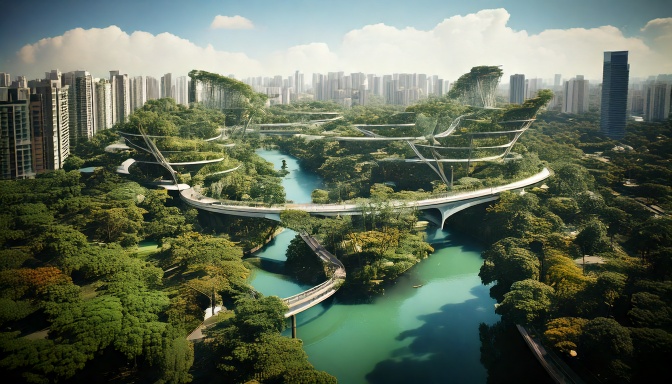
These ideas aren’t abstract—they’re personal. A cracked parking lot screamed for a rain garden; a glassy office tower begged for a living wall. Cowan’s bio-regional lens makes us wonder: where does my city’s ecological pulse beat? Is it in the river we’ve buried under concrete, or the hills we’ve shaved for suburbs? Episode 309’s data assures us these fixes aren’t pipe dreams—cities like Singapore and Toronto are already proving it with super trees and river revitalization. But Cowan’s protopia in Episode 310 nudges us further: it’s not enough to patch; we must reorient. It’s a shift from viewing urban sprawl as inevitable to seeing it as a canvas for reciprocity. These episodes don’t just inform—they provoke action, whether it’s planting a native shrub or questioning a local policy.
What’s Your City’s Story?
The week’s biggest lesson is agency: cities are ours to shape. Episode 309 teaches us the tools—green infrastructure isn’t a luxury, it’s a necessity. Episode 310 gives us the compass—protopia over defuturing, solidarity over extraction. Together, they insist we’re not passive residents but active stewards of our urban ecosystems.
What’s your city whispering to you? Where could it breathe greener, connect deeper?
Share your thoughts—because this isn’t just a podcast; it’s a conversation about the future we’re building, block by block, bio-region by bio-region.
Ready to build a better tomorrow for our cities? I’d love to hear your thoughts, ideas, or even explore ways we can collaborate. Connect with me at wtf4cities@gmail.com or find me on Twitter/X at @WTF4Cities - let’s make urban innovation a reality together!
 What is The Future for Cities? Podcast
Leave a comment