
This week, What is The Future for Cities? Podcast joined Podcasthon 2025, a global initiative supporting charities – we chose Chiara Marletto‘s quantum gravity experiments which can be supported through Wolfson College at the University of Oxford. Thus, we explored the intersection of physics and urban evolution through two compelling episodes. Episode 307 delves into Chiara Marletto’s The Science of Can and Can’t, introducing constructor theory as a revolutionary lens on possibility, while Episode 308 features Chiara herself, a quantum theory expert, discussing its implications for cities. Together, these episodes reveal how universal physical laws shape what’s possible—and impossible—in urban environments, offering profound insights for researchers, planners, and city enthusiasts alike. Here’s a reflection on their significance.
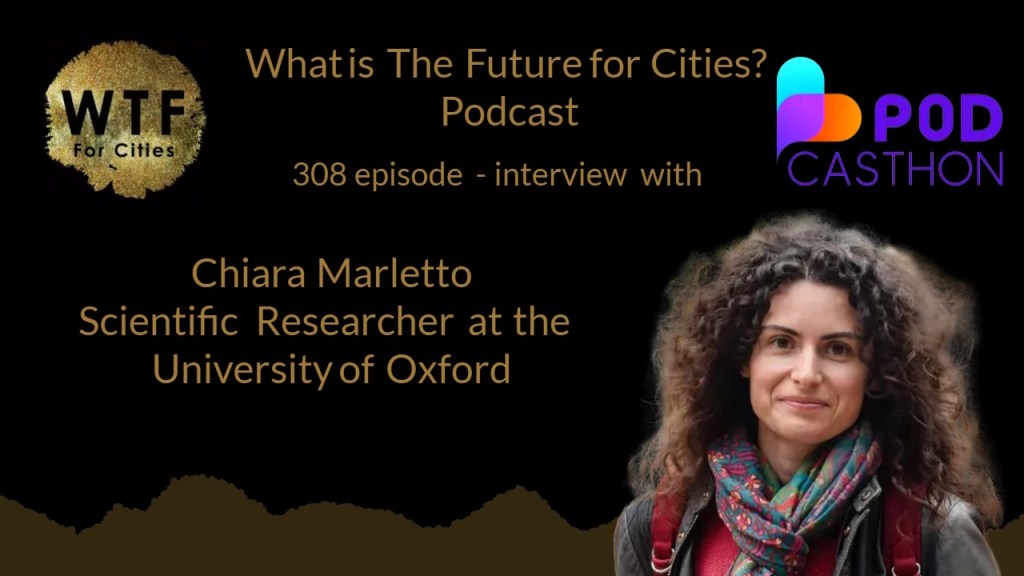
This is also a special episode to be part of Podcasthon 2025 – a globally coordinated effort for podcasts to highlight a charity of their choice. WTF4Cities is happy to participate in this 3rd edition of the Podcasthon with thousands of podcasts worldwide.
Constructor Theory and the Realm of Possibility
Episode 307, based on Chiara Marletto’s 2021 book The Science of Can and Can’t, presents constructor theory—a paradigm shift in physics from describing what happens to defining what can or cannot occur. Traditional physics tracks observable events—planets orbit, energy flows—but Chiara proposes a focus on universal principles of possibility. She introduces “counterfactual resilience,” laws that stand firm across all scenarios, such as the impossibility of perpetual motion due to energy conservation. Paired with this is the concept of “universal constructors”—theoretical systems capable of executing any physically permissible task, akin to an omnipotent machine.
This framework extends beyond abstract theory, touching information, computation, and life itself. Chiara posits information as a physical property—think a blank DVD versus one encoded with data—shaping quantum computing’s potential. She frames life as systems carrying knowledge, constrained yet enabled by physics’ “can” and “can’t” rules. For cities, this is transformative. If urban systems could act as constructors—adapting, repairing, or innovating within physical limits—what might emerge?
The episode’s scope is vast—linking thermodynamics’ arrow of time to life’s resilience—but its urban relevance lies in reframing limits. Cities thrive where physics allows, from steam engines to skyscrapers. Constructor theory asks: what’s next? Could self-regenerating materials or quantum-informed infrastructure become feasible? It’s a call to rethink urban design not as reactive but as proactive, bounded only by what physics permits.
Chiara Marletto on Knowledge and Urban Evolution
Episode 308, featuring Chiara Marletto with co-host Ben Vass, builds on this foundation, weaving constructor theory into urban futures. Chiara frames cities as “extended phenotypes”—structures humans craft to nurture and expand knowledge, much like nests for birds. Her insight, echoed in the episode’s trailer, is striking: “Knowledge progresses… mirrored by how cities evolve.” She views problems—traffic congestion, waste—not as dead ends but as “portals” to innovation, a perspective rooted in her physics-first approach.
Her current work on quantum gravity, a Podcasthon 2025 highlight, amplifies this. Chiara’s experiment tests if gravity exhibits quantum traits—think entanglement, a uniquely quantum correlation. Success could unlock ultra-precise sensors for urban use (e.g., earthquake detection, subsurface mapping) or even gravity-based technologies (engines, quantum computing enhancements). A negative result might challenge quantum theory itself, sparking new physics—either way, cities stand to gain. Supporting Wolfson College fuels this leap, bridging abstract science to tangible urban impact.
Chiara’s vision extends further. She imagines cities integrating quantum computing and virtual reality, reducing physical travel while enhancing connectivity—spaces where knowledge flows freely. She also speculates on “constructors” in materials—nanorobots fixing traffic lights or buildings self-repairing—echoing Episode 307’s theoretical machines. These aren’t sci-fi fantasies but possibilities physics might unlock, reshaping urban resilience and form. Her core argument: knowledge never halts, so cities don’t either. They’re dynamic, evolving with each scientific stride.
Physics as the Backbone of Urban Possibility
Together, Episodes 307 and 308 paint a compelling picture: physics isn’t peripheral to cities—it’s their backbone. Episode 307’s constructor theory redefines limits—life persists because physics allows knowledge to endure, and cities could harness this for innovation. Episode 308 grounds this in urban reality—knowledge drives evolution, and physics sets the stage. Chiara’s quantum gravity work exemplifies this: proving gravity’s quantum could revolutionize sensing or propulsion, while a contrary outcome might redefine quantum foundations—both feeding urban advancement.
Historically, physics has sculpted cities—thermodynamics birthed roads, electricity lit streets. Constructor theory extends this legacy, suggesting cities as labs for what’s next. Chiara’s “problems as portals” resonates—congestion might yield flying cars, decay might spawn self-healing structures. Her emphasis on knowledge’s open-ended growth aligns with urban dynamism—cities aren’t finished; they adapt.

The week’s takeaway is clear: cities thrive within physics’ “can” and “can’t.” Episode 307 offers the framework—universal laws of possibility—while 308 applies it—knowledge as urban fuel. Chiara’s optimism is infectious: every limit’s a chance to innovate.
What could your city become with quantum tools or self-fixing streets?
Join the dialogue at WTF4Cities.com—share your thoughts, explore Episodes 307 and 308, and consider backing Wolfson’s research. Physics isn’t just stars and quarks—it’s the pulse of our cities, beating toward what’s possible.
 What is The Future for Cities? Podcast
Leave a comment